Stakeholders Seek Stronger Role for Traditional, Religious Leaders in National Unity
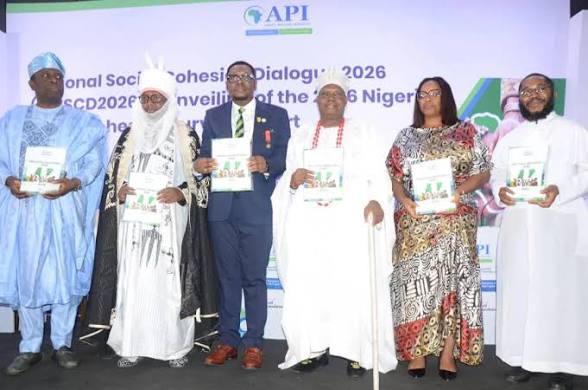
Stakeholders have called on the Federal Government to work more closely with traditional rulers and religious leaders in efforts to promote peace, unity and social cohesion across Nigeria.
The call was made on Thursday at the 2026 National Social Cohesion Dialogue organised by the Africa Polling Institute in Abuja.
The event brought together policymakers, traditional rulers, religious leaders, civil society organisations and development partners to assess the state of national cohesion and consider ways of strengthening integration among Nigeria’s diverse population.
The dialogue, themed “Strengthening the Role of Religious and Traditional Institutions as Key Agents of Social Cohesion,” also featured the presentation of the 2026 Nigeria Social Cohesion Survey, supported by the Ford Foundation.
Participants noted that traditional and religious institutions remain highly trusted by many Nigerians and have continued to play important roles in conflict mediation, humanitarian interventions and community peacebuilding.
The discussion took place amid continuing insecurity, economic difficulties, ethnic and religious tensions, as well as declining public trust in government institutions.
Presenting the survey report, the Executive Director of the Africa Polling Institute, Professor Bell Ihua, said Nigeria’s Social Cohesion Index increased to 48.8 per cent in 2026.
He said the figure represented a two-percentage-point rise from the previous year and was the highest score recorded since the study began.
Although the result is still slightly below the 50 per cent level regarded as a sign of stronger social cohesion, Ihua said the improvement showed Nigerians’ ability to sustain peaceful coexistence despite current social and economic pressures.
He said one of the major outcomes of the survey was a shift in citizens’ sense of identity.
For the first time since the survey was introduced, more respondents identified themselves first as Nigerians rather than primarily through ethnic, religious or regional affiliations.
According to Ihua, the development suggests a growing sense of common identity and represents progress in Nigeria’s nation-building process.
However, the survey also showed that public confidence in government institutions remained low, while traditional and religious leaders continued to enjoy relatively higher levels of trust.
He explained that the Nigeria Social Cohesion Project measures relationships among citizens and their willingness to cooperate across ethnic, religious and political differences for national stability and development.
The 2026 survey examined 14 areas, including identity, trust, social justice, equity, civic participation, tolerance, gender equality, disability inclusion, corruption, accountability, security, migration and expectations about the future.
Speaking for the Ford Foundation, Programme Officer Onyinye Onyema-Obi said Nigeria’s diversity could drive national progress if it was properly managed through responsible leadership.
She described religious and traditional leaders as custodians of community values, culture and trust, noting that they have significant influence over public attitudes and behaviour.
Onyema-Obi said the rise in insecurity, misinformation and social division had made the role of trusted community leaders even more important.
She added that peace could not be achieved through policies and institutions alone, but also depended on interpersonal relationships and leaders who encourage cooperation rather than division.
The Archbishop of the Catholic Archdiocese of Abuja, Most Rev. Ignatius Kaigama, whose message was delivered by Rev. Fr. Emmanuel Unamba, said the survey should challenge political leaders and community stakeholders to take action.
Kaigama said the continued trust in traditional and religious institutions offered an opportunity to strengthen national unity, especially as confidence in government bodies continued to decline.
He said Christian and Islamic teachings both promote peace, solidarity and mutual respect, and urged Nigerians to apply those shared values in addressing national challenges.
The Archbishop warned against allowing ethnic, religious or regional identities to take precedence over national loyalty.
He said Nigerians should remain proud of their cultures and faiths but should not allow such identities to weaken their commitment to the country.
Kaigama said religious and traditional leaders were well placed to promote cohesion because they are deeply connected to their communities and often serve as mediators, moral guides and providers of social support.
He called for formal consultation structures between government and traditional or religious leaders, saying grassroots leaders often possess information and perspectives that formal institutions may lack.
He also recommended greater recognition for traditional institutions, more independence in the selection of traditional rulers and increased support for faith-based and community-led development initiatives.
Kaigama cautioned traditional and religious leaders against partisan politics, saying their credibility depends on their ability to remain neutral.
“Once they become aligned with political interests, they risk losing the moral authority and public trust that make them effective agents of social cohesion,” he said.
He also criticised the practice of awarding honours and traditional titles largely because of wealth, warning that it weakens moral standards and negatively influences younger people.
To improve the capacity of religious and traditional institutions, Kaigama called for structured training in conflict resolution, community development and social cohesion.
In a goodwill message delivered by the Falakin Kano, Mukhtar Ibrahim Bello, the Emir of Kano, Muhammadu Sanusi II, described traditional and religious institutions as essential channels for dialogue, reconciliation and mediation in a diverse country like Nigeria.
Sanusi said the trust placed in traditional rulers and faith leaders comes with a responsibility to promote justice, tolerance, peaceful coexistence and national integration.
He urged them to reject extremism, discrimination and divisive language.
The former Governor of the Central Bank of Nigeria also called for stronger partnerships among government agencies, civil society groups and community leaders in tackling social challenges and improving cohesion.
Participants agreed that Nigeria’s economic and security challenges could be addressed more effectively if trusted community institutions were supported to bridge divisions and rebuild public confidence.
They said lasting peace and development would depend on inclusion, trust and a shared commitment to national values.
Meanwhile, the Chairman of the Ekiti State Council of Traditional Rulers and Ogoga of Ikere-Ekiti, Oba Samuel Alagbado, praised the Emir of Kano for speaking openly on issues of national importance.
Oba Alagbado said Sanusi’s willingness to speak truth to those in power was commendable, noting that many traditional rulers face limitations that prevent them from publicly criticising authorities.
“We are happy that some traditional rulers have the courage to speak truth to power,” he said, adding that not every monarch can do so without risking removal from office.
The dialogue ended with a renewed call for the government and other stakeholders to strengthen traditional and religious institutions while protecting their neutrality, independence and public credibility.
Participants maintained that these institutions could play a central role in building a more peaceful, united and inclusive Nigeria.