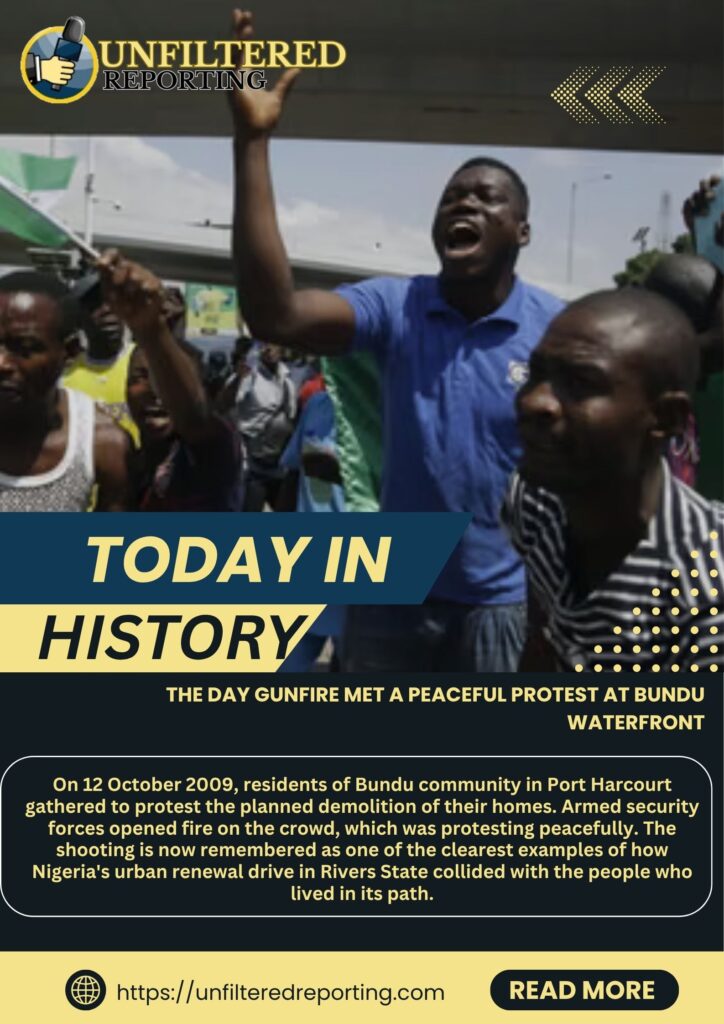



Today in History: The Day Gunfire Met a Peaceful Protest at Bundu Waterfront

On 12 October 2009, residents of Bundu community in Port Harcourt gathered to protest the planned demolition of their homes. Armed security forces opened fire on the crowd, which was protesting peacefully. The shooting is now remembered as one of the clearest examples of how Nigeria’s urban renewal drive in Rivers State collided with the people who lived in its path.
Bundu is one of the waterfront settlements of Port Harcourt. There are more than 40 of these settlements, home to over 200,000 people, and they are among the most densely populated parts of the city. The state government had begun demolishing houses in several of them, saying it was paying compensation to property owners and trying to check criminal activity. The most recent demolition was Njemanze waterfront in August 2009. Amnesty International estimated that between 13,800 and 19,000 people were affected by it. So when officials turned up at Bundu, residents had good reason to fear they were next.
That morning, government authorities accompanied by armed police and Joint Task Force personnel went to Bundu to conduct an enumeration, a count of the structures earmarked for demolition. Residents had learned of this the day before, and a crowd gathered at the entrance to the community. According to the plaintiffs in a later court case, the protesters tried to run away but were chased and fired upon by the security agents. Some of those shot reportedly fled into nearby buildings, and one man told Amnesty his sister was shot while she was inside.
Amnesty later documented at least one death and 12 serious injuries. Amnesty interviewed 12 of the people who were shot. They included Tamuno Tonye Ama, who was hit in the thigh and recalled that there was nowhere to run. The true toll is still unknown. Eyewitnesses told Amnesty of a pile of bodies being carted off in a truck. Joy Williams, who was shot in the leg, was only 17.
The official account differed sharply. Rivers State authorities said the security forces had themselves been fired on by people who had benefitted from lawlessness in the waterfront. Later, the state’s governor went further and told Amnesty International that there had been no firing, no shooting, and that no one was killed or injured that day. Amnesty said it had gathered clear evidence to the contrary. Its statement the day after the shooting reported that some 23 men were arrested, taken to a Port Harcourt magistrate court on 13 October, and remanded in prison.
In October 2010, Amnesty published a report called *Port Harcourt Demolitions: Excessive Use of Force Against Demonstrators, calling on the Nigerian government to set up an independent commission of inquiry into the use of force and firearms by the police and the Joint Task Force. That never happened. For five years the authorities refused to investigate. Ten residents of Bundu and neighbouring communities then took the matter to the ECOWAS Court of Justice, the regional court of West Africa. That court eventually ruled that Nigerian security forces had committed human rights abuses. For the protesters, it was a long-delayed acknowledgement of what they had said from the start.
Bundu itself was never demolished, but the authorities have forced thousands of people from their homes and demolished other waterfront communities as part of the urban renewal programme. Amnesty also pointed to the rules governing policing, urging the government to repeal regulations that permit officers to shoot protesters whether or not they pose a threat to life. The events of 12 October 2009 raise a question that reaches beyond one community: how far can a government go in reshaping a city when the people being moved are never fully heard?