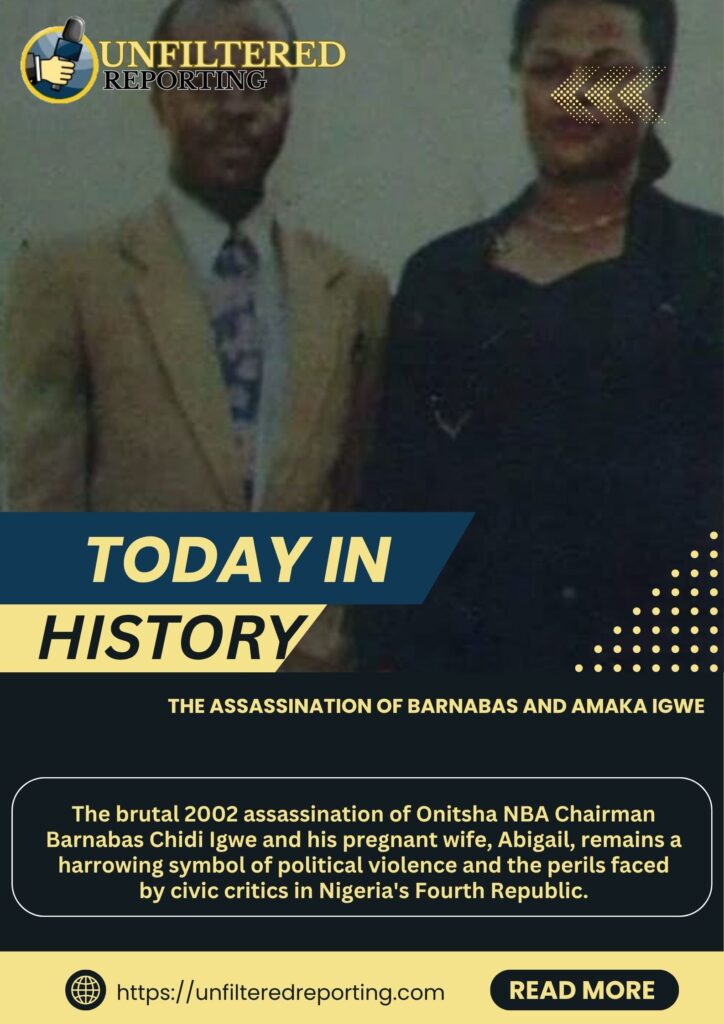

Today in History: The Assassination of Barnabas and Amaka Igwe

On September 1, 2002, the Nigerian legal community and the nation at large suffered one of its most harrowing shocks. Barrister Barnabas Chidi Igwe then Chairman of the Nigerian Bar Association (NBA), Onitsha Branch and his pregnant wife, Barrister Abigail “Amaka” Igwe, were brutally murdered in Onitsha, Anambra State. The assassination remains a stark symbol of the dangers faced by civic critics and the deep scars of political violence in Nigeria’s Fourth Republic.
In the months leading up to their deaths, Anambra State was gripped by severe administrative and social turmoil. The state government under Governor Chinwoke Mbadinuju faced intense criticism amid prolonged strikes by public school teachers, civil servants, and court workers who had gone unpaid for nearly a full academic year.
As the leader of the Onitsha NBA, Barnabas Igwe became a fearless and vocal opponent of the administration. He openly challenged the state’s governance failures, heavily criticized the state-backed or tolerated “Bakassi Boys” security outfit for extrajudicial actions, and ultimately joined civil society coalitions in demanding the governor’s resignation due to gross mismanagement of public funds.
On the evening of September 1, 2002, the couple was returning to Onitsha after attending a national NBA conference in Ibadan. As they drove along Oraifite Street, their vehicle was intercepted by armed men.
The assailants dragged the couple out of the car and subjected them to a savage assault using machetes and heavy clubs. Amaka, who was pregnant, succumbed to her injuries later that night, while Barnabas passed away in the early hours of the following morning after enduring unspeakable trauma. Eyewitness and investigative reports indicated that the killers deliberately ran over their bodies with an automobile to ensure their deaths before fleeing the scene.
The assassination triggered immediate national outrage. Human rights organizations, including Human Rights Watch, condemned the killings, pointing directly to credible evidence of prior death threats issued to Igwe by state actors and political loyalists. The NBA declared a nationwide day of mourning, and thousands of lawyers marched in black protest demanding justice.
Despite public pressure, subsequent investigations and legal trials stalled amid systemic hurdles, political interference, and institutional breakdowns, leaving the full circle of perpetrators and sponsors largely unpunished. Decades later, the tragedy of Barnabas and Amaka Igwe continues to be invoked by civil rights advocates as a watershed moment highlighting the heavy price of accountability, the perils of state-enabled impunity, and the enduring quest for justice in Nigeria.