

Trump Threatens to ‘Blow Up’ Oman Over Strait of Hormuz Deal with Iran
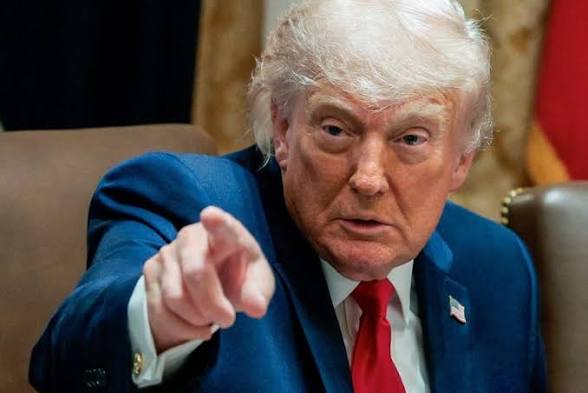
United States President Donald Trump has issued a blunt military threat against Oman, a longstanding American ally in the Gulf, after reports emerged that the sultanate was in discussions with Iran over a new framework for managing shipping through the Strait of Hormuz.
The warning came during a White House Cabinet meeting on Wednesday, when Trump was asked by a reporter whether he would accept a short-term arrangement allowing Iran and Oman to jointly control the strategically vital waterway. The president’s response was characteristically unsparing: “Nobody is going to control it. It’s international waters, and Oman will behave just like everybody else, or we will have to blow them up. They understand that. They’ll be fine.”
The remarks were triggered by a report from Iranian state television claiming that Tehran and Muscat were in negotiations over a new transit mechanism for the Strait of Hormuz, with the Deputy Secretary of Iran’s Supreme National Security Council, Ali Bagheri Kani, confirming that discussions were underway and stressing that passage through the waterway would no longer follow previous arrangements.
Iranian state media also reported that it had obtained an unofficial draft of a broader US-Iran peace agreement that would give Iran and Oman joint management of Strait traffic, restore shipping to pre-war levels within a month, lift the American naval blockade, and require the withdrawal of US military forces from Iran’s area. Trump flatly rejected those claims, insisting that no sanctions relief or unfreezing of Iranian assets had been agreed upon, and describing the reported draft as a fabrication.
The Trump administration simultaneously announced sanctions on Iran’s newly established Persian Gulf Strait Authority, the body Tehran created to manage passage requests through the waterway, with the US Treasury warning that the agency was linked to the Islamic Revolutionary Guards Corps.
Treasury Secretary Scott Bessent escalated the pressure further on Thursday, posting a pointed warning specifically directed at Muscat. Bessent declared that Washington would not tolerate either Iran or Oman imposing fees on commercial ships transiting the Strait, and warned that the US Treasury would aggressively target any actors direct or indirect involved in facilitating a tolling system in the waterway.
The warning to Oman was notable not only for its tone but for its target: Oman has for decades served as a quiet but critical back-channel between the United States and Iran, playing a discreet mediating role in successive rounds of nuclear negotiations and, more recently, in the ongoing diplomatic efforts to bring the three-month-long US-Israel war on Iran to a close.
The Strait of Hormuz has been at the centre of the conflict since Iran militarised the waterway following the outbreak of hostilities on February 28, effectively shutting down normal shipping traffic and triggering a sharp spike in global energy prices. The closure has been one of the most economically damaging consequences of the war, and restoring free navigation through the waterway has emerged as a central demand of the Trump administration and a major sticking point in peace negotiations. A fragile ceasefire agreed on April 8 has held imperfectly, with both sides continuing to exchange low-level hostilities and fresh threats even as indirect talks have continued.
The threat against Oman drew immediate international attention, with critics pointing out the startling nature of a sitting American president threatening to destroy a country with which the United States has maintained decades of close strategic ties. Iran’s Bagheri Kani responded defiantly, stating that Tehran would not allow the Strait to become a source of insecurity for the country and that powers which had historically used the passage against Iranian interests would be held accountable. For many observers, Trump’s threat underscored the fragility of any potential deal and the extraordinary volatility of American foreign policy at one of the most consequential moments in the Middle East’s modern history.