
My Thought Process, Political Advocacy Align With Tinubu’s Policy Direction
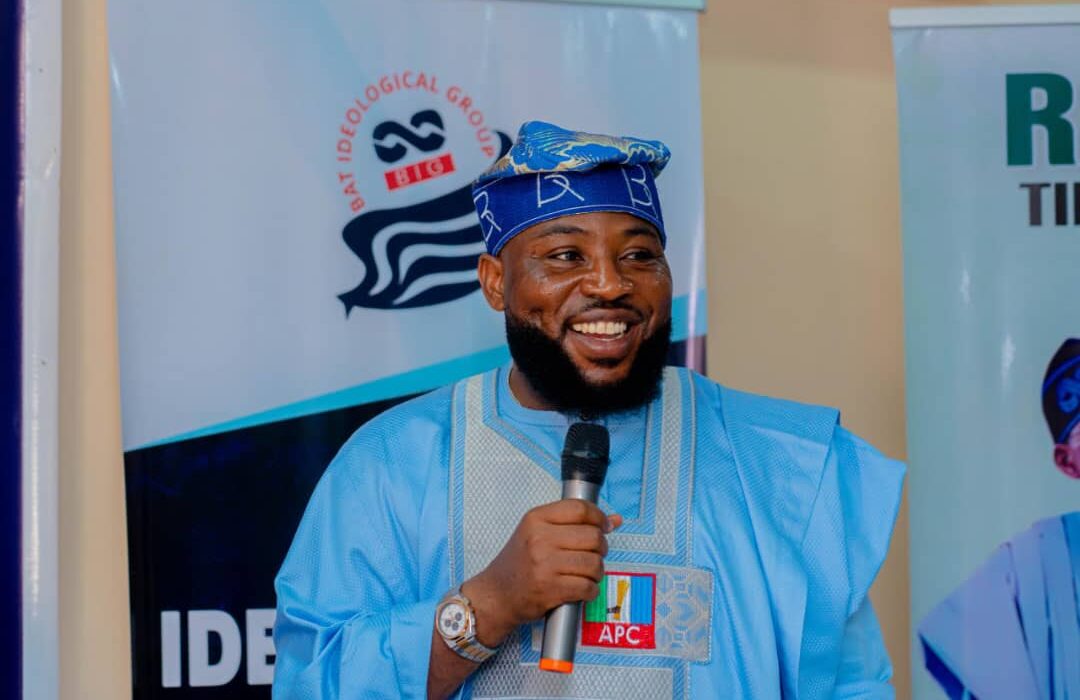
By Bamidele Atoyebi
When we founded the Bola Ahmed Tinubu Ideological Group (BAT-IG), the objectives were clear and was never just to swell the ranks of support groups. The idea was to raise men and women who could study and imbibe the political philosophy, courage, strategic thinking and leadership capacity of President Bola Ahmed Tinubu and reproduce those qualities at every level of leadership.
We wanted people who could think beyond political mobilisation, identify problems, formulate solutions and act. People who could become what we describe as “mobile Asiwajus” in their states, local governments and wards: leaders capable of carrying preserving a political spirit built around courage, strategic thinking, service and solution-driven governance.
With time, some of our ideas have found striking parallels in policies and pronouncements from the Tinubu administration. This is not to suggest that every subsequent government action originated from BAT-IG. That would be immodest and at variance with our objectives. But when an idea is articulated by us and a remarkably similar policy direction subsequently emerges from the administration, it is worth noting the alignment.
One pointer to the above is our grassroots intervention model.
From the beginning, we submitted that an ideological political organisation should not merely celebrate government. It should identify gaps at the grassroots and develop practical solutions around them. That philosophy produced interventions such as the Rigasa electricity project in Kaduna State.
BAT-IG began pushing for a solution to Rigasa’s decade-long electricity problem in November 2025. Following sustained advocacy, the Niger Delta Power Holding Company (NDPHC) commenced a project comprising a 7.5MVA injection substation, two kilometres of 11kV line and 1.5 kilometres of 33kV line. The groundbreaking ceremony took place on October 23, 2026, with the Kaduna State Deputy Governor representing Governor Uba Sani.
The broader philosophy behind that bottom-up intervention was simple: identify a problem, take responsibility for finding a solution and connect the community to the institution capable of delivering it.
Then came a striking national development.
On April 22, 2026, President Tinubu approved a ₦17 billion Community-Based National Social Action Fund covering Nigeria’s 8,804 wards. Under the initiative, each ward was to work with a verified community-based organisation to identify and execute priority projects based on local needs.
BAT-IG subsequently described the initiative as closely aligned with proposals the group had earlier circulated internally and advocated publicly. The significance, therefore, is not simply that a government programme was created. It is that the administration adopted a development framework built around identifying needs at ward level and allowing communities to define priority interventions.
That same philosophy informed another major BAT-IG proposal: a Monthly Policy Focus and Quarterly Leadership Empowerment Summit for governors, ministers, political appointees and local government chairmen. In August 2026, BAT-IG publicly postulated that Nigeria’s challenge was increasingly not simply the availability of resources but the ability of different levels of government to deploy those resources toward shared priorities. The group proposed that the Presidency should designate specific development priorities periodically and bring political leaders together to review implementation.
The proposal was rooted in a simple political principle: the President cannot personally implement his vision in 36 states and 774 local governments. He needs people who understand the vision and can translate it into action.
That is also why I have consistently submitted that President Tinubu needs like-minded political leadership around him. A president may have the right policies, but the quality of implementation ultimately depends on the people entrusted with carrying them out.
It was from this conviction that we went further to establish and register a like-minds leadership foundation. The idea is to build a platform capable of developing people who share the values of purposeful leadership, strategic thinking, courage, service and solution-driven governance that we associate with the Asiwaju political philosophy.
The same thinking appears in our advocacy on security and troop welfare.
We argued that Nigeria’s frontline security personnel should receive stronger welfare incentives, including better treatment for their families and improved support for those making enormous sacrifices in the defence of the country. The Tinubu administration subsequently introduced several significant but strikingly similar welfare measures to our ideas. In March 2026, the Presidency highlighted approvals covering salary reviews, allowances, equipment procurement and decent accommodation for members of the Armed Forces.
By August, President Tinubu approved salary increases ranging from 30 per cent to 80 per cent for approximately 250,000 armed forces personnel, with the highest increase going to personnel from private to staff sergeant. The annual salary bill for the Armed Forces was projected to rise from ₦660 billion to ₦924 billion.
Again, the point is not that BAT-IG can claim sole authorship or origination of these decisions. The point is that our political thinking had already been moving in the direction of treating the welfare of security personnel as a strategic national-security issue, rather than merely an administrative matter.
The Kwara security intervention offers another example.
On May 13, 2026, BAT-IG publicly appealed for stronger federal security intervention in Kwara South. Part of that intervention was the idea of establishing a military or police training centre in the area.
We did not see that proposal merely as a place for training personnel. The strategic thinking was that wherever there is a significant and permanently established security presence, particularly an Army presence, the area becomes more difficult for terrorists and kidnappers to operate around. A heavily secured military training centre would therefore serve the dual purpose of developing security personnel and creating a stronger security presence capable of deterring terrorists from using Kwara South as a base of operation.
We took the matter beyond public advocacy. We met with the Inspector-General of Police on the issue and also wrote to President Tinubu, urging stronger federal security intervention, including the establishment of a Nigeria Defence Academy-related security presence that could help protect the people of Kwara South from being exterminated by insecurity.
Months later, President Tinubu approved the doemation of a new Nigerian Army battalion in Omu-Aran, Irepodun Local Government Area of Kwara State. The state government said the formation would strengthen counterterrorism and anti-kidnapping operations.
The terminology may not be exact, but the strategic direction is closely aligned: establish a strong federal security presence in Kwara South to deter terrorists and kidnappers and protect the people. That is why we don’t regard the development as another significant point of alignment.
Another example is our engagement on education and economic opportunity.
In 2024, I wrote Nigerian States and Their Mineral Resources for Primary and Secondary School Pupils because I believed Nigerian children should learn early about the mineral resources in their communities, the industries they can support, the careers they can create and the investment opportunities they represent. The objective was to catch them young; move young Nigerians beyond the assumption that success must mean becoming a doctor, lawyer or leaving their communities for the cities.
We also took the idea of developing learning and intervention centres further through our engagement with the Universal Basic Education Commission (UBEC). We met with the UBEC Secretary on the matter and followed up formally in writing. The Secretary agreed to work with us on the idea.
In August 2026, President Tinubu, while speaking about the performance of Nigeria’s capital market, said financial-market knowledge could be taught in classrooms and that young Nigerians should be exposed to investment and economic opportunities early.
The subject matter is different, but the underlying philosophy similar chords: catch young Nigerians early, expose them to economic opportunities and give them knowledge that can make them participants rather than spectators in the economy.
Even our messaging around the difficult reform period found a striking parallel in the President’s own later position.
In June 2026, I compared the economic transition under Tinubu with the biblical journey of the Israelites from Egypt toward the Promised Land, arguing that a difficult transition should not automatically be interpreted as a reason to return to the old system.
President Tinubu subsequently used the same Moses-and-Egypt analogy while defending the continuation of his reforms, arguing against calls to return to fuel subsidy.
Other examples abound, including our advocacy for stronger political accountability, better coordination between the federal and sub-national governments, and consequences for public officials who receive increased resources but fail to translate them into visible development.
There is also an ideological alignment in how we have analysed political leadership itself.
In one of my articles in June this year, I described the ADC as an existentially empty gathering of politicians without a coherent or humanistic philosophy. I also analysed Atiku Abubakar’s political pasturalism and argued that repeatedly moving from one political platform to another without building a lasting political institution or philosophy offers little enduring leadership value.
President Tinubu later acknowledged a similar point in his own political commentary, describing Atiku as a political wanderer and questioning the leadership value of such political movement.
The same principle featured in my article yesterday, November 6, 2026. I argued that anyone who is serious about building a lasting political legacy should be interested in building institutions, creating a political platform or investing in an existing political party rather than continually moving from one platform to another in pursuit of personal political interests.
For me, politics cannot simply be about where an individual can secure the next opportunity. It must be about what that individual is building that can outlive him.
That is precisely why I have continued to emphasise the need for like-minded leadership around President Tinubu. A leader cannot build a lasting legacy alone. He needs people who understand the philosophy behind the vision and have the courage and capacity to sustain it.
These examples are why I insist that BAT-IG was not conceived as another organisation created merely to adulate a politician. We started from an ideological premise: if we admire a leader, we should study what makes his leadership effective and build people who can replicate those qualities.
That is why we counsel our members to hold their shoulders high. Not because they have already become Asiwaju, and certainly not because BAT-IG has solved all of Nigeria’s problems, but because we have already contributed to solving several problems and are still actively working on others.
We should therefore hold our shoulders high because of the standard we are setting for ourselves, not because we believe the work is finished.
Money will come. Political opportunities will come. Appointments may come. But those things cannot be the foundation of an ideological movement though may later form secondary accruals.
The foundation must be doctrine. It must be philosophy. It must be intellectual capacity. It must be policy thinking. It must be the ability to walk into a community, identify a problem, understand the institutional structure around it, develop a solution and pursue that solution until something changes.
That is the kind of political leadership we believe Nigeria needs.
And perhaps this is the most important lesson from these alignments: facts are better judges than applause.
When an idea we have proposed later appears in government policy, we document it. When the President independently arrives at a similar conclusion, we acknowledge the alignment. Where the evidence does not establish that our proposal actuated the government action, we should be honest enough to say so.
But taken together, these examples demonstrate something difficult to dismiss: BAT-IG’s ideological project has consistently been built around anticipating problems, developing solutions and interpreting the political direction of President Tinubu’s administration.
We are not simply following Asiwaju.
We are studying him.
We are learning from him.
We are attempting to reproduce the best of his political and leadership instincts in another generation.
That is what we mean when we say we are building “working Asiwajus” across Nigeria.
The ultimate test will not be how loudly we praise President Tinubu today. It will be whether the men and women we are building can one day occupy positions of responsibility and solve problems with the same courage, strategic depth and commitment to service that inspired the movement in the first place.
That is the real meaning of ideological politics.
And that is the journey BAT-IG has chosen.
Comrade Bamidele Atoyebi is the Convenor of the Bola Ahmed Tinubu Ideological Group, National Coordinator of Accountability and Policy Monitoring PR and a publisher of Unfiltered and Mining Reports.