



Shettima Seeks Northern Support for Tinubu’s Re-election, Cites Agricultural, Infrastructure Gains
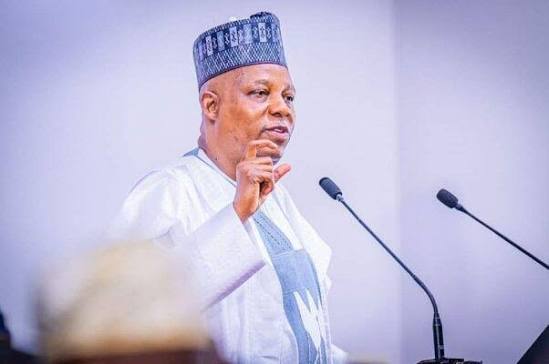
Vice President Kashim Shettima has urged political leaders and residents of Northern Nigeria to support President Bola Tinubu’s re-election bid in 2027, arguing that the region has benefited from the administration’s policies and stands to gain more from a second term.
Shettima made the appeal on Monday at the State House in Abuja while receiving members of Arewa for Asiwaju (A4A), a political organisation mobilising support for Tinubu’s return to office.
He urged northern stakeholders to unite behind the president, pointing to federal appointments, agricultural financing and infrastructure development as areas in which the region had benefited from the administration.
The vice president cited the Bank of Agriculture’s reported disbursement of N450 billion to 700,000 smallholder farmers nationwide, noting that approximately 70 per cent of the beneficiaries were from the North.
He also assured the delegation that the administration remained committed to delivering major infrastructure projects across the country, including in northern communities.
Shettima called on the group to intensify its grassroots mobilisation across wards, communities and local government areas ahead of the 2027 presidential election.
The Director-General of A4A and former Jigawa State Governor, Abubakar Badaru, said the organisation would sustain its campaign activities until Tinubu secured another term.
Badaru disclosed that the group was engaging influential Nigerians, including Muslim and Christian religious leaders, to broaden support for the president and Vice President Shettima.
He added that A4A was working with the Presidential Campaign Council while maintaining its focus on grassroots mobilisation.
The chairman of the organisation’s Board of Trustees and former Kano State Governor, Ibrahim Shekarau, said the group, which supported Tinubu during the 2023 election, was preparing to replicate its efforts in 2027.
Shekarau said the organisation had held engagements with northern governors and other political stakeholders to identify areas of cooperation ahead of the election.
He also announced plans to establish a permanent secretariat to coordinate the group’s operations, monitor activities across states and strengthen communication with its members.
Shekarau invited Shettima to inaugurate the organisation’s office complex on October 17, 2026.
The meeting was attended by several former governors, including Joshua Dariye of Plateau State, Simon Lalong of Plateau State, Jolly Nyame of Taraba State, Yahaya Bello of Kogi State, Ibrahim Shema of Katsina State and Isa Yuguda of Bauchi State. Also present was the President’s Special Adviser on Policy and Coordination, Hadiza Bala Usman, and the Chairman of the National Drug Law Enforcement Agency, Buba Marwa.
Meanwhile, the Minister of Information and National Orientation, Mohammed Idris, has defended the administration’s economic policies, saying recent indicators suggest progress while acknowledging that many Nigerians continue to struggle with the cost of living.
Speaking during an engagement with senior editors at Radio House in Abuja on Monday, Idris cited declining inflation, improved foreign exchange reserves, increased oil production and investments in infrastructure and social programmes as signs of economic recovery.
He said the government’s immediate challenge was to ensure that improvements in national economic indicators translated into lower household expenses, stronger purchasing power and better living conditions.
Idris stated that inflation had fallen from approximately 27 per cent in January 2025 to around 15 per cent at the time of his briefing. He also said Nigeria recorded a current account surplus of $12 billion in the first half of 2026, compared with $8.6 billion during the corresponding period of 2025.
According to the minister, the country’s external reserves exceeded $54 billion in September, while economic growth was projected to surpass four per cent in 2026.
He maintained that stronger reserves, improved oil production and increased non-oil export earnings were helping to strengthen the economy and create opportunities for investment.
However, Idris acknowledged that improvements in economic performance had yet to ease the financial pressures facing many households, particularly in the areas of food, transportation and energy.
He identified infrastructure development as a major component of the administration’s economic strategy, arguing that road, rail, port and electricity projects could stimulate economic activity, generate employment and improve access to markets.
The minister said four major legacy infrastructure projects covered approximately 3,000 kilometres across the country’s six geopolitical zones. He also highlighted a highway project valued at about N1.5 trillion in Niger State, which he said was expected to improve connectivity along an important agricultural and commercial corridor.
On food security, Idris listed agricultural mechanisation, improved access to farm inputs, irrigation and financing as measures being pursued to increase domestic production and improve food availability.
He also highlighted investments in healthcare and education, disclosing that the government had commissioned two additional cancer treatment centres, bringing the total under the initiative to five, with a target of 10 centres.
On education financing, the minister said the Nigerian Education Loan Fund had supported more than 1.6 million students, with over N192 billion disbursed for institutional fees and approximately N180 billion provided as upkeep allowances.
He further cited the Three Million Technical Talent programme as part of efforts to equip young Nigerians with digital skills relevant to employment and emerging industries.
Idris also said the Presidential Compressed Natural Gas and Electric Vehicle Initiative had attracted approximately $2.5 billion in private investment, alongside about N250 billion in government funding and commitments.
He disclosed that more than 120,000 vehicles had been converted under the initiative, with over 400 certified conversion centres established nationwide. More than 90 refuelling stations were operational, while about 180 others were under development, he added.
The minister further announced that the Federal Government had issued a N758 billion bond to settle outstanding pension liabilities and another N1.2 trillion in bonds to address inherited debts owed to electricity generation and gas companies.
He said the government was also expanding social protection and consumer credit initiatives while strengthening security operations against terrorism, banditry, kidnapping, crude oil theft and illegal refining.
Separately, the Minister of Innovation, Science and Technology, Kingsley Udeh, has argued that Tinubu should be given a second term to complete the economic reforms introduced by his administration.
Udeh, who made the case during an appearance on Arise News’ Prime Time, said the president’s policies were beginning to produce positive results, although their full benefits had yet to reach Nigerians.
The minister cited Nigeria’s economic growth, which he said had increased from approximately two per cent in 2023 to around four per cent, alongside higher revenue allocations to state and local governments.
Using Enugu State as an example, Udeh said increased resources available to subnational governments had created opportunities for infrastructure and transportation development.
He acknowledged that inflation and economic hardship remained major concerns but maintained that the reforms had placed the country on a path towards recovery.
Udeh also supported the argument that the presidency should remain in the South after Tinubu’s first term, citing the existing power-rotation arrangement. He noted that the eventual emergence of a president from the South-East would depend on building political support across the country’s regions.


