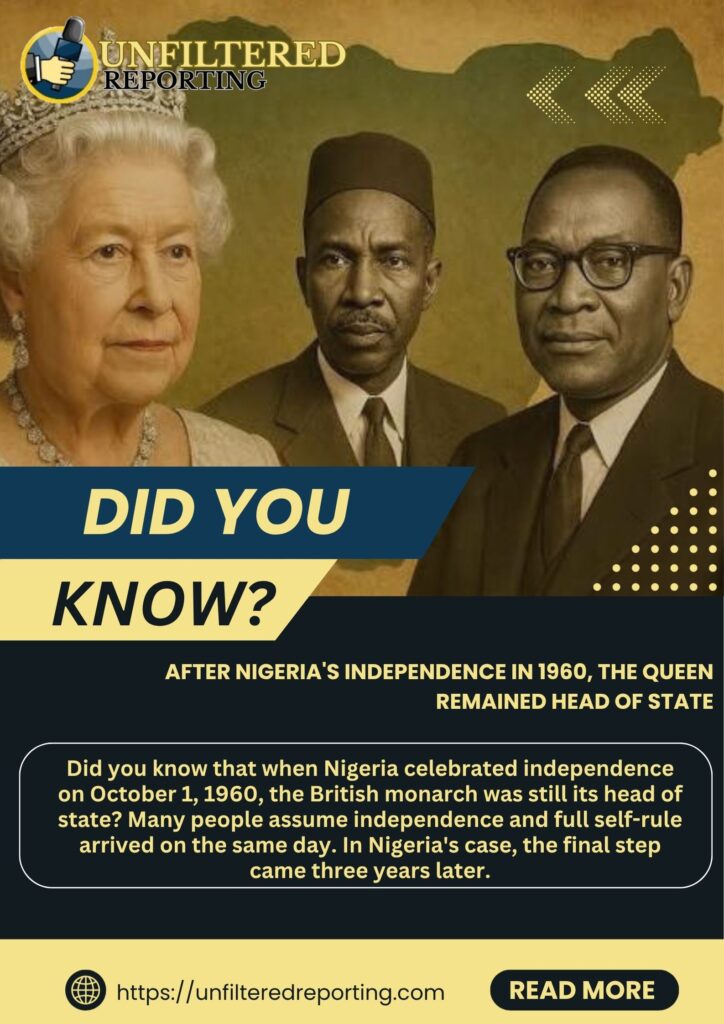
Did you Know: After Nigeria’s Independence in 1960, the Queen Remained Head of State
Did you know that when Nigeria celebrated independence on October 1, 1960, the British monarch was still its head of state? Many people assume independence and full self-rule arrived on the same day. In Nigeria’s case, the final step came three years later.
When the Union Jack came down on October 1, 1960, Nigeria became a sovereign country with its own government, led by Prime Minister Abubakar Tafawa Balewa. But it chose to remain a constitutional monarchy within the Commonwealth, as several other former British territories did at the time. Queen Elizabeth II was formally Queen of Nigeria, and she was represented in the country by a Governor-General.
Sir James Robertson, the last British governor, briefly stayed on in that role after independence. In November 1960, Nnamdi Azikiwe, popularly known as “Zik,” took over as the first Nigerian Governor-General. It was a landmark appointment: a Nigerian now held the office that had once belonged to colonial administrators.
Independence negotiations in the 1950s focused on getting Nigeria’s regions, political parties and leaders to agree on a workable federal arrangement. Keeping the existing constitutional framework, with the Crown at its head, was a practical way to transfer power smoothly without reopening every dispute at once. Cutting ties with the monarchy could wait.
Three years later, on October 1, 1963, Nigeria adopted a republican constitution. The monarchy was removed from the picture, and the country gained a president as ceremonial head of state. Nnamdi Azikiwe, who had been Governor-General, became Nigeria’s first president, while Balewa continued as prime minister and head of government.
The change also affected the legal system. Before 1963, the Judicial Committee of the Privy Council in London remained Nigeria’s final court of appeal. Becoming a republic ended that arrangement, and the Supreme Court of Nigeria became the highest court in the land.
The 1960 to 1963 gap is a reminder that independence was a process rather than a single moment. Sovereignty came first, and the full cutting of constitutional ties with Britain followed. Today, October 1 is celebrated as Independence Day, but the same date in 1963 marks another milestone in how modern Nigeria took shape.