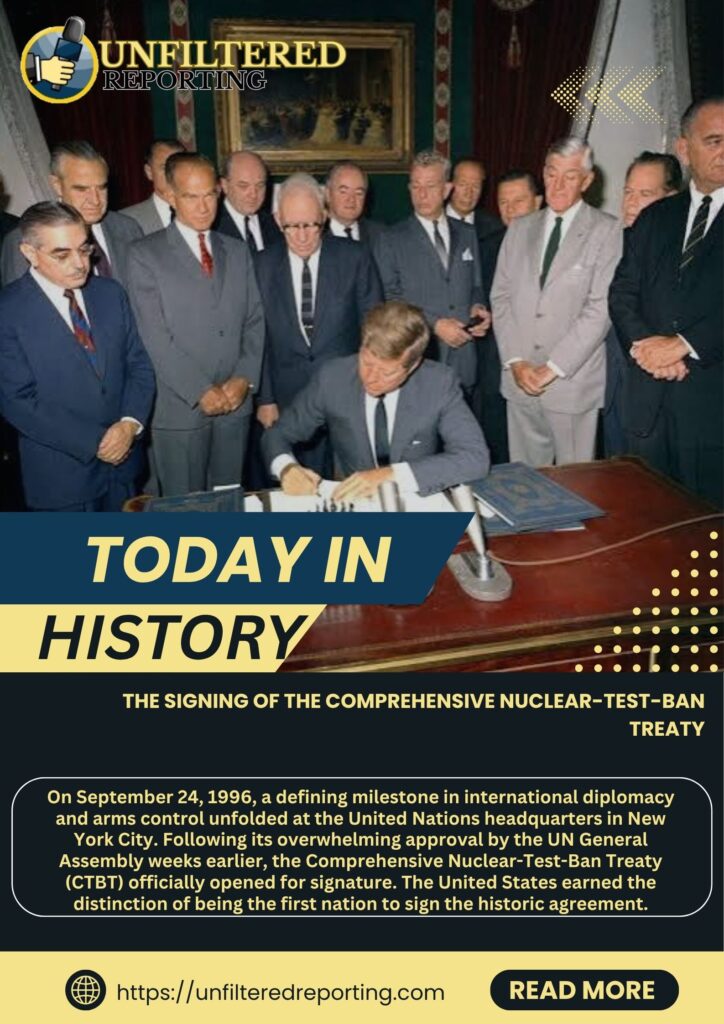


Today in History: The Signing of the Comprehensive Nuclear-Test-Ban Treaty
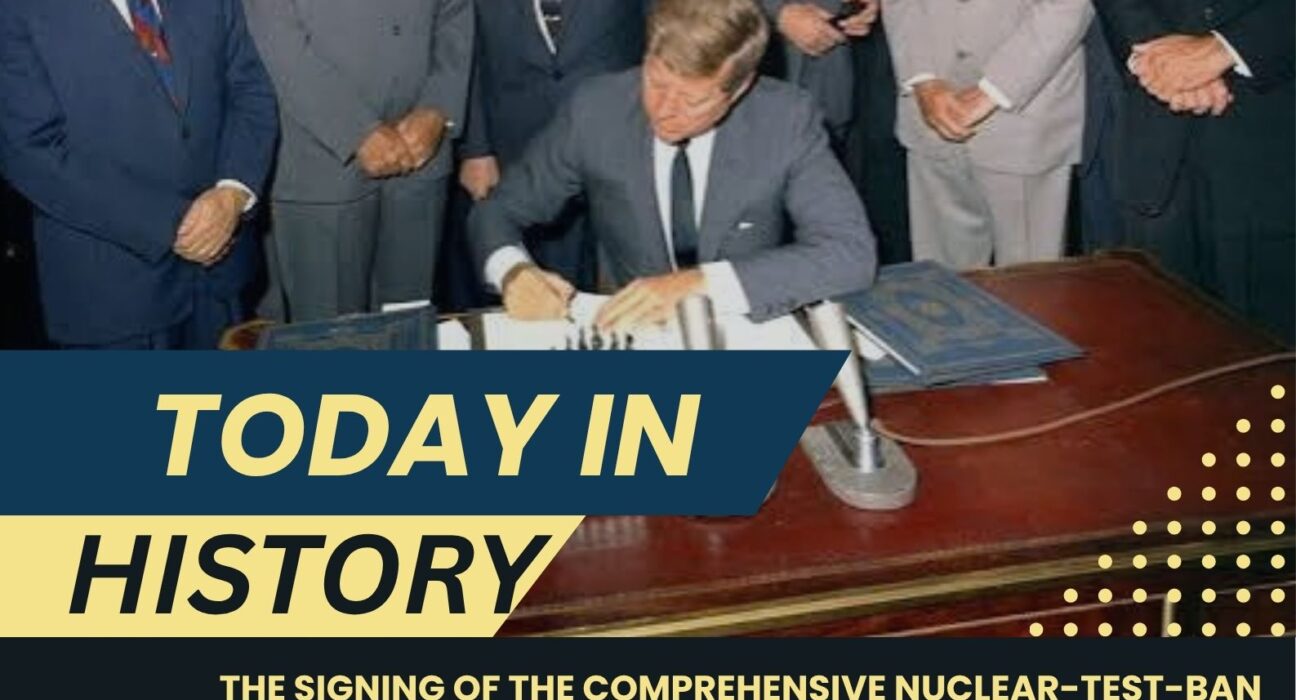
On September 24, 1996, a defining milestone in international diplomacy and arms control unfolded at the United Nations headquarters in New York City. Following its overwhelming approval by the UN General Assembly weeks earlier, the Comprehensive Nuclear-Test-Ban Treaty (CTBT) officially opened for signature. The United States earned the distinction of being the first nation to sign the historic agreement.
Designed to put an end to all nuclear test explosions across the globe whether for military or civilian purposes and spanning underground, underwater, atmospheric, or outer space environments the treaty represented decades of relentless international advocacy.
The path toward a comprehensive test ban was fraught with Cold War complexities and spanned nearly five decades. The concept was first introduced to the global stage in 1954 by Indian Prime Minister Jawaharlal Nehru, who sought to halt the dangerous escalation of the nuclear arms race and prevent radioactive fallout from atmospheric testing.
While incremental agreements such as the 1963 Limited Test Ban Treaty (LTBT) and the 1974 Threshold Test Ban Treaty (TTBT) placed partial restrictions on testing, they still permitted underground detonations and left ample room for the qualitative improvement of nuclear arsenals. It was not until the conclusion of the Cold War and a 1995 agreement to indefinitely extend the Nuclear Non-Proliferation Treaty (NPT) that international momentum coalesced, setting a firm target of 1996 to finalize negotiations.
One of the most remarkable technical achievements associated with the CTBT is its robust verification regime. To ensure that no signatory state could secretly violate the accord, the treaty mandated the creation of the International Monitoring System (IMS). Supported by the Preparatory Commission for the Comprehensive Nuclear-Test-Ban Treaty Organization (CTBTO), this global network utilizes advanced technologies including seismic, hydroacoustic, infrasound, and radionuclide monitoring stations to detect even the smallest clandestine nuclear explosions anywhere on Earth.
Although the CTBT has faced hurdles regarding its formal entry into force which requires ratification by specific nuclear-capable states outlined in Annex 2 of the agreement it has nevertheless fostered a powerful global norm against nuclear testing. By establishing transparent, scientific verification methods and embedding a culture of restraint among major powers, the historic events of September 24, 1996, remain a cornerstone of modern international security and nuclear non-proliferation efforts.