


Today in History: The Bomb at Adolf Hitler Wolf’s Lair
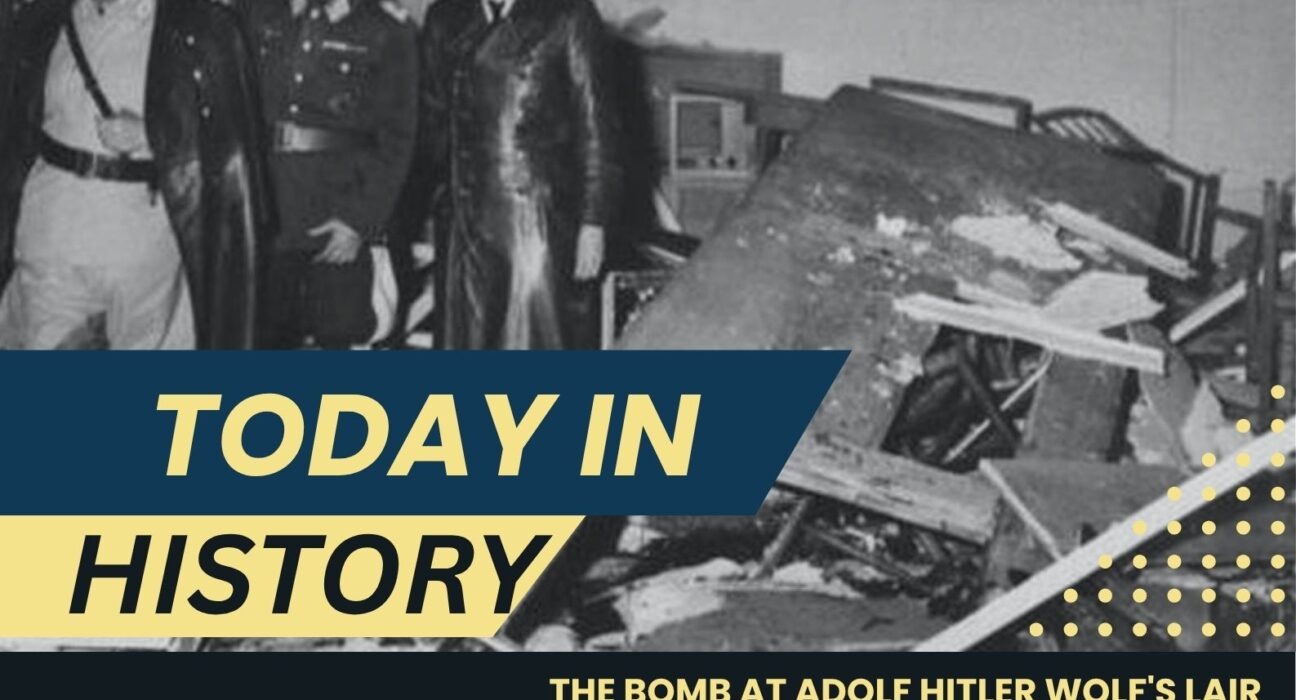
On July 20, 1944, deep inside the heavily fortified Wolf’s Lair headquarters in East Prussia, a briefcase containing a plastic explosive detonated just feet away from Adolf Hitler. The blast shattered the wooden conference room, killing four people and injuring dozens. Hitler, however, survived with only minor injuries because a heavy oak table leg absorbed the brunt of the explosion. This dramatic event was the climax of Operation Valkyrie, the most famous and near-successful attempt by internal German forces to assassinate Hitler and overthrow the Nazi regime.
At the heart of the conspiracy was Colonel Claus von Stauffenberg, a charismatic aristocratic army officer who had been severely wounded in North Africa, losing his left eye, his right hand, and two fingers on his left hand. Disillusioned by the atrocities of the Nazi regime and convinced that Hitler was leading Germany toward total destruction, Stauffenberg joined a clandestine network of military officers, politicians, and civilians determined to take action. As Chief of Staff of the Replacement Army, Stauffenberg held direct access to Hitler during military briefings, which made him the primary operative to carry out the attack.
Operation Valkyrie was originally an official emergency continuity-of-government plan designed by the Wehrmacht to suppress internal rebellion or army mutinies. The conspirators cleverly modified these secret orders so that once Hitler was dead, the Reserve Army would be deployed to arrest SS and Gestapo officers, secure communication nodes across Berlin, and establish an interim government to negotiate peace with the Allies.
On the morning of the attack, Stauffenberg flew to the briefing carrying two chemical-fuse bombs in his briefcase. He managed to arm one bomb, placed the briefcase beneath the heavy table near Hitler, and excused himself to answer a pre-arranged phone call. At 12:42 PM, the bomb detonated. Seeing the explosion and destruction from a distance, Stauffenberg assumed no one could have survived, bluffed his way past security checkpoints, and flew back to Berlin to lead the military coup.
However, several critical factors saved Hitler. After Stauffenberg left the room, another officer shifted the heavy briefcase behind a thick, solid-oak table leg, which unintentionally shielded Hitler from the full force of the blast. Additionally, because of the hot summer weather, the meeting had been moved from an underground concrete bunker into a wooden hut with open windows, allowing the blast pressure to dissipate rather than crush the interior. Confused news reports and hesitation among co-conspirators in Berlin further delayed the mobilization of the Reserve Army for crucial hours.
By evening, official radio broadcasts confirmed that Hitler was alive, and the coup collapsed rapidly as loyalist troops reclaimed control of the capital. Before midnight on July 20, Claus von Stauffenberg and several core conspirators were captured and executed by firing squad in the courtyard of the Bendlerblock in Berlin.
Hitler’s retaliatory measure was swift and brutal. The Gestapo arrested thousands of suspected individuals, leading to nearly five thousand executions, including field marshals, generals, diplomats, and civilians. Families of the conspirators were also targeted under collective punishment laws. Despite its failure, the July 20 plot remains a key moment in modern history, serving as proof that figures within the German military were willing to risk everything to resist the Third Reich from within.