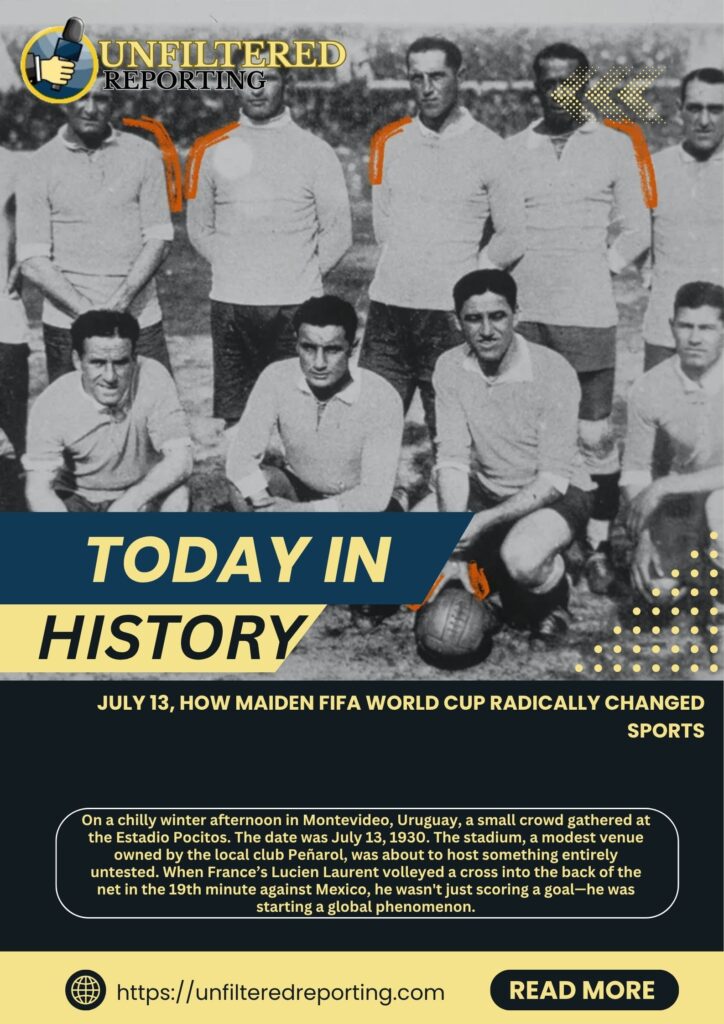



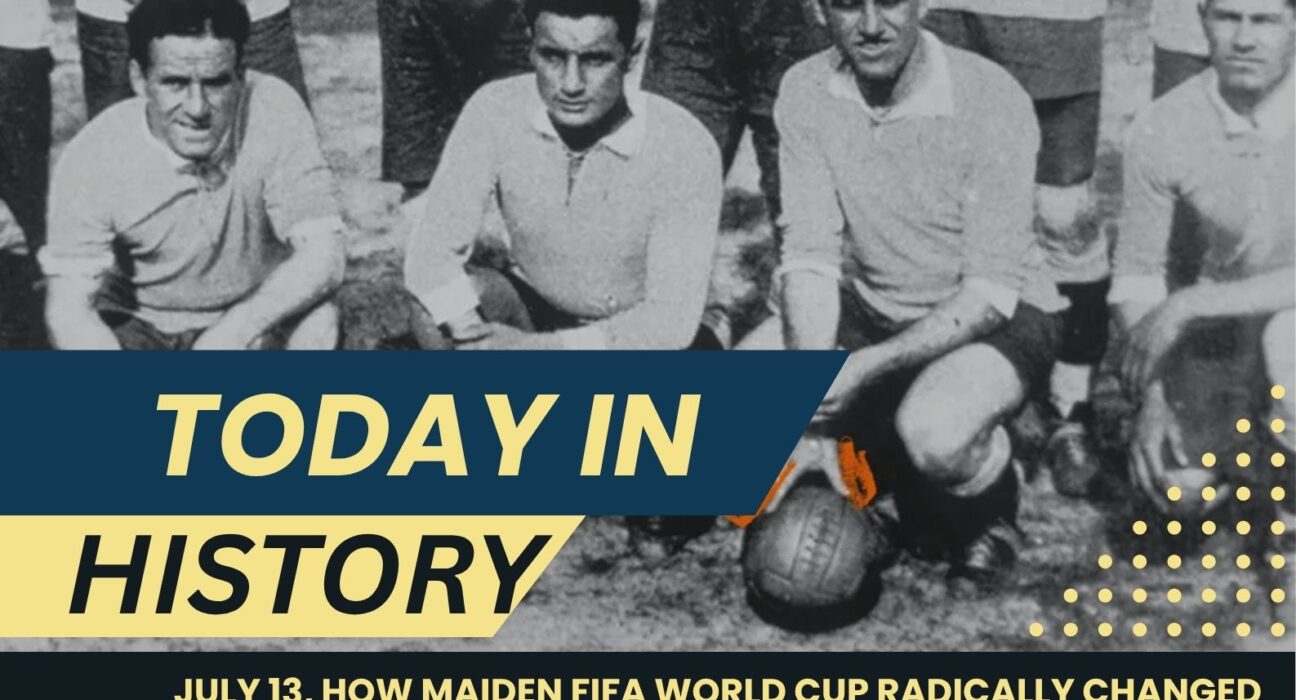
Today in History: July 13, How Maiden FIFA World Cup Radically Changed Sports
On a chilly winter afternoon in Montevideo, Uruguay, a small crowd gathered at the Estadio Pocitos. The date was July 13, 1930. The stadium, a modest venue owned by the local club Peñarol, was about to host something entirely untested. When France’s Lucien Laurent volleyed a cross into the back of the net in the 19th minute against Mexico, he wasn’t just scoring a goal—he was starting a global phenomenon.
Ninety-six years ago today, the very first FIFA World Cup kicked off, forever changing the world of sports.
Before 1930, international football was mostly played at the Olympic Games. While the Olympics drew massive crowds, they only allowed amateur players to compete. Because the sport was becoming professional in the 1920s, the world’s best players were being left out of the biggest games.
Enter Jules Rimet. As the President of FIFA, he drove an ambitious plan to create an independent world championship open to every player. In 1929, FIFA chose Uruguay to host the first tournament.
The choice made perfect sense: Uruguay had won back-to-back Olympic gold medals in 1924 and 1928, and they were celebrating 100 years of their first constitution. However, European nations were not happy with the choice.
Hosting a tournament in South America in 1930 was an absolute logistical nightmare. Europe was struggling through the Great Depression, and traveling across the Atlantic Ocean required a grueling, two-week ship voyage.
Fearing their star players would be gone too long from their local club leagues, major footballing powers like Italy, Spain, Germany, and England refused to go. Ultimately, only 13 teams participated: seven from South America, two from North America, and just four from Europe (France, Belgium, Yugoslavia, and Romania), who all traveled together aboard a single cruise ship named the SS Conte Verde.
A Crowded Voyage:
The Conte Verde didn’t just carry three teams; it also carried Jules Rimet himself, who safely packed the iconic gold World Cup trophy in his suitcase, along with the tournament referees.
The tournament began simultaneously on July 13, with France defeating Mexico 4–1, while the United States shut out Belgium 3–0.
As the days went on, the initial skepticism disappeared, replaced by massive local passion. The center of the action was the magnificent Estadio Centenario, a giant 90,000-seat stadium built specifically for the tournament in just five months.
The games were fierce and highly contested. The United States surprised everyone by reaching the semi-finals. However, the tournament predictably ended with a classic South American final: a bitter rematch between neighbors Uruguay and Argentina.
The tension surrounding the July 30 final was incredibly high. Over 10,000 Argentine fans crossed the river to Montevideo to watch the game. The rivalry was so intense that the teams even argued over which match ball to use. FIFA compromised, letting Argentina use their own ball for the first half, and Uruguay use theirs for the second half.
Argentina led 2–1 at halftime using their ball. But in the second half, using their preferred ball and cheered on by the roaring home crowd, the Uruguayans staged a spectacular comeback. They scored three straight goals to win 4–2, becoming the first-ever World Champions.
What started as an experimental, heavily boycotted tournament in South America laid the foundation for the single most-watched sporting event on the planet.
The 1930 World Cup proved that football had a unique power to bring people together across vast oceans. Today, every four years when the world stops to watch the modern tournament, the legacy of that July afternoon in Montevideo lives on.