



Today in History: How Yar’Adua’s 2009 Amnesty Redefined Nigeria’s Oil Economy
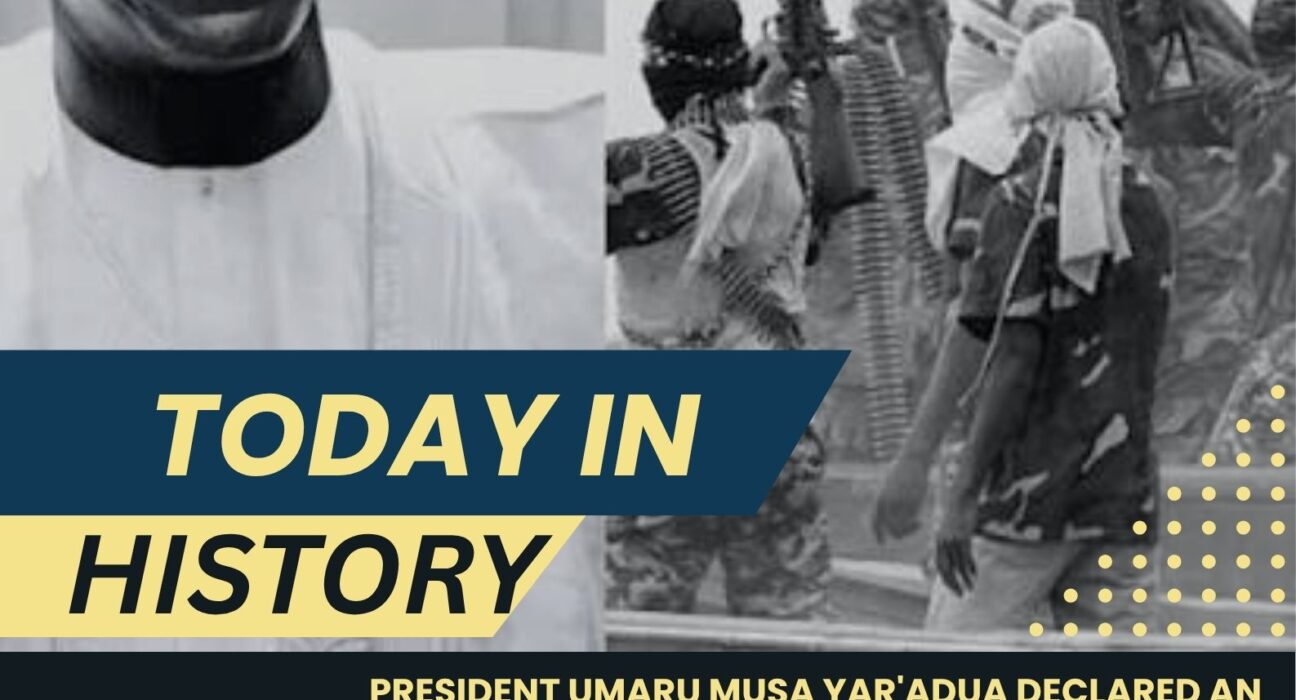
On June 25, 2009, Nigeria stood at a critical economic and security crossroads. Niger Delta, the heart of the nation’s wealth was engulfed in a violent, multi-year insurgency. Production of crude oil had plummeted from over 2 million barrels per day to a staggering low of under 1 million, crippling the national treasury.
Recognizing that military force alone could not secure peace, President Umaru Musa Yar’Adua made a historic gamble. Exercising his powers under Section 175 of the Nigerian Constitution, he announced an unconditional amnesty for all Niger Delta militants willing to surrender their weapons within a 60-day window.
For decades, the communities of the Niger Delta watched billions of dollars in oil wealth flow out of their lands while leaving behind severe pollution, environmental degradation, systemic poverty, and acute underdevelopment.
By the mid-2000s, this deep-seated frustration birthed a heavily armed insurgency, led prominently by the Movement for the Emancipation of the Niger Delta (MEND). Militant factions launched sophisticated attacks on pipelines, kidnapped foreign oil workers, and engaged in illegal oil bunkering (siphoning). The region became virtually ungovernable, and the Nigerian economy was bleeding profusely.
Yar’Adua’s proclamation laid the foundation for what became the Presidential Amnesty Programme (PAP). The initiative was built on a standard three-tier peacebuilding framework of disarmament, demobilization, and reintegration.
Militants were required to hand over automatic weapons, gunboats, and ammunition at designated collection centers between August 6 and October 4, 2009. Over 26,000 fighters registered, stepping out of the creeks to receive a monthly stipend of ₦65,000 to support their immediate transition. Furthermore, the government pledged extensive vocational training, university scholarships both locally and internationally, and employment to give ex-militants a sustainable alternative to violence.
High-profile militant commanders including Government Ekpemupolo (popularly known as Tompolo), Ateke Tom, and Boyloaf eventually accepted the offer, leading thousands of their foot soldiers out of the trenches.
The immediate aftermath of the declaration brought a profound shift to Nigeria’s socio-political and economic landscape. Within months of the weapons handover, oil production bounced back to near-capacity, stabilizing the national budget and restoring investor confidence. Thousands of young Niger Delta youths were trained as pilots, maritime engineers, and agricultural experts in institutions across the globe.
While the program halted large-scale coordinated sabotage, structural issues like environmental pollution and regional poverty remained largely unresolved.
President Yar’Adua passed away in May 2010, less than a year after declaring the amnesty. His successor, Goodluck Jonathan, sustained the program, but critics argue it gradually shifted from a comprehensive development agenda into a massive, costly payout system to keep the peace.
June 25, 2009, remains a defining milestone in contemporary Nigerian history. It proved that dialogue and economic compromise could accomplish what military campaigns could not, rewriting the playbook for conflict resolution in the West African sub-region.