

Today in History: The First Ever Documented Blood Transfusion
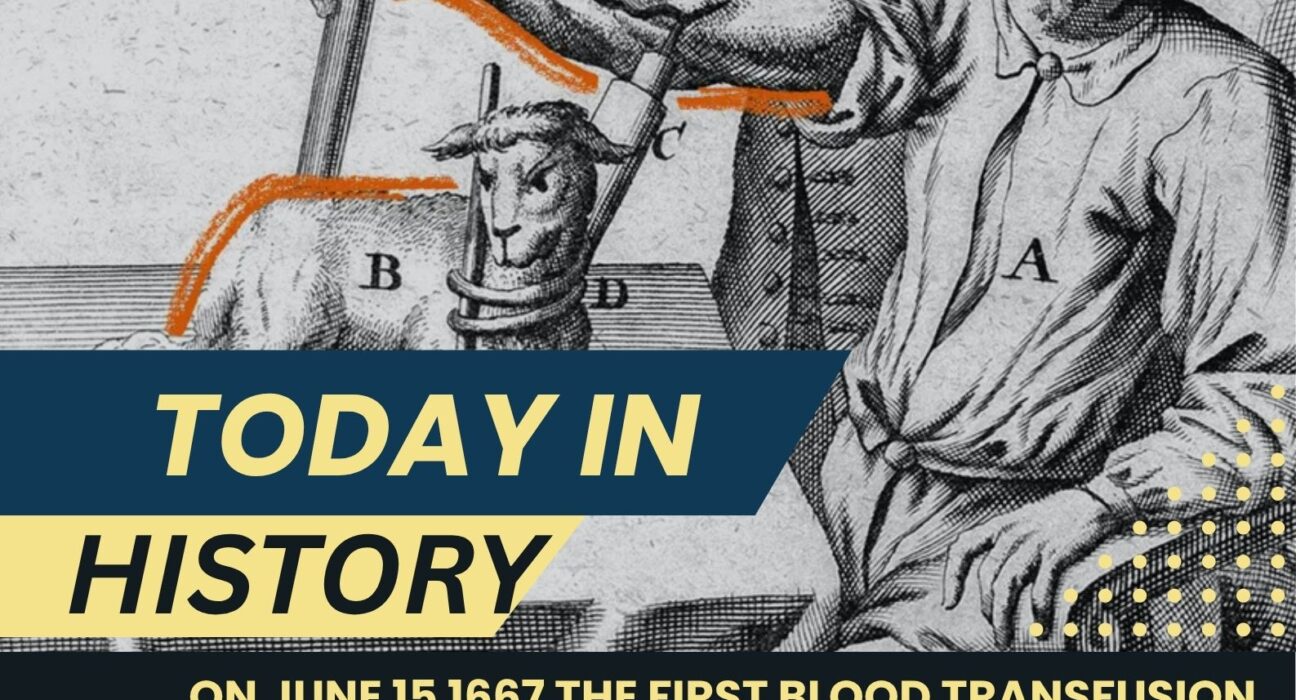
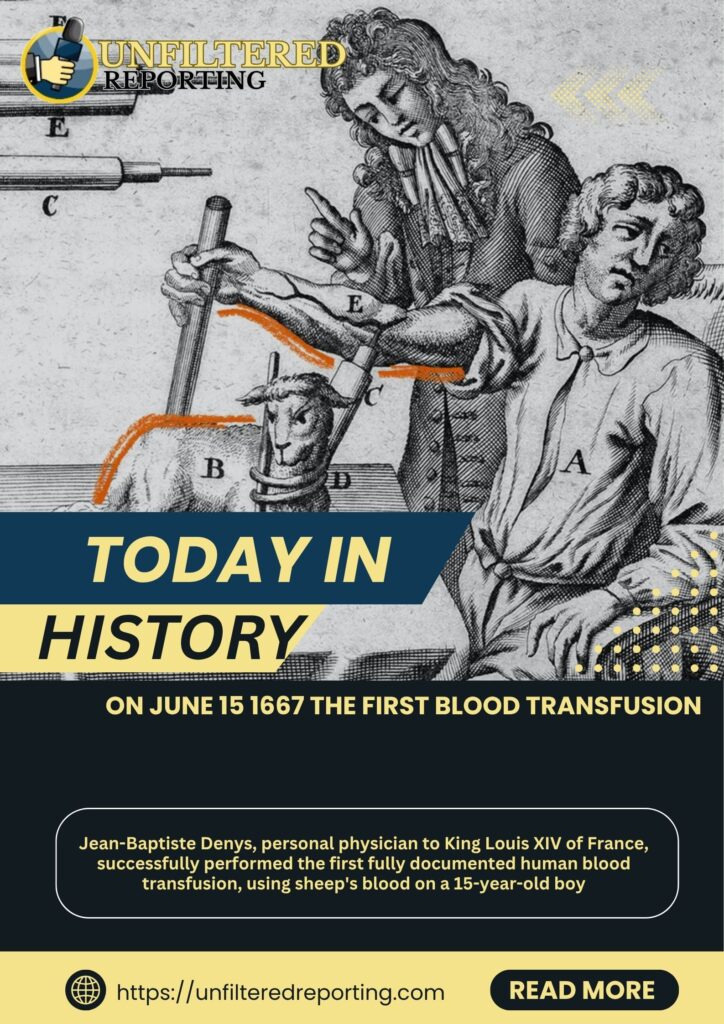
On June 15, 1667, a small crowd gathered in Paris to witness an experiment that felt closer to sorcery than science. Jean-Baptiste Denys, an ambitious young physician to King Louis XIV, was about to attempt something never successfully documented in human history: transferring the blood of a living animal into the veins of a human being.
The patient was a 15-year-old boy who had been suffering from a relentless, weakening fever. In a desperate bid to save him and test a radical new theory Denys connected the boy’s veins to those of a lamb.
The boy didn’t just survive; he recovered. But while hailed as a miracle at the time, this event triggered a medical and ethical storm that shut down the field of blood transfusions for nearly two centuries.
To understand why a 17th-century doctor would reach for a sheep, you have to look at how medical science viewed the body back then. English physician William Harvey had only discovered the circulation of blood a few decades prior, in 1628. Suddenly, the medical world realized the bloodstream was a highway.
Doctors reasoned that if you were sick, your blood was corrupted. Replacing it with “pure” blood seemed like the ultimate cure. Denys chose a lamb because the animals were viewed as gentle, pure, and free of human vices. Doctors genuinely believed transferring a lamb’s blood could calm a violent or feverish patient. Furthermore, animal blood was abundant, and experimenting on livestock didn’t carry the legal weight of using human blood.
Using quills as crude needles and silver tubes to connect the blood vessels, Denys transferred roughly three ounces of sheep’s blood into the teenager. The boy felt a sudden, intense warmth in his arm but otherwise showed no immediate ill effects. His fever broke, and he made a full recovery.
Today, we know the boy survived purely because of luck and dosage. The human immune system is designed to fiercely attack foreign proteins. Because Denys administered a very small amount of blood, the boy’s immune system was able to process the foreign lamb cells without triggering a fatal, full-body shock.
Emboldened by his success, Denys performed a second transfusion on a laborer, who also survived. But the luck of xenotransplantation transferring fluids between different species quickly ran out.
His fourth patient, a man named Antoine Mauroy who suffered from violent mania, was given calf’s blood in hopes of curing his insanity. During the second transfusion attempt, Mauroy experienced what we now recognize as a severe hemolytic transfusion reaction.
Mauroy suffered from agonizing pain, a rapid pulse, heavy sweating, and notably, his urine turned “as black as soot” a classic sign of his kidneys failing as they tried to filter out destroyed foreign blood cells.
Mauroy survived the procedure but died a few months later during a subsequent bout of illness.
Mauroy’s widow accused Denys of murder, leading to a high-profile, bitter trial. While Denys was ultimately acquitted because it was suspected that Mauroy’s wife actually poisoned him with arsenic, the French courts had seen enough.
In 1668, the French Parliament banned all blood transfusions involving humans. The Royal Society in England followed suit, and the Vatican officially condemned the practice.
The idea of blood transfusion was effectively locked away for over 150 years. It wasn’t until 1818 that British obstetrician James Blundell performed the first successful human-to-human transfusion, and not until 1901 when Austrian scientist Karl Landsteiner discovered human blood groups that the procedure finally became safe. Jean-Baptiste Denys’s experiment remains a fascinating milestone: a daring leap into the unknown that proved humans could manipulate the very fluid of life, even if they didn’t yet possess the map to navigate it safely.