
UN Leadership Race Heats Up as Latin America, Africa Submit 4 Candidates
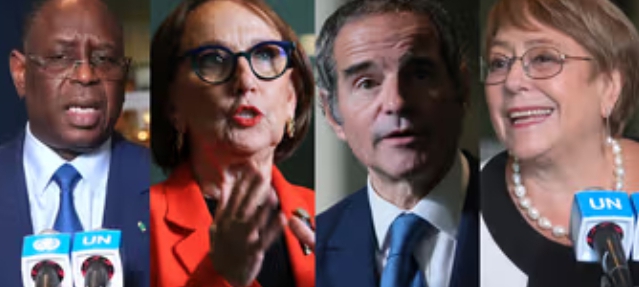
Four candidates from Latin America and Africa have formally entered the race to succeed António Guterres as Secretary-General of the United Nations, as the global body confronts mounting questions over its relevance and authority.
The contenders—Michelle Bachelet of Chile, Rafael Grossi of Argentina, Rebeca Grynspan of Costa Rica, and Macky Sall of Senegal—are seeking a five-year term beginning next year. Additional candidates could still join the race in the coming months.
The next UN chief will inherit an organisation grappling with declining influence, as major powers increasingly bypass multilateral frameworks while simultaneously calling for reform and cost-cutting.
Analysts warn that unilateral actions by these same powers have contributed to the erosion of the UN’s standing.
Describing the role as “one of the toughest jobs in the world”, Annalena Baerbock, President of the UN General Assembly, said the next Secretary-General would play a decisive role in defending the UN Charter and the broader rules-based international order.
The field is notably smaller than in 2016, when 13 candidates competed before Guterres was selected. Despite decades of advocacy, no woman has ever led the UN in its 80-year history, intensifying scrutiny on gender representation in the current race.
By convention, the position rotates geographically, with Latin America widely viewed as next in line, while candidates from the five permanent members of the Security Council are excluded.
Policy experts have stressed the urgency of the moment as Daniel Forti of the International Crisis Group wrote that the need for “a clear, proactive vision” on peacemaking and crisis management could not be more urgent, warning that failure to act decisively could further weaken the institution.
Candidates present competing visions for multilateralism
Each candidate brings a distinct profile. Bachelet, a former president of Chile and UN human rights chief, has retained backing from Brazil and Mexico despite losing support at home following a political shift. Her candidacy has drawn criticism from some US conservatives, with Washington signalling reservations about her suitability.
Grossi, a veteran diplomat and current head of the International Atomic Energy Agency, has emphasised the continued relevance of multilateral institutions, stating that “even in times of division,” they can deliver meaningful outcomes.
Grynspan, who leads the UN Conference on Trade and Development, has positioned herself as a reform-oriented candidate, stressing equality and her long-standing commitment to development and human rights. “I am not waiting for special treatment. I want equal treatment,” she said.
Sall, Senegal’s former president, has campaigned on strengthening multilateralism and addressing the concerns of developing economies, particularly debt burdens. However, his bid has received mixed support within Africa, including a lack of endorsement from his own country and Nigeria.
If successful, Sall would become only the third African to lead the UN, following Boutros Boutros-Ghali and Kofi Annan.