

Tinubu Meets Security Chiefs Amid U.S. Alert, Deadly Borno Airstrike
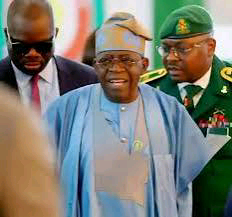
President Bola Tinubu is currently presiding over a high-level security meeting with service chiefs and intelligence leaders at the Presidential Villa in Abuja.
The closed-door session, which began around 2:00 p.m. on Monday, marks the President’s first official engagement since returning to the capital from Bayelsa State last Friday.
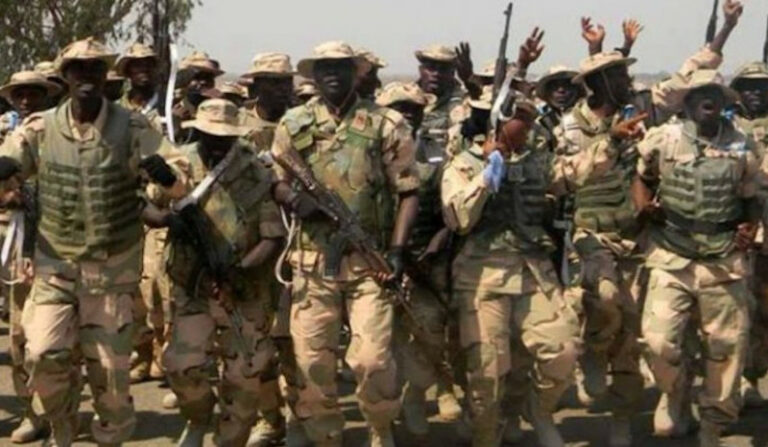
In attendance are the Chief of Defence Staff, the service chiefs of the Army, Navy and Air Force, the Director-General of the Department of State Services, the Director-General of the National Intelligence Agency, and the Inspector-General of Police, Tunji Disu.
The National Security Adviser, Nuhu Ribadu, is also part of the meeting.
The emergency talks come against the backdrop of rising security concerns, including a recent advisory by the United States Department of State authorising the voluntary departure of non-essential embassy staff and their families from Abuja.
In its April 8 notice, the US government cited a worsening security environment and placed 23 Nigerian states under its highest travel risk category, “Level 4: Do Not Travel,” pointing to threats ranging from insurgency in the North-East to banditry and communal violence in other regions.
The US Embassy in Abuja subsequently suspended visa appointments, although its consulate in Lagos continues to offer both routine and emergency services.
Reacting, the Federal Government said the advisory was based on US internal procedures and does not reflect the broader security reality across the country. Minister of Information, Mohammed Idris, maintained that while some areas face challenges, there is no widespread breakdown of law and order.
The meeting is also taking place hours after a Nigerian Air Force operation in Borno State reportedly resulted in significant civilian casualties. The strike, carried out on April 11 in the Jilli area near the Borno–Yobe border, was said to have hit a local market.
Amnesty International, citing eyewitness accounts, reported that more than 100 people were killed, with some estimates placing the death toll higher, while many others sustained injuries.
The Nigerian Air Force confirmed conducting targeted airstrikes against terrorist positions in the area but did not acknowledge civilian casualties. However, the Presidency defended the operation, stating that the location had been used by insurgents as a logistics base.
In comments to Bloomberg, presidential spokesman Temitope Ajayi said the site was considered a legitimate military target due to its alleged use by Boko Haram and the Islamic State West Africa Province.
Amnesty International has since called for an independent probe into the incident, describing it as indicative of serious lapses in protecting civilian lives during military operations.
Nigeria continues to grapple with multiple security challenges across its regions, including insurgency in the North-East, banditry and kidnappings in the North-West and North-Central, and separatist violence in the South-East.
Recent incidents have underscored the scale of the crisis. In February, more than 100 people were reportedly killed and dozens abducted in an attack in Kwara State, while cases of mass kidnappings have persisted across several northern states.
According to Amnesty International, at least 1,100 people were abducted nationwide between January and April 2026, though the Nigeria Police Force has disputed the figure as unverified.
As of the time of filing this report, the meeting at the Presidential Villa was still in progress, with vehicles conveying top security officials seen within the premises.