

I Spend ₦40,000 Daily to Power My Home, Says Pete Edochie
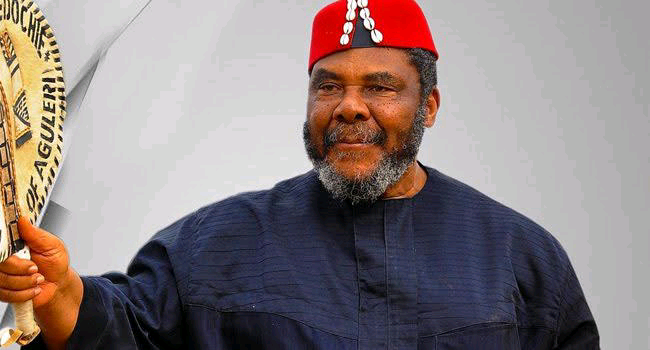
Veteran Nollywood actor, Pete Edochie has expressed concern over the rising cost of maintaining electricity in his home, revealing that he spends about ₦40,000 daily due to Nigeria’s unstable power supply.
Edochie disclosed this during an interview with African Independent Television (AIT) on Thursday, where he detailed the expenses he incurs on electricity and alternative power sources.
The actor, who will turn 79 on Saturday, said he spends approximately ₦10,000 every day purchasing electricity units. He added that he spends an additional ₦30,000 daily on alternative power, including ₦20,000 for diesel and ₦10,000 for fuel to run generators.
According to him, the financial burden of powering his home has become overwhelming.
“I pay ₦10,000 every day for electricity in my house. Then I spend another ₦30,000—₦20,000 for diesel and ₦10,000 for fuel. Altogether, that is ₦40,000 every day on light. It disturbs me a lot. I’m not working just to pay for electricity,” the actor, known for his role in the film Lionheart, said.
He also suggested that many political office holders appear more focused on enjoying the privileges of office than addressing the economic hardship faced by Nigerians.
Edochie’s comments came amid fresh data indicating a further decline in electricity generation nationwide.
The National Grid of Nigeria reported in a post on its official X account on Friday morning that electricity generation across the country had dropped again, continuing a pattern of instability recorded on the grid this year.
Frequent disruptions and operational challenges have repeatedly reduced power output, worsening electricity supply for homes and businesses.
Reports on X also indicated that several communities experienced prolonged blackouts within the last 24 hours.
Residents of Odogunyan and Odonla in the Ikorodu North Local Council Development Area of Lagos were reportedly without electricity since Thursday morning.
Operational data showed that electricity distribution companies received only 2,830 megawatts on Thursday after gas shortages forced some power plants to reduce output.
Figures from the Nigerian Independent System Operator indicated that total generation stood at 3,940.53 megawatts at about 5:00 a.m. on March 5, 2026. However, between 6:00 a.m. and 8:00 a.m., some generation units went offline due to inadequate gas supply, resulting in an additional drop of 292 megawatts.
The reduced generation meant the 11 distribution companies collectively received a load allocation of 2,830 megawatts, while output later declined further to about 1,490 megawatts around 6:00 p.m.
Among the distribution companies, Abuja Electricity Distribution Company received the highest allocation with 490 megawatts, followed by Ikeja Electric with 484 megawatts and Eko Electricity Distribution Company with 413 megawatts.
Other allocations included 306 megawatts to Ibadan Electricity Distribution Company, 207 megawatts to Benin Electricity Distribution Company and 198 megawatts to Enugu Electricity Distribution Company.
Further allocations showed Port Harcourt Electricity Distribution Company receiving 178 megawatts, Kano Electricity Distribution Company 173 megawatts, Kaduna Electricity Distribution Company 161 megawatts, Jos Electricity Distribution Company 144 megawatts and Yola Electricity Distribution Company 76 megawatts.
The situation underscores the ongoing challenges in Nigeria’s power sector, where gas shortages, weak infrastructure and limited investment continue to restrict electricity generation despite the country’s large natural gas reserves.
Meanwhile, the Federal Government is advancing plans to deploy more than 1,000 mini-grid projects as part of a rural electrification initiative aimed at expanding access to electricity.
Managing Director of the Rural Electrification Agency, Abba Aliyu, disclosed in Abuja during a visit by the National Judicial Institute that the projects form part of a $750 million public programme expected to contribute over 200 megawatts of solar power to the national grid.