Nigeria, AFC Ink $1.3bn Alumina Partnership to Boost Mining, GDP
The Federal Government of Nigeria has signed a major investment agreement with the Africa Finance Corporation to fund a $1.3 billion alumina refinery and related mining initiatives, in a move aimed at expanding the solid minerals sector and strengthening the nation’s economic base.
The Memorandum of Understanding was executed between the Solid Minerals Development Fund and the Africa Finance Corporation following months of negotiations, with the partnership expected to unlock large-scale private capital, deepen mineral value addition and reposition Nigeria as a competitive destination for mining investment.
Speaking at the signing ceremony, the Minister of Solid Minerals Development, Dele Alake, described the agreement as a defining moment for the sector, noting that it would significantly raise mining’s contribution to national output and attract further foreign direct investment.
At the centre of the deal is the planned construction of a $1.3 billion alumina refinery designed to process about one million tonnes of bauxite ore annually. The facility will deploy a modern Bayer-process production system and include an on-site gas-fired cogeneration plant to supply both steam and power. Over an estimated 20-year operational lifespan, the plant is projected to deliver about 19 million tonnes of alumina at a 95 per cent utilisation rate.
Beyond the refinery, the agreement also covers a nationwide geoscience mapping programme and the creation of a joint investment vehicle to fast-track exploration and development of identified mineral assets across Nigeria.
Officials say these components are critical to reducing exploration risks, improving data availability and accelerating production.
Executive Secretary of the Solid Minerals Development Fund, Hajia Fatima Shinkafi, said the transaction marks the agency’s most significant undertaking since it was established.
“We are very proud and honored to facilitate this phenomenal milestone, which is quite unprecedented since the inception of SMDF. It is a $1.3bn CAPEX. SMDF has come of age to be able to sit here and sign this deal with AFC. I thank the AFC for collaborating with us to boost the value addition policy of my boss, Dele Alake,” she said.
Economic projections linked to the project indicate that it could contribute about $1.2 billion to Nigeria’s Gross Domestic Product annually, generate over $25 billion in value to the economy over its lifecycle, and earn an estimated $8 billion in foreign exchange, making it one of the largest private investments ever recorded in the mining sector.
Initial feasibility studies jointly conducted by the partners reportedly confirmed the project’s commercial viability, reinforcing the Ministry’s push to use credible data and reforms to attract long-term capital.
According to officials, the mapping initiative will also help build a reliable mineral database to support future investments.
Permanent Secretary of the Ministry, Engr. Farouk Yabo, commended the partnership, describing it as evidence of strong leadership and policy consistency.
He said the project has the potential to place Nigeria firmly on the global mining map and pledged the support of the ministry’s bureaucracy to ensure smooth implementation.
Reaffirming government backing, Minister Alake said all necessary approvals have been granted to fast-track the investments. He also directed agencies under the Ministry to prioritise the processing of permits, licences and regulatory clearances required for timely execution.
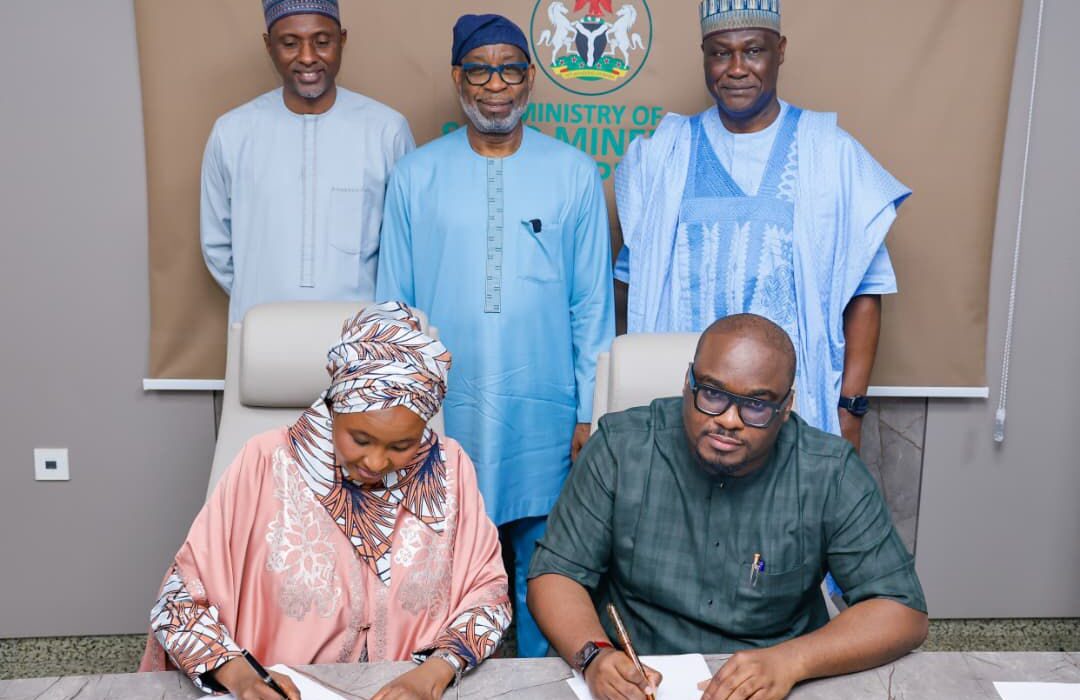
The agreement was signed on behalf of the Federal Government by the SMDF, while Franklin Edochie, Deputy Director and Head of Metals and Mining at the Africa Finance Corporation, signed for the corporation. The ceremony was witnessed by AFC President and CEO, Samaila Zubairu, and senior government officials.
Industry observers say the partnership signals a renewed push by the Federal Government to move Nigeria’s mining sector away from raw exports toward value-added processing, with the alumina project expected to serve as a flagship for that transition.