
Senate Queries N34 Trillion Import Waivers as Customs Defends Fiscal Incentives
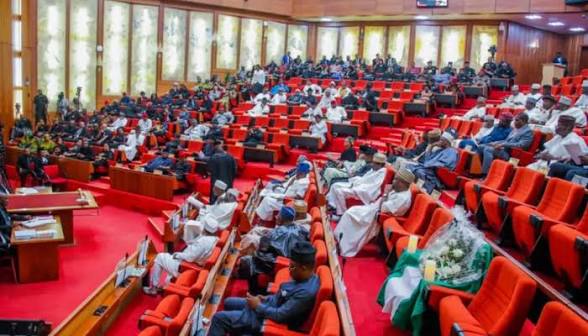
The Senate Committee on Finance has commenced an investigation into approximately N34 trillion worth of Import Duty Exemption Certificates (IDECs) issued by the Federal Government between March 1, 2000, and December 2025, amid growing concerns over their effect on government revenue.
At an investigative hearing on Monday, the committee also warned several Ministries, Departments and Agencies (MDAs) that failed to appear before it over ongoing inquiries into the remittance of internally generated revenue and operating surpluses to the Consolidated Revenue Fund (CRF) for the 2023–2025 period.
Chairman of the committee, Senator Sani Musa, said agencies that continue to ignore legislative invitations could face sanctions and possible referral to President Bola Tinubu for administrative action.
Appearing before the panel, Comptroller-General of the Nigeria Customs Service (NCS), Bashir Adewale Adeniyi, defended the import duty waivers, describing them as targeted fiscal measures introduced to address national security, economic and social priorities rather than simply reduce government earnings.
Adeniyi disclosed that import duty exemptions approved by the government had reached about N34 trillion by 2025, noting that nearly 60 per cent of the approvals covered the importation of military equipment to strengthen Nigeria’s security response.
He said other beneficiaries included imports of Compressed Natural Gas (CNG), electric and hybrid vehicles, medical equipment and healthcare supplies, industrial machinery, manufacturing inputs, and food commodities introduced under government intervention programmes aimed at easing inflation.
According to him, the effectiveness of such incentives should be measured by their broader economic impact, including increased industrial output, lower consumer prices, improved healthcare delivery and enhanced national security, rather than by revenue generation alone.
He, however, urged the Federal Government to strengthen monitoring mechanisms to ensure beneficiaries of duty waivers deliver the intended economic benefits.
The committee also reviewed Customs’ revenue performance over recent years. Adeniyi said the Service generated N3.2 trillion in 2023 against a target of N3.67 trillion, representing an eight per cent shortfall.
He added that revenue collection improved in 2024, with Customs collecting N6.1 trillion, exceeding its N5.079 trillion target by more than 20 per cent.
For 2025, Customs realised about N7.2 trillion, surpassing the projected N6.584 trillion, while collections had reached approximately N4.5 trillion as of June 2026, against an annual target of N11 trillion.
The Customs boss attributed fluctuations in revenue to disruptions in global trade caused by the Russia-Ukraine war and tensions in the Middle East, particularly the conflict involving Iran, but expressed optimism that cargo volumes were beginning to recover, with improved figures recorded in July.
The Fiscal Responsibility Commission (FRC) told lawmakers that government-approved waivers on imports of commodities such as maize and rice had reduced Customs revenue, although it confirmed that all revenue collected by the Service was remitted directly into the Treasury Single Account (TSA).
Lawmakers also examined the Federal Government’s decision to reduce import duties on vehicles. Senator Adams Oshiomhole argued that lower tariffs on imported vehicles, including fairly used ones, could weaken Nigeria’s local automobile assembly industry by making imported vehicles more attractive.
Responding, Adeniyi said Customs only implements government policies and does not formulate them. He acknowledged that reduced tariffs would affect revenue but explained that the policy was introduced to make vehicles more affordable for Nigerians facing economic hardship.
On the National Single Window initiative, Adeniyi said implementation had entered its second phase, with systems of relevant government agencies already integrated and stakeholders across the trade value chain undergoing sensitisation.
Despite operational challenges, he expressed confidence that the project would improve transparency, facilitate trade and enhance Nigeria’s competitiveness.
He further disclosed that Customs’ modernisation programme, driven by electronic payment systems, digital declarations, geospatial intelligence and surveillance technology, had strengthened revenue generation and border security.
According to him, Nigeria’s export trade has expanded by about 70 per cent since the establishment of a dedicated export command in 2023.
The FRC also informed the committee that the Nigeria Customs Service had not submitted audited financial statements beyond 2019 and currently had an estimated outstanding operating surplus liability of about N8.9 billion, subject to reconciliation after updated audited accounts are received.
The committee directed the Comptroller-General to submit comprehensive revenue records and outstanding audited financial statements within one week.
During the hearing, the Corporate Affairs Commission (CAC) acknowledged an outstanding N13.9 billion in unremitted revenue covering 2023 to 2025.
Registrar-General Hussaini Ishaq Magaji told lawmakers the commission had begun settling the liability in instalments. While commending the agency’s revenue performance, the committee directed the CAC, the FRC and relevant officials to reconcile the figures and determine the exact outstanding balance.
Proceedings involving NNPC Limited were postponed after the company’s Group Chief Executive Officer failed to appear.
The company’s Financial Controller, Tajudeen Karim, informed lawmakers that the Chief Financial Officer was receiving medical treatment. However, senators insisted that only the GCEO and other senior executives could adequately respond to issues relating to the company’s remittances to the Federation Account, compliance with Executive Orders, monthly revenue reconciliation and ongoing reforms.
The committee adjourned NNPC’s appearance until next week and directed the GCEO alongside key finance officials to appear in person.
Senator Musa also criticised the absence of several invited government agencies, including the Office of the Accountant-General of the Federation (OAGF), Industrial Training Fund (ITF), Nigerian Communications Commission (NCC), Nigerian Maritime Administration and Safety Agency (NIMASA), Federal Airports Authority of Nigeria (FAAN), Nigerian Railway Corporation (NRC), National Environmental Standards and Regulations Enforcement Agency (NESREA), Nigerian Civil Aviation Authority (NCAA), Small and Medium Enterprises Development Agency of Nigeria (SMEDAN), Nigerian Institute of Transport Technology (NITT), Institute for Agricultural Research (IAR), Nigeria Agricultural Quarantine Service (NAQS), Federal Medical Centre (FMC), Jabi, and the Veterinary Council of Nigeria (VCN).
He said the Senate was carrying out its constitutional oversight responsibility and maintained that every government agency entrusted with public funds must fully account for revenues collected on behalf of the Federal Government.