



Controversial ‘Akara, Kulikuli’ Discourse Surfaces in University Examination
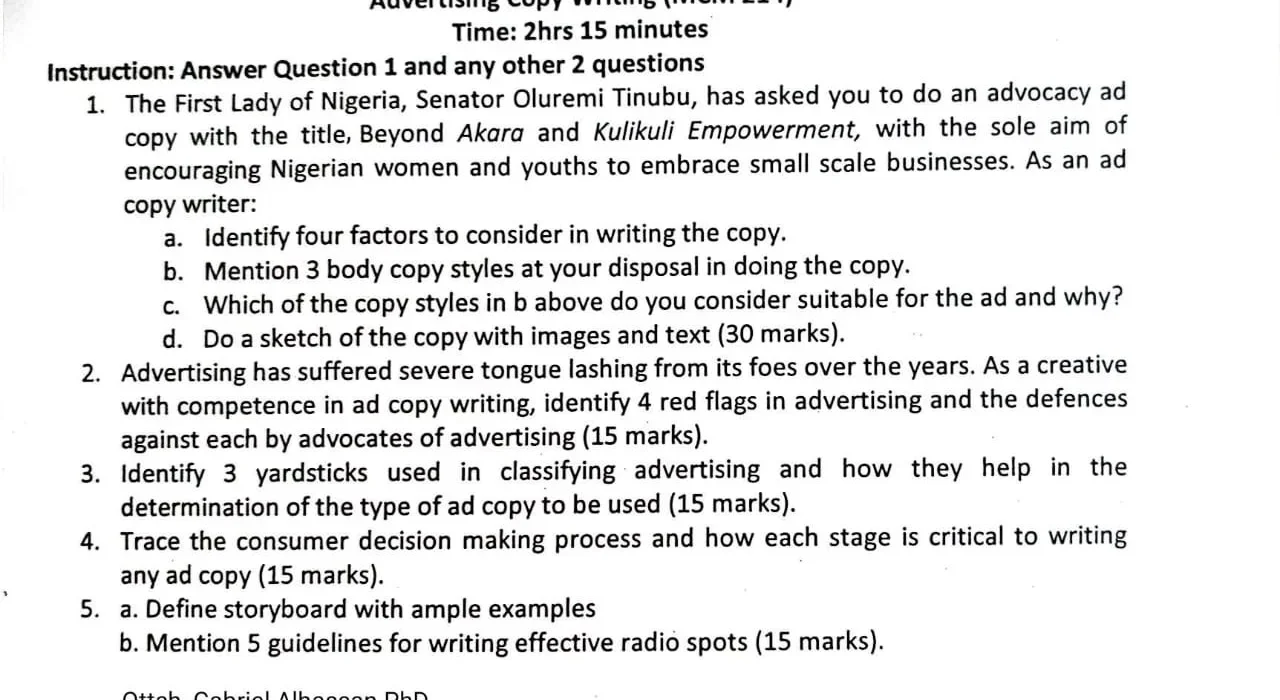
The public debate surrounding First Lady Senator Oluremi Tinubu’s remarks on small-scale businesses has officially reached the academic sphere. Students in the Department of Mass Communication at Prince Abubakar Audu University in Kogi State were recently presented with an examination question linked to the controversial topic.
During their “Advertising Copy Writing” (MCM 214) exam for the 2025/2026 academic session, students were tasked with developing an advocacy advertisement campaign. The question required them to create a copy titled “Beyond Akara and Kulikuli Empowerment,” with the objective of motivating Nigerian women and youth to engage in small-scale entrepreneurial ventures. As part of the 30-mark exercise, students were expected to outline factors for creating the copy, define specific body copy styles, justify their choice of style, and illustrate the advertisement with both text and imagery.
This academic prompt follows widespread social media backlash sparked in June, when the First Lady encouraged Nigerian women to venture into low-capital businesses like frying akara or producing kulikuli.
Her comments drew sharp criticism from many Nigerians who felt her suggestion disregarded the harsh economic realities of rising inflation, unemployment, and food costs.
In response to the criticism, Senator Tinubu defended her position, clarifying that the government’s empowerment initiatives encompass a broad spectrum of petty trading beyond just bean cakes and groundnut snacks.
She highlighted various financial assistance programs aimed at supporting small-scale traders across the country. Additionally, government officials, including presidential aide Dada Olusegun, dismissed the outcry as a superficial attack, maintaining that critics have failed to acknowledge the wider scope of the ‘Renewed Hope Initiative’ and its various interventions in healthcare and economic empowerment.