


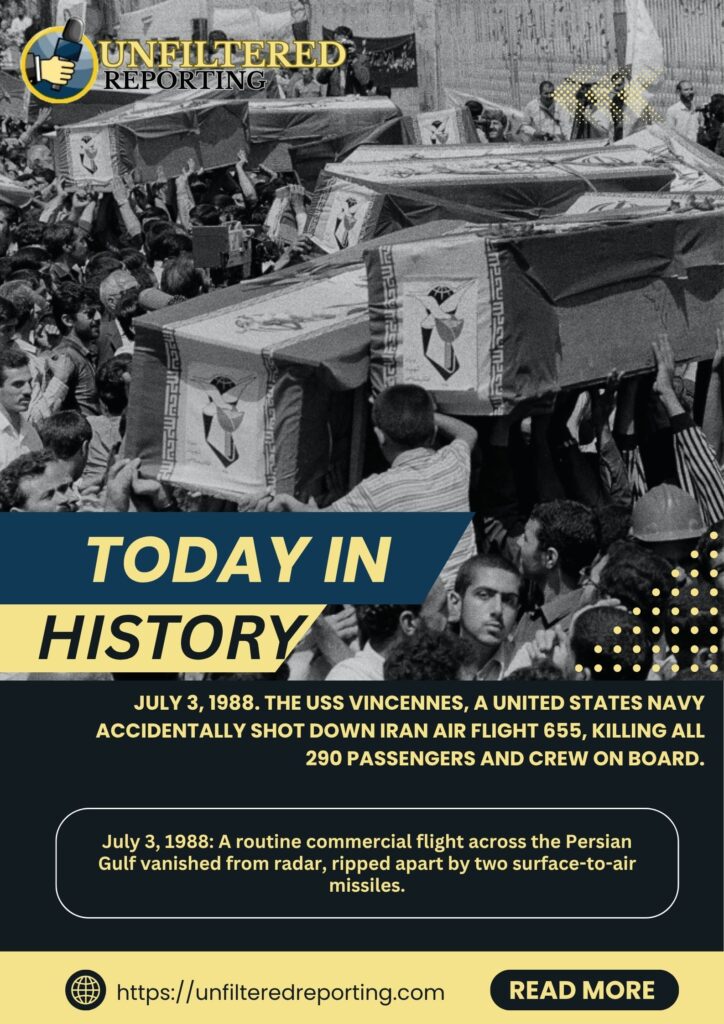
Today in History: The Tragedy of Air Flight 655
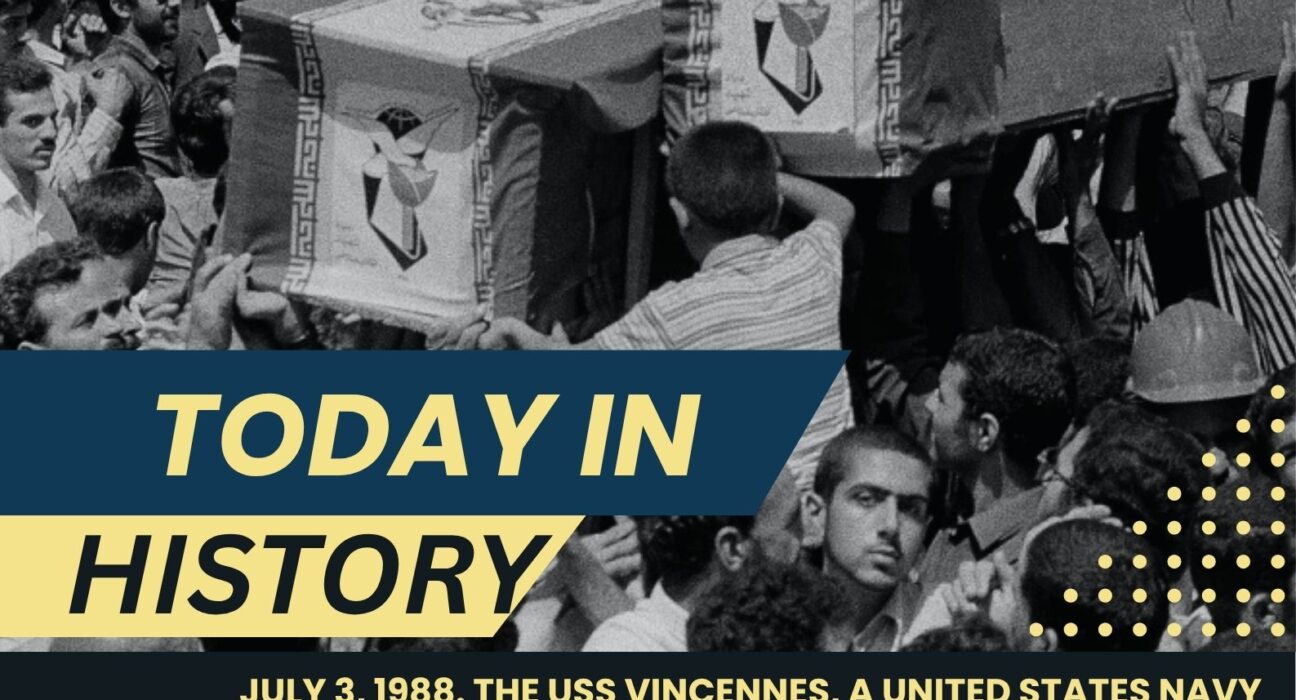
On July 3, 1988, a commercial airliner flying its routine path across the Persian Gulf vanished from radar screens, ripped apart by two surface-to-air missiles. Within hours, a devastating reality emerged: the attacker was not a rogue military force, but the USS *Vincennes*, a highly advanced United States Navy guided-missile cruiser. All 290 civilians on board Iran Air Flight 655 were killed, making it one of the deadliest aviation tragedies in history and a profound case study in the dangers of high-tech wartime psychology.
To understand why the USS Vincennes fired on a civilian airliner, one must look at the tense, claustrophobic environment of the Persian Gulf in the late 1980s. The Iran-Iraq War was in its final, brutal months. Both nations had turned to the “Tanker War”—attacking commercial oil vessels in the Gulf to choke off the other’s economy.
The U.S. Navy had deployed heavily to the region to protect commercial shipping. Just a year earlier, in May 1987, an Iraqi jet had mistakenly fired missiles at the USS Stark, killing 37 American sailors. American crews in the Gulf were on hyper-alert, operating under rules of engagement that prioritized aggressive self-defense.
On the morning of July 3, the USS Vincennes, commanded by Captain William C. Rogers III, was involved in a surface skirmish with Iranian Revolutionary Guard gunboats. Amidst the chaos of this firefight, Iran Air Flight 655 took off from nearby Bandar Abbas International Airport, a joint civilian-military airfield, bound for Dubai.
Iran Air Flight 655 was an Airbus A300, a massive commercial aircraft. It was flying along a well-established, international civilian air corridor, transmitting standard civilian transponder signals, and ascending normally.
Yet, inside the Combat Information Center (CIC) of the USS Vincennes, a dangerous psychological phenomenon known as scenario fulfillment took root. The crew, already engaged in combat with Iranian gunboats, expected an attack from the air.
The ship’s Aegis combat system picked up the plane’s civilian signal, but also noted a military transponder signal that had likely been cached on their screens from an Iranian F-14 fighter sitting on the tarmac at Bandar Abbas minutes prior. Though the Airbus was steadily climbing to its cruising altitude, several crew members misread their consoles or panicked under pressure, reporting to Captain Rogers that the unknown aircraft was descending toward the ship in an attack profile.
The Vincennes issued ten radio warnings across military and civilian distress frequencies. However, the airliner’s pilot, believing the warnings were directed at an Iranian military aircraft operating nearby, did not adjust course. Convinced his ship was seconds away from being struck by a hostile fighter jet, Captain Rogers made the fateful decision to fire. Two SM-2MR missiles launched from the deck of the cruiser, and both found their target.
The destruction of Flight 655 triggered immediate international outrage. Iran condemned the attack as a barbaric act of intentional mass murder. The U.S. government initially claimed the ship acted in clear self-defense against an F-14 flying outside the civilian corridor, a narrative that quickly unraveled as official investigations got underway. The tragedy resulted in 290 fatalities, including 274 passengers—among them 66 children and 16 crew members.
A formal Navy investigation, led by Rear Admiral William Fogarty, later concluded that the tragedy was driven almost entirely by human error exacerbated by combat stress. The Aegis system itself had functioned correctly, but the crew distorted the data to fit their immediate fears. Despite the catastrophic error, Captain Rogers and the ship’s tactical air officer were not court-martialed; instead, they were later awarded Legion of Merit medals for their overall tour of duty, sparking deep resentment in Tehran.
For many years, legal battles raged. In 1996, the United States and Iran reached a settlement at the International Court of Justice. The U.S. expressed deep regret for the loss of life and paid compensation to the victims’ families, though it stopped short of issuing a formal apology or admitting legal liability.
The shotdown of Iran Air Flight 655 remains a defining moment in modern military history. It forced global militaries to completely rethink human-computer interaction, weapon system interfaces, and the psychological training of combat crews facing data overload.
Decades later, the tragedy stands as a sobering reminder of the horrific civilian cost that can occur when the fog of war meets high-tech military might. For Iran, it remains a historical scar that deeply shapes its enduring distrust of American military presence in the Middle East.