
Archaeologists Identify Possible Site of Jesus Christ’s Baptism in Jordan
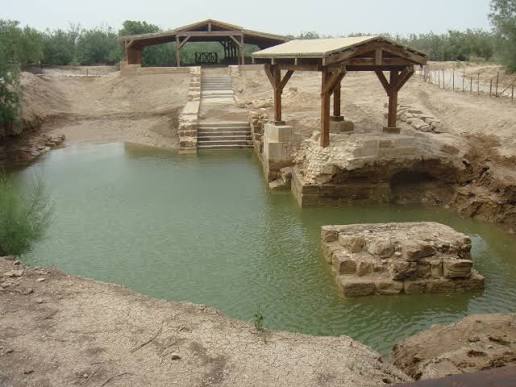
Archaeologists have identified what they believe could be the location where Jesus Christ was baptised by John the Baptist, following excavations at Bethany beyond the Jordan in present-day Jordan.
The site lies on the eastern bank of the River Jordan, approximately five miles north of the Dead Sea. Its identity has been debated by scholars and religious historians for centuries.
According to a report by GB News on Tuesday, Professor Mohammad Waheeb of Jordan’s Hashemite University based his conclusion on archaeological remains uncovered during excavations conducted between 1996 and 2002.
He compared the discoveries with historical records left by ancient travellers and Christian pilgrims.
The findings were published in the Egyptian Journal of Archaeological and Restoration Studies.
Waheeb said the excavations uncovered evidence supporting the identification of the eastern bank as the location of Jesus’ baptism. The discoveries included churches, baptismal pools, prayer halls and water systems, suggesting that the area was an important centre of early Christian worship.
Historical accounts from two travellers also contributed to the research. The Pilgrim of Bordeaux, writing in AD 333, and Theodosius, writing in AD 530, both placed the baptism site about five miles from the point where the River Jordan empties into the Dead Sea.
Theodosius recorded that the distance between the place where Jesus was baptised and the river’s outlet into the Dead Sea was five miles. According to the report, this description corresponds with the location of the archaeological remains.
Waheeb also examined the historical confusion surrounding the names Bethany and Bethabara. He argued that uncertainty partly arose from the early Christian scholar Origen, who reportedly failed to locate the riverside settlement and suggested that the relevant Gospel passage referred to Bethabara, associated with the western bank of the Jordan.
The research distinguishes Bethany beyond the Jordan, identified in John 1:28 as the place where John the Baptist conducted his ministry, from another biblical location called Bethany near Jerusalem, associated with Mary, Martha and Lazarus.
Waheeb further cited the Madaba Mosaic Map, a fifth- or sixth-century representation of biblical locations, arguing that its separate labels for sites on opposite sides of the Jordan support the view that Bethany beyond the Jordan and Bethabara were different places.
The archaeological site is situated near Tell Mar Elyas, also known as Elijah’s Hill, in Wadi al-Kharrar. The area features natural springs, an oasis and vegetation along the valley leading to the River Jordan, with Jericho visible across the river.
Excavations revealed remains dating to the Roman, Byzantine and early Islamic periods. Waheeb, however, distinguished evidence of habitation during the first century from religious structures built in later centuries.
He said the remains indicated that the area was inhabited during the period associated with John the Baptist and Jesus.
The report also noted that most surviving manuscripts available to Origen used the name Bethany, making the distinction between the two biblical locations central to Waheeb’s argument.
Changes in the course of the River Jordan over the centuries may also explain why some structures that were once close to the river now stand on dry land. Seasonal flooding and shifting channels could have displaced the river or damaged buildings originally constructed near its banks.
Concluding the study, Waheeb said the archaeological evidence aligned with accounts from ancient pilgrims, the Madaba Mosaic Map and biblical texts. The identification remains a scholarly claim supported by the research rather than an independently established certainty.