



Did you know: Babies Have More Bones Than Adults?
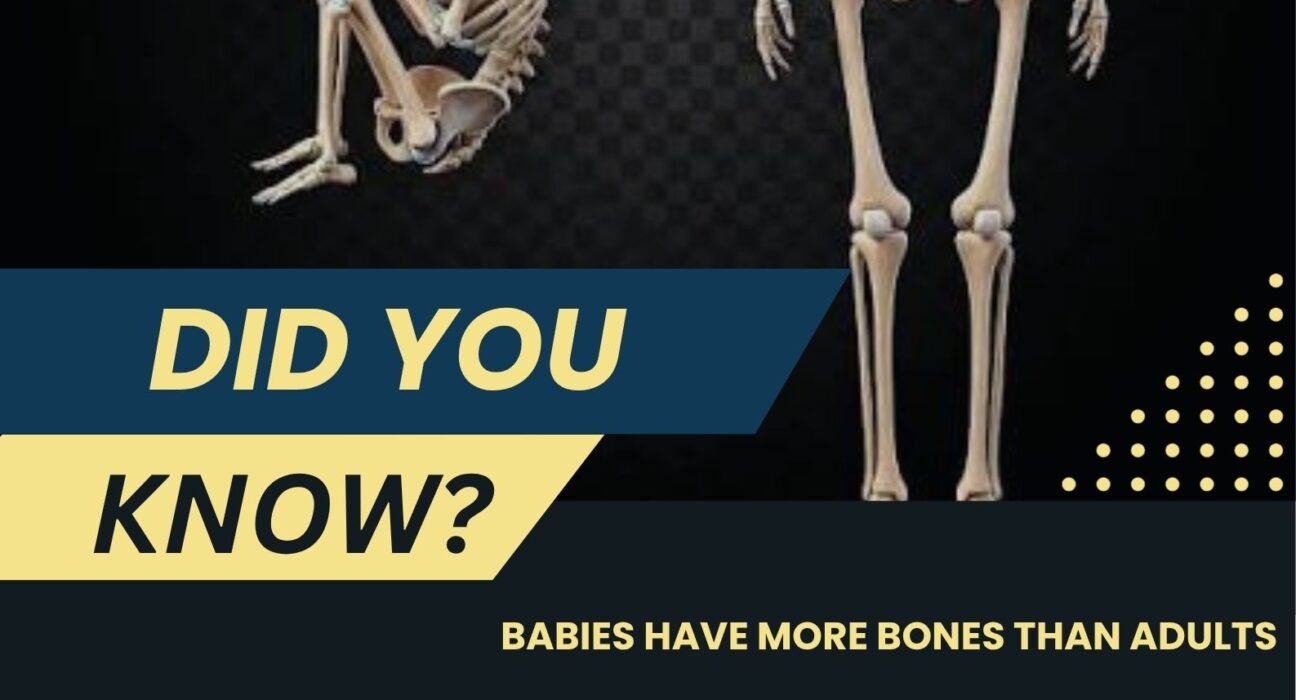
A newborn baby has somewhere between 275 and 300 bones, but a fully grown adult has only 206. Nobody loses bones along the way. They fuse together as the body grows.
Many of a baby’s bones aren’t fully hardened yet. They begin as soft, flexible cartilage, the same material that gives your nose and ears their bendy shape. Over time, a process called ossification gradually turns that cartilage into solid bone. Many of these early bones are also made of several separate pieces that later join into one.
This design has two big advantages. The first is an easier birth. A baby’s skull is made of several separate plates that aren’t locked together, and the gaps between them, called fontanelles (the “soft spots” on a baby’s head), let the skull flex and compress slightly while passing through the birth canal. The second is room to grow. Bones that start as flexible cartilage and separate pieces can grow quickly, and a baby’s body changes faster in the first year than at almost any other time in life. The flexibility also helps babies survive the bumps and tumbles of learning to roll, crawl and walk.
The fusing happens at different times in different parts of the body. In the skull, the soft spots close gradually: the one at the back of the head usually closes within the first few months, and the larger one on top typically closes between 12 and 18 months. In the spine, five separate vertebrae at the base merge into a single bone called the sacrum, while a few tiny ones below it fuse to form the tailbone, or coccyx. The pelvis begins as separate pieces that join together during the teenage years.
In the arms and legs, long bones like the thigh bone have growth plates, areas of cartilage near the ends where bones lengthen. When growth finishes, usually in the late teens or early twenties, these plates harden into solid bone and fuse. This is why people stop getting taller. Some bones, like the collarbone, can keep finishing their fusion into the mid-twenties.
Because the fusing happens in a fairly predictable order, doctors and forensic scientists can look at X-rays and estimate a person’s age by checking which growth plates are still open and which have closed.
Babies don’t have extra bones in the sense of a spare set. They have a flexible, still-assembling skeleton, and as they grow, its many small pieces join together into the 206 bones of the adult body.