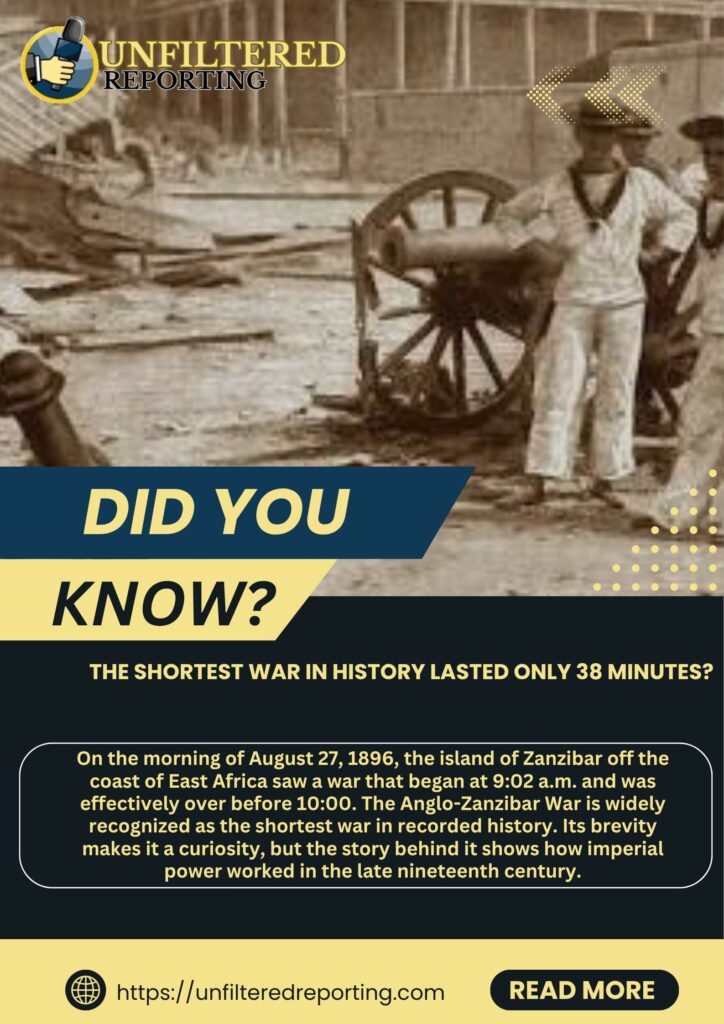



Did You Know: The Shortest War in History Lasted Only 38 Minutes?
On the morning of August 27, 1896, the island of Zanzibar off the coast of East Africa saw a war that began at 9:02 a.m. and was effectively over before 10:00. The Anglo-Zanzibar War is widely recognized as the shortest war in recorded history. Its brevity makes it a curiosity, but the story behind it shows how imperial power worked in the late nineteenth century.
By the 1890s, Zanzibar was a wealthy Indian Ocean sultanate, long a hub of the clove trade and, more darkly, of the East African slave trade. Both Britain and Germany were competing for influence in the region. The 1890 Anglo-German (Heligoland-Zanzibar) Treaty recognized Zanzibar as a British sphere of influence. The sultans kept their thrones, but one condition mattered more than any other: a new sultan could not take power without the approval of the British consul.
On August 25, 1896, Sultan Hamad bin Thuwaini died suddenly. Many suspected poisoning, though this was never proven. Britain wanted his cousin Hamoud bin Mohammed to succeed him. Another cousin, Khalid bin Barghash, had other plans. Within hours, he occupied the palace and declared himself sultan without seeking British approval, a direct challenge to British authority.
The British consul, Basil Cave, demanded that Khalid stand down. Khalid refused and gathered roughly 2,800 men in and around the palace, armed with whatever weapons were available, including artillery and a Gatling gun. Britain assembled naval forces in the harbor under Rear Admiral Harry Rawson, including the cruisers HMS St George and Philomel and the gunboats Thrush and Sparrow. The ultimatum was clear: leave the palace by 9:00 a.m. on August 27 or face bombardment. Khalid did not leave.
At 9:02 a.m., the British ships opened fire. The wooden palace caught fire and parts of it collapsed, and the Sultan’s small vessel, the Glasgow, was sunk in the harbor. The shelling stopped at around 9:40 a.m., after the palace flag came down and the defense collapsed. Sources put the duration between 38 and 45 minutes, with 38 being the most commonly cited figure.
Around 500 people on the Zanzibari side were killed or wounded, many of them palace staff and civilians caught inside the burning buildings. The British side suffered a single injury: a petty officer on one of the gunboats.
Khalid fled to the German consulate, and Germany refused to hand him over. He was smuggled out aboard a German ship to German East Africa (modern Tanzania) and was eventually captured by British forces in 1916. He was exiled to the Seychelles and later lived in Mombasa until his death in 1927. Hamoud bin Mohammed was installed as sultan, and in 1897 Zanzibar formally abolished slavery, a reform Britain had long pressed for.
The war is a stark example of gunboat diplomacy: using naval power to impose political outcomes on weaker states. Zanzibar remained a British protectorate until 1963, then merged with Tanganyika in 1964 to form Tanzania.