



Today in History: The Triumph and Tragedy of the USS Indianapolis
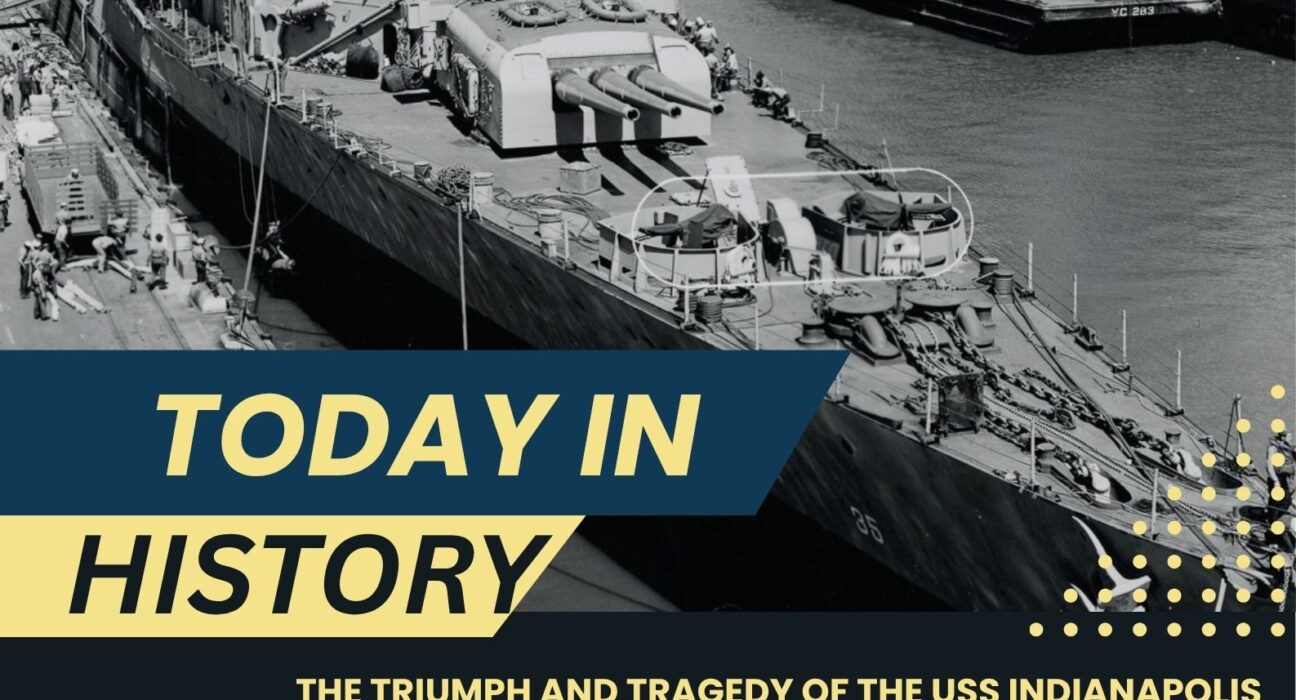
On July 30, 1945, near the closing mark of World War II, one of the most agonizing chapters in naval history began in the middle of the Pacific Ocean.
The Portland-class heavy cruiser USS Indianapolis (CA-35) flagship of the U.S. Fifth Fleet and a decorated veteran of the Pacific Theater was struck by two torpedoes from the Japanese submarine I-58. Within roughly 12 minutes, the vessel capsized and plunged into the ocean, setting off a harrowing four-day struggle for survival that remains the single worst loss of life from a single ship in U.S. Navy history.
Days before the disaster, the Indianapolis completed a top-secret assignment critical to ending the war. Departing San Francisco on July 16, 1945, the ship set a high-speed record across the Pacific to deliver enriched uranium-235 and essential components for “Little Boy” the atomic bomb that would be dropped on Hiroshima on August 6 to the U.S. Army Air Forces base on Tinian Island.
The crew was completely unaware of the nature of their cargo. The delivery was executed without incident on July 26, after which the ship sailed to Guam before heading toward Leyte Gulf in the Philippines to join preparations for the anticipated invasion of the Japanese mainland.
Shortly after midnight on July 30, 1945, positioned roughly halfway to its destination, the cruiser was ambushed. The Japanese submarine I-58, commanded by Mochitsura Hashimoto, launched a spread of torpedoes. Two torpedoes struck the starboard side. The first blew off the bow, and the second hit midship, igniting aviation fuel tanks and bulk ammunition.
The severe structural damage caused rapid flooding. The ship listed heavily, lost power, and sank beneath the surface within 12 minutes. Of the 1,195 men aboard, approximately 300 went down with the vessel. Roughly 900 sailors and marines escaped into the oil-slicked ocean, left floating with a limited number of life rafts and standard-issue life jackets.
What followed was a brutal ordeal of exposure, dehydration, and marine hazards. Due to administrative oversights and classified operations reporting errors, the failure of the Indianapolis to arrive at Leyte on July 31 went unreported, and no search party was dispatched.
Stranded 280 miles from the nearest land, the men endured blistering daytime heat, hypothermia at night, and severe saltwater poisoning as exhaustion led many to drink seawater. Attracted by the noise and explosions, dozens of oceanic whitetip and tiger sharks circled the survivors for days.
On August 2, 1945 four days after the sinking a U.S. Navy PV-1 Ventura aircraft flown by Lieutenant Wilbur “Chuck” Gwinn spotted the survivors while on a routine anti-submarine patrol. Gwinn dropped survival gear and radioed for immediate assistance.
A PBY Catalina flying boat piloted by Lieutenant Commander Adrian Marks landed in high seas to begin pulling men directly out of the water, while naval vessels rushed to the coordinates. Out of the 1,195 men onboard, only 316 survived the ordeal, leaving 879 total casualties.
The news of the tragedy was held by the U.S. Department of War until August 15, 1945, when it was announced concurrently with President Harry S. Truman’s declaration of Japan’s surrender, blunting public shock.
In the aftermath, the ship’s commander, Captain Charles B. McVay III, was court-martialed for failing to zigzag to avoid submarine attacks—making him the only U.S. Navy captain court-martialed for losing a ship in WWII, despite evidence that visibility was poor and his requests for an escort had been denied. Following a campaign led by surviving crew members and researchers, the U.S. Congress passed a joint resolution in October 2000 exonerating Captain McVay, and official records were updated to reflect that he was absolved of blame for the loss of the vessel.