
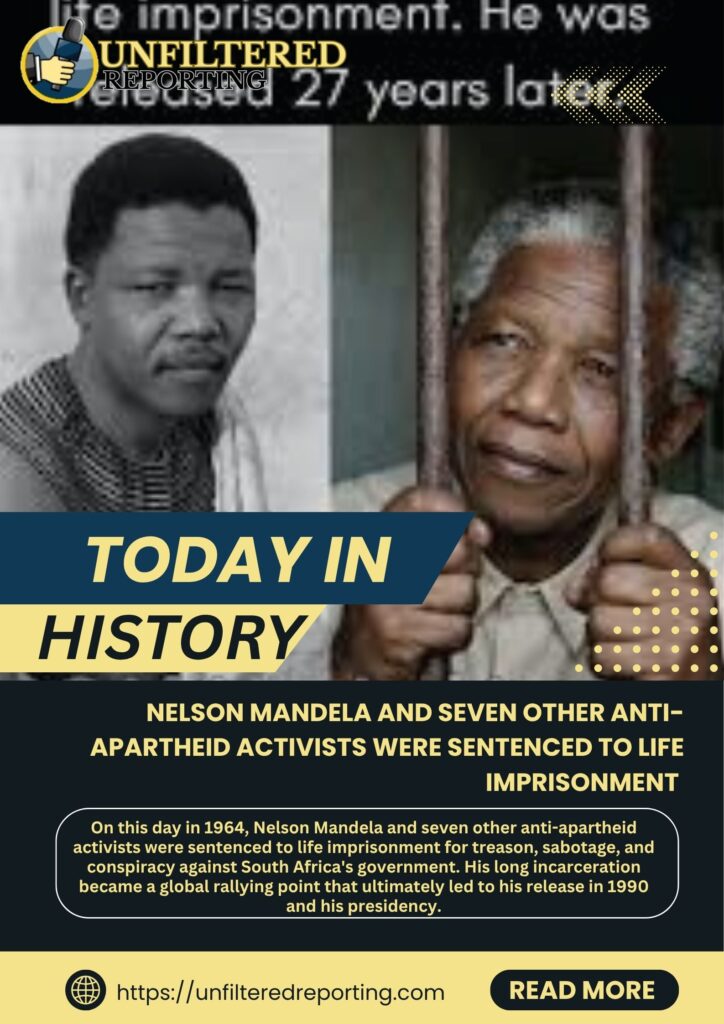
June 12, 1964, was Designed to Erase Nelson Mandela, Allies from History but Accomplished the Opposite
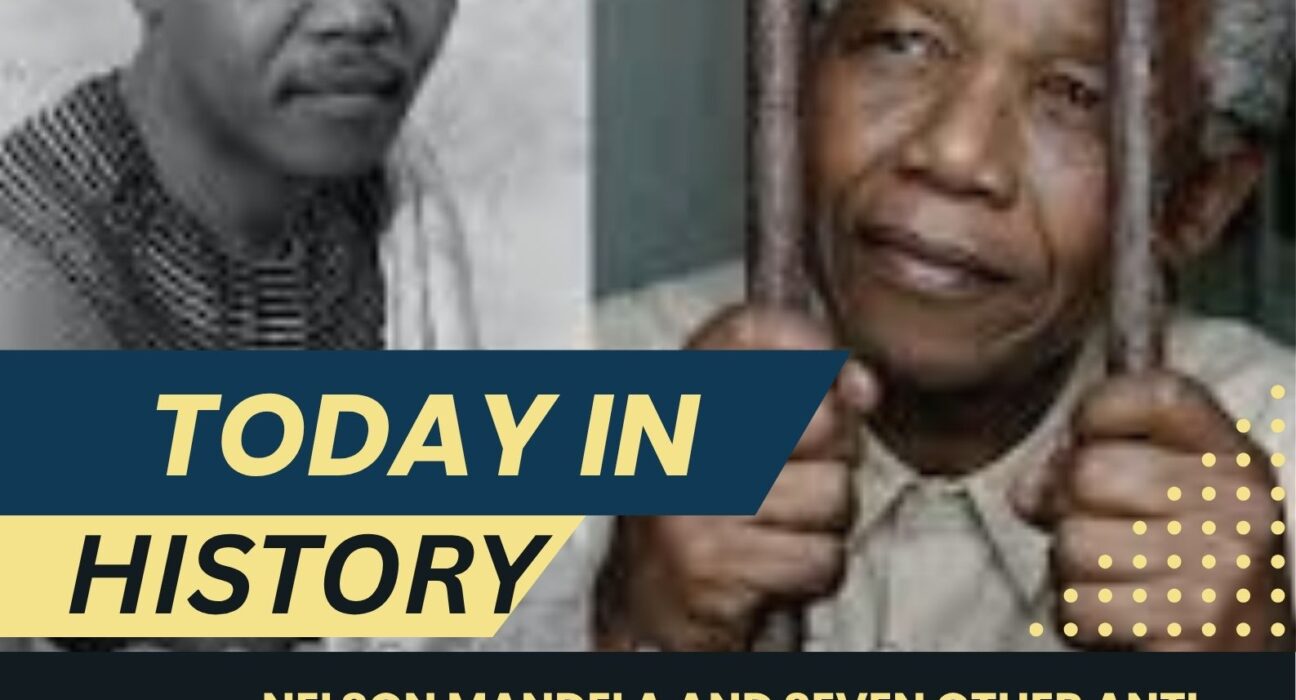
The Rivonia Trial remains one of the most defining moments of the 20th century. What South Africa’s apartheid regime intended to be a permanent silencing of its most potent critics instead became the catalyst for its eventual downfall.
On June 12, 1964, Nelson Mandela and his co-accused were sentenced to life imprisonment. Rather than crushing the anti-apartheid movement, the verdict lit a slow-burning fuse that would ignite global conscience and reshape history.
The path to the June 12 sentencing began nearly a year earlier. On July 11, 1963, South African security forces raided Liliesleaf Farm in Rivonia, a quiet suburb of Johannesburg. The farm had been serving as the secret headquarters for the banned African National Congress (ANC) and its armed wing, Umkhonto we Sizwe (“Spear of the Nation”).
The police captured key leadership figures and uncovered thousands of documents outlining plans for guerrilla warfare, sabotage, and revolution. Ten leaders representing a multi-racial coalition against apartheid were put on trial, facing severe charges that included sabotage targeting infrastructure, treason, conspiracy to overthrow the state, and furthering the objectives of communism.
The state openly sought the death penalty. Realizing that execution was a very real possibility, Mandela and his defense team chose a bold strategy. They opted not to deny the actions or cross-examine state witnesses extensively. Instead, they used the courtroom as a political platform to put the apartheid system itself on trial.
On April 20, 1964, Mandela opened the defense with a commanding four-hour speech that would echo across the decades. He admitted to his role in planning sabotage, explaining that decades of peaceful protest had yielded nothing but increased state violence and a systematic denial of basic human rights.
He concluded with words that defined his life:
“I have fought against white domination, and I have fought against black domination. I have cherished the ideal of a democratic and free society in which all persons live together in harmony and with equal opportunities. It is an ideal which I hope to live for and to achieve. But if needs be, it is an ideal for which I am prepared to die.”
While the global community watched in tense anticipation, Justice Quartus de Wet delivered his sentence. Bowing slightly to immense international pressure including a United Nations resolution calling for amnesty—the judge spared the men the gallows, sentencing them instead to life imprisonment.
Eight activists were convicted, including Nelson Mandela, Walter Sisulu, Denis Goldberg, Govan Mbeki, Raymond Mhlaba, Elias Motsoaledi, Andrew Mlangeni, and Ahmed Kathrada. Goldberg, as the only white activist convicted, was sent to a separate Pretoria prison facility, while Mandela and the majority of his comrades were immediately flown to Robben Island. This harsh, isolated penal colony off the coast of Cape Town was intended by the state to be their final resting place.
The apartheid government’s victory was entirely short-lived. By isolating these leaders, they inadvertently created a powerful symbol. Over the next twenty-six years, the struggle grew from a localized rallying cry into a massive international campaign.
The image of Mandela locked away on Robben Island became the ultimate personification of the fight against institutionalized racism. It drove global economic sanctions, cultural boycotts, and relentless diplomatic pressure that eventually made the apartheid state untenable.
When Mandela finally walked out of Victor Verster Prison on February 11, 1990, it wasn’t as a defeated convict, but as a triumphant statesman. Just four years later, in 1994, he was elected South Africa’s first Black president in its first fully democratic election.