



Mosquitoes Reach Iceland for the First Time, Ending Its Status as Last Mosquito-Free Nation on Earth
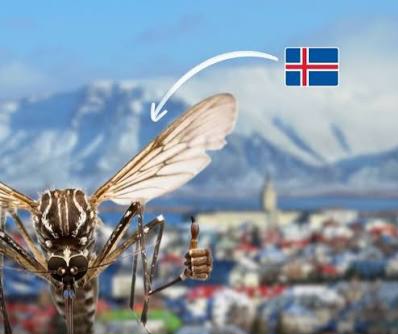
Iceland, for centuries the last place on Earth where humans could live without ever being troubled by a mosquito, has lost that remarkable distinction.
Three specimens of the species Culiseta annulata were discovered in a garden in Kiðafell, in the Kjós region just north of the capital Reykjavík, in October 2025 the first confirmed detection of wild mosquitoes ever recorded on Icelandic soil. With their arrival, Antarctica now stands as the only mosquito-free landmass remaining on the planet.
The discovery was made by a local resident, Björn Hjaltason, who had set out a ribbon soaked in red wine as a lure for moths on his farm one October evening. What he caught instead was something Icelanders had never encountered in the wild before one male and two female mosquitoes. The insects were sent to the Natural Science Institute of Iceland, where entomologist Matthías Alfreðsson examined and identified them, delivering a finding that biologists had long anticipated but never been able to confirm.
The Natural Science Institute formally announced the discovery on October 21, 2025.
For generations, scientists were asked why Iceland had no mosquitoes while virtually everywhere else on Earth did. The answer lay in the island’s uniquely punishing climate not simply its cold, but its volatility. Iceland’s winters do not hold steady; they oscillate between mild spells and sudden freezes, a rhythm that proved lethal to mosquito larvae. When temperatures briefly rose, mosquito pupae would stir and begin developing, only to be wiped out when the cold returned before the life cycle could complete. That freeze-thaw instability functioned, in effect, as a natural kill switch for millennia. Iceland’s remote position in the middle of the North Atlantic, hundreds of miles from the nearest landmass, made natural colonisation nearly impossible as well.
What allowed Culiseta annulata to beat that system is its unusual ability to overwinter as adults rather than as eggs or larvae in standing water.
The species shelters in enclosed human-made structures barns, basements, outbuildings waiting out the cold in an already fully-developed state. When warmth returns, it is immediately ready to feed and reproduce, bypassing the vulnerable developmental stages that Iceland’s erratic climate had always destroyed.
Scientists believe the insects’ arrival is likely linked to a combination of rising Arctic temperatures and the expansion of human activity, including aviation and tourism routes that increasingly connect Iceland to parts of Europe where the species is common.
Scientists writing in the journal Science described the arrival of mosquitoes in Iceland not merely as a biological curiosity but as a warning signal. The Arctic is currently warming at roughly four times the global average rate, and Iceland experienced record-breaking heat in 2025.
Researchers from the University of Texas at Austin and Dartmouth College argued that the development reflects a broader ecological shift already underway, with insect species moving across the Arctic in new ways and at unprecedented scales.
They called for a coordinated international monitoring system to track arthropod changes across the region before their consequences for ecosystems, wildlife and human health become impossible to manage. Culiseta annulata is not known to carry diseases that affect humans, but scientists warned that its establishment could open the door to other, more dangerous species expanding northward as the climate continues to warm.