

Iran Claims Significant Missiles Capabilities Intact, Claims Airspace Control
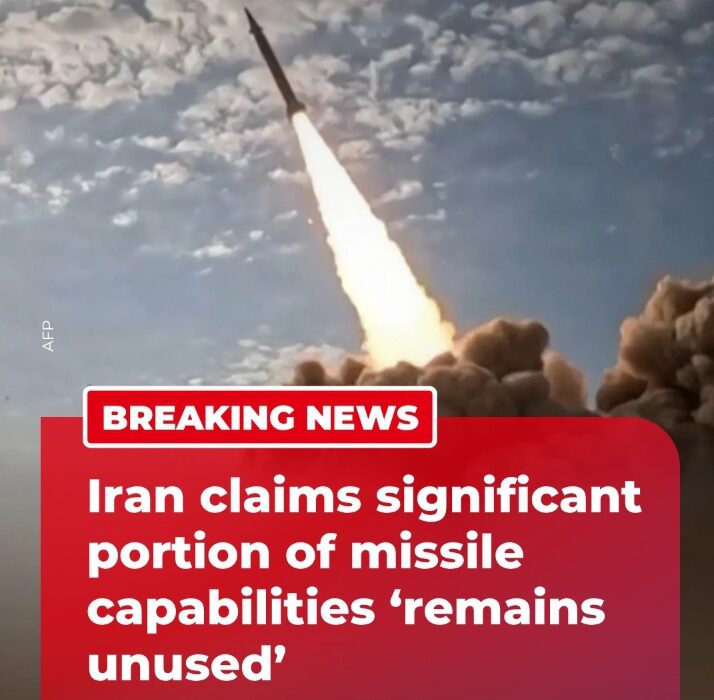
Iranian Defence Ministry spokesman Brigadier General Reza Talaei-Nik has stated that a “significant portion” of the country’s missile capabilities remains unused following recent hostilities with the United States and Israel.
The remarks were carried by Iran’s semi‑official Tasnim news agency and other state‑affiliated outlets.
Talaei‑Nik also asserted that the Iranian armed forces “maintained complete control over the skies of the occupied territories” until the moment a ceasefire came into effect.
According to Tasnim, Iranian forces held the upper hand throughout the conflict and that only “a portion” of the country’s missile arsenal was employed during the fighting.
The spokesperson used the announcement to highlight Iran’s domestic military production. He noted that more than 1,000 types of weapons are currently manufactured entirely inside the country and that around 9,000 companies are cooperating with the armed forces and the defence ministry.
Talaei‑Nik described this capacity as the result of “more than 25 years of investment and preparation in the defence industry, to the extent that even if some facilities are damaged, the process of production and support continues across the country’s geographical expanse.”
He also addressed maritime confrontations, claiming that hostile warships repeatedly retreated hundreds of kilometres from the Sea of Oman in response to actions by Iranian forces. Shipping through the Strait of Hormuz has been severely disrupted since the US and Israel initiated military operations against Iran on 28 February, rattling global energy markets and raising fears of prolonged economic damage.
Iran has closed the strait to all traffic in retaliation for what it calls an illegal American blockade, which Talaei‑Nik described as “a lever of control for realising the demands of the Iranian nation.”
According to the spokesman, the armed forces have forced enemy vessels to retreat in the Gulf of Oman on repeated occasions by implementing “smart and thorough control” over the chokehold.
The conflict began on 28 February when the US and Israel launched military strikes against Iran. On the same day, Iranian Supreme Leader Ali Khamenei was killed in the attacks. In retaliation, Iran fired missile and drone barrages at Israel and other regional countries hosting US military assets.
A two‑week ceasefire was agreed on the night of 8 April, and subsequent negotiations mediated by Pakistan were held in Islamabad on 11‑12 April. As Foreign Minister Syed Abbas Araghchi arrived in the Pakistani capital on 25 April for new bilateral talks—including a possible meeting with US negotiators Steve Witkoff and Jared Kushner—the military’s statement was widely seen as a signal that Tehran retains considerable firepower even as diplomatic channels reopen.
The message came as a new assessment by the US‑based Institute for the Study of War reported that Islamic Revolutionary Guards Corps (IRGC) Commander Brigadier General Ahmad Vahidi and his inner circle have repeatedly blocked attempts by Parliament Speaker Mohammad Bagher Ghalibaf and other pragmatic officials to push the Iranian regime toward a more flexible negotiating position. Despite that internal friction, the United States confirmed that Witkoff and Kushner would travel to Pakistan on 26 April to take part in “a new round of talks” with Iranian officials.