
From Fuel Queues to Domestic Refining: President Ruto’s Assessment of Nigeria’s Energy Transition
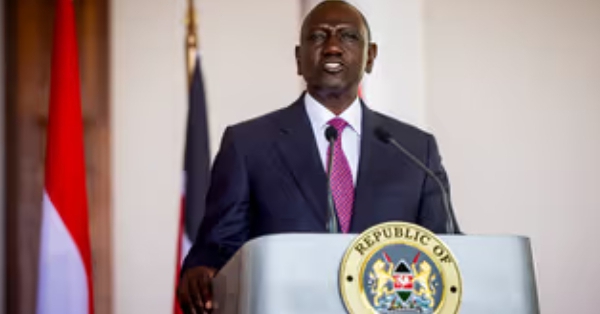
On April 23, 2026, during the Africa We Build Summit in Nairobi, Kenyan President William Ruto delivered a pointed remark about Nigeria’s long-standing energy paradox. His statement, which quickly circulated across the continent, captured a decades-long failure of policy and a singular private intervention that sought to resolve it.
Speaking before an audience of African leaders and investors, Ruto contrasted Nigeria’s oil wealth with the lived reality of its citizens, using the Dangote Refinery as a case study for homegrown industrial solutions.
President Ruto began by framing the central contradiction of Africa’s most populous nation—an irony familiar to many across the continent. He noted that Nigeria’s status as a crude oil producer had for decades failed to translate into energy security for its own citizens.
“Nigeria has been a producer of oil for as long as we can remember. Yet not long ago, people in Nigeria queued for hours at petrol stations in search of fuel. This persisted for years—until an African stepped forward to change the narrative.”
Ruto’s observation was grounded in verifiable reality. Despite ranking as Africa’s largest oil producer and a member of OPEC, Nigeria had for decades been almost entirely reliant on imported refined petroleum products. This dependency stemmed from the prolonged dysfunction of its state-owned refineries in Port Harcourt, Warri, and Kaduna, which remained largely moribund for years. For much of 2024 and into 2025, cyclical fuel shortages remained a recurring feature of Nigerian life. In February 2024, long queues and frustration extended across Lagos as a fresh round of scarcity hit the metropolis, with many filling stations shut to motorists. By August 2024, the crisis had deepened, with gridlocks forming around petrol stations and pump prices surging as high as N1,000 per litre.
The underlying economics of this system were punishing. To keep pump prices artificially low, the Nigerian government had for years maintained an opaque fuel subsidy regime. President Bola Tinubu ended this practice in his inauguration address on May 29, 2023, a move that instantly tripled petrol prices overnight from less than N300 to over N600 per litre. While the removal was framed as a necessary reform, it initially exacerbated the pain for consumers already weary of the country’s dysfunctional supply chain.
It is within this context that Ruto placed Dangote’s intervention, arguing that the answer to the crisis was not imported from Europe or Asia but came from within the country itself.
“That African is Aliko Dangote, who built the Dangote Refinery. The solution to Nigeria’s long-standing fuel challenge did not come from Europe or Asia—it came from within Nigeria itself.”
Construction of the Dangote Refinery began in 2016 in the Lekki Free Economic Zone in Lagos. The sheer scale of the project was unprecedented: a single-train facility with a capacity to process 650,000 barrels of crude oil per day, making it Africa’s largest oil refinery and the world’s largest single-train refinery. After years of delays, the refinery was formally commissioned in May 2023 and commenced production of diesel, kerosene, and aviation fuel on January 12, 2024. By February 2026, it had reached its initial nameplate capacity of 650,000 barrels per day.
The economic impact was immediate and measurable. By the end of 2025, the combined output of the Dangote Refinery and other smaller domestic facilities had begun to displace imports, with domestic refineries supplying roughly 37.53 per cent of the country’s petrol demand. The financial benefits were also clear: Nigeria’s petrol import bill crashed by 54 per cent in the first quarter of 2025 as local supply improved. By February 2026, a single month had seen Dangote meet approximately 92 per cent of the nation’s petrol demand.
The transformation on the ground was tangible. By late 2025, long fuel queues had largely disappeared, and the downstream sector was shifting from a scarcity-driven market to one where competition increasingly determined price. In December 2025, the Dangote Refinery slashed its ex-depot petrol price from N828 to N699 per litre, triggering a broader price war that pushed pump prices downward across the country.
As Ruto emphasized, the lesson extended beyond Nigeria’s borders. He argued that this single project proved Africa possessed the necessary leadership, industrial capacity, and financial strength to transform its own economic trajectory without waiting for foreign intervention.
Challenges on the Path to Full Sufficiency
Despite these gains, the story of the Dangote Refinery is not one of unqualified success. The structural dysfunction of Nigeria’s energy sector has proven resilient, and the refinery’s operations have been consistently hampered by local challenges. The most persistent has been the chronic shortfall of crude oil supply from the state-owned Nigerian National Petroleum Company (NNPC).
According to Dangote Refinery CEO David Bird, the facility was expected to receive between 13 and 15 crude cargoes monthly under a naira-for-crude arrangement, but was receiving only about five, creating a crippling supply gap. To bridge this deficit, the refinery has been forced onto the international spot market at significant premiums, including paying as much as $18 more per barrel for Nigerian crude than the prevailing market price. Between October 2025 and mid-March 2026, the facility experienced a crude supply shortfall of approximately 79.53 million barrels, representing an estimated $5.40 billion in crude value it could not access.
This supply constraint has direct consequences for consumers. In a briefing in Lagos, Bird noted that the refinery had voluntarily absorbed 20 per cent of rising global crude costs, but 80 per cent of that increase was passed to marketers and ultimately to consumers, contributing to petrol prices ranging between N1,200 and N1,300 per litre in major cities by mid-2026.
Moreover, the downstream market remains contested. In 2025, despite the Dangote Refinery’s operations, imports still accounted for roughly 62.47 per cent of total petrol consumption. A fierce price war erupted between the refinery and established importers, with Dangote cutting prices repeatedly—20 times in a single year by December 2025—to squeeze out competing imports. In response, importers and marketers have accused the Dangote Group of leveraging its market power to fix prices and create a quasi-monopoly in the downstream sector, charges the company has denied.
President Ruto’s April 2026 address was a testament to a new industrial narrative for the continent. In the Dangote Refinery, he saw a blueprint—a proof of concept that private African capital could resolve infrastructure gaps that had long defied state-led fixes. Yet the story also carries a cautionary note: the refinery has demonstrated its technical capability to meet Nigeria’s full demand, but its potential remains constrained by the very policy and supply failures it was built to overcome. The solution to Nigeria’s energy crisis may indeed reside in Nigeria, but unlocking it fully will require not only industrial capacity but also the political and regulatory coherence to support it.
As Ruto told the delegates in Nairobi:
“Right here in this room, we have the political leadership, the industrial capacity, and the financial strength needed to transform our continent. We must stop looking elsewhere and start acting now.”
Whether Africa heeds that call will determine whether the Dangote Refinery remains an exception or becomes a model for the continent’s industrial future.