



US Talk of Greenland Acquisition Tests NATO Unity as Allies Downplay Invasion Fears
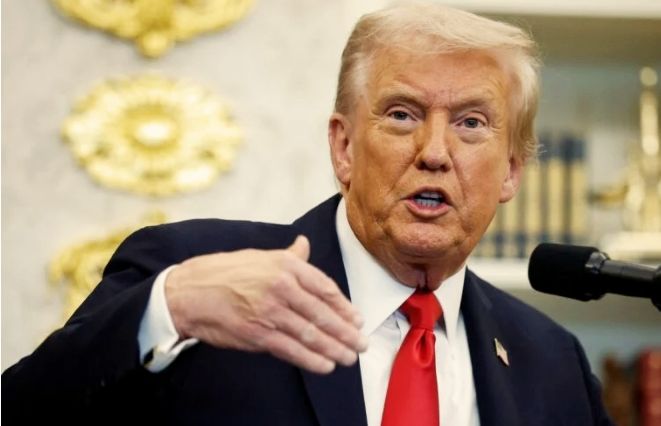
Fresh remarks from the White House suggesting that President Donald Trump is weighing options, including the possible use of military force, to take control of Greenland have reignited concerns in Europe about the future of the NATO alliance.
While Washington insists no decision has been taken, the renewed focus on the mineral-rich Arctic territory has unsettled allies, particularly Denmark, which retains sovereignty over Greenland.
Copenhagen has warned that any attack on a NATO member would fundamentally undermine the alliance that has anchored Western security for more than 70 years.
At the centre of the controversy is whether the administration’s language reflects a genuine plan or a negotiating tactic aimed at exerting pressure.
Trump’s interest in Greenland is not new. The semi-autonomous territory, which hosts a US military base and is strategically located in the Arctic, has been on his radar since his first term. However, officials say the tone from Washington has recently hardened.
Following the president’s military intervention in Venezuela, European capitals were rattled by his renewed insistence that the United States should control Greenland. The White House has since framed the issue as a security imperative.
“The president and his team are discussing a range of options to pursue this important foreign policy goal, and of course, utilising the US military is always an option,” White House Press Secretary Karoline Leavitt said Tuesday.
Her comments came despite firm opposition from Denmark and public backing for Copenhagen from several European leaders.
Despite the rhetoric, many analysts and officials believe actual military action against Greenland remains improbable. Unlike Venezuela, Denmark is a close US ally, and any use of force would trigger a profound crisis within NATO.
French President Emmanuel Macron dismissed the likelihood of such a move, saying he could not “imagine a scenario” in which the United States would breach Danish sovereignty.
Under NATO’s Article Five, an attack on one member is considered an attack on all. Any US assault on Greenland would therefore strike at the core of the alliance itself, an outcome widely viewed as unthinkable.
Moreover, the United States already has significant latitude in Greenland. Existing agreements with Denmark allow Washington to expand its military presence on the island if it chooses.
“We don’t believe he would, there is no need, the US can get any access they want from Denmark,” a senior NATO diplomat told AFP, speaking on condition of anonymity. “But given the persistent rhetoric, we can’t be entirely sure.”
So far, there has been no evidence of the type of military buildup that preceded US action in Venezuela. US media reports suggest diplomatic routes remain the preferred option, with Secretary of State Marco Rubio telling lawmakers that Trump favours purchasing Greenland rather than seizing it.
“I hope the Danes, the Greenlanders and the Americans will sit around a fire somewhere and an outcome will be reached,” another NATO diplomat said.
NATO has largely avoided formal involvement in the Greenland dispute, wary of deepening internal divisions at a time when unity is critical.
“I don’t think this issue will ever be brought up in a NATO framework in order to avoid any divisions,” a third NATO diplomat said.
With Russia’s war in Ukraine ongoing, European members are particularly cautious about anything that could weaken US engagement in the alliance.
NATO Secretary General Mark Rutte has sought to redirect the debate by stressing shared concerns about security in the Arctic, especially regarding Russia and China, arguments Trump has cited to justify his interest in Greenland.
“The Danes are totally fine if the US would have a bigger presence than they have now,” Rutte told CNN. “We have to make sure that the Arctic stays safe.”
While NATO treads carefully, some European governments are considering a firmer response. French Foreign Minister Jean-Noel Barrot said Paris is consulting with Germany and Poland on possible next steps.
Behind the scenes, there is growing concern that even raising the possibility of coercion against an ally could have lasting consequences for the alliance.
“No one has any interest in a quarrel within NATO, except our enemies,” Belgian Defence Minister Theo Francken said. “I’m convinced initiatives will be taken in the coming days, behind the scenes or in the open, to resolve this situation.”
For now, diplomats say the crisis remains more rhetorical than real. But they acknowledge that the continued uncertainty surrounding Trump’s intentions has already placed new strain on an alliance facing its most challenging geopolitical moment in decades.