

Holocaust: The Back Chapter of The Jew
Holocaust: The Back Chapter of The Jew
The Holocaust, also referred to as the Shoah, represents one of the most horrific periods in human history. It was the state-sponsored, systematic persecution and murder of approximately six million European Jews by the Nazi regime and its collaborators. Between 1933 and 1945, the German government, led by Adolf Hitler, utilized the full power of the state to dehumanize and eventually eliminate an entire population based on a radicalized ideology of racial purity.
The roots of this tragedy were planted long before the first death camp was built. Centuries of European antisemitism provided a foundation for Nazi propaganda, which portrayed Jewish people as a “parasitic” threat to the so-called “Aryan race.” Following Germany’s defeat in World War I and the subsequent economic collapse of the Great Depression, the Nazi Party exploited national frustration by scapegoating Jews for the country’s misfortunes, turning ancient prejudices into a central pillar of government policy.
When Adolf Hitler rose to power in 1933, the persecution began through legal and social exclusion. The Nuremberg Laws of 1935 stripped Jewish people of their citizenship and forbade them from marrying or even working alongside non-Jewish Germans. This “legal” phase of the Holocaust was designed to isolate Jews from the social, economic, and political life of the country, making them “outsiders” in their own homes and setting the stage for more violent actions.
State-sponsored violence became overt during Kristallnacht, or the “Night of Broken Glass,” in November 1938. Throughout Germany and Austria, Nazi supporters burned synagogues, looted Jewish-owned businesses, and arrested thousands of Jewish men. This event signaled a transition from discriminatory legislation to physical brutality, proving that the Nazi state would no longer protect its Jewish residents from public violence and destruction.
As World War II began in 1939, the Nazi regime expanded its reach across Europe, bringing millions more Jews under its control. In occupied territories, particularly in Poland and the Soviet Union, Jews were forced into ghettos overcrowded, walled-off sections of cities where they faced starvation, disease, and forced labor. These ghettos were not intended as permanent residences but as temporary holding centers for a population the Nazis intended to disappear.
The transition to mass murder began with the invasion of the Soviet Union in 1941. Mobile killing units known as Einsatzgruppen followed the German army, carrying out mass shootings of Jewish communities in pits and ravines. While these units murdered more than a million people, the Nazi leadership sought a more “efficient” and less psychologically taxing method for their soldiers to carry out the genocide, leading to the development of gas chambers.
At the Wannsee Conference in 1942, high-ranking Nazi officials coordinated the logistics for the “Final Solution to the Jewish Question.” This was the formal plan to deport Jews from across Europe to specialized extermination camps in occupied Poland. Unlike concentration camps, which were primarily for forced labor and imprisonment, extermination camps like Treblinka and Belzec were designed specifically as “death factories” where the primary activity was mass murder.
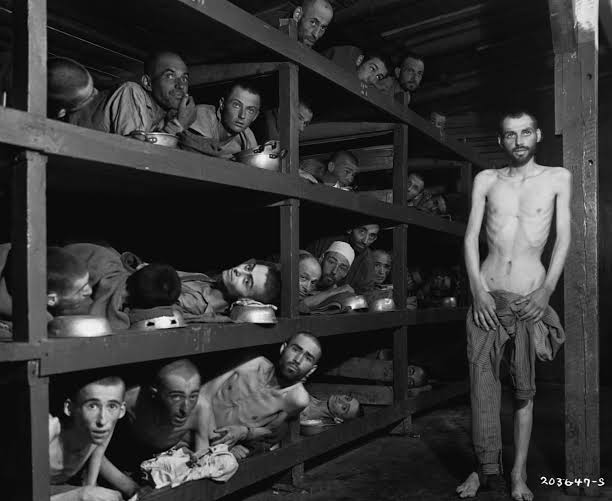
Auschwitz-Birkenau stands as the most notorious symbol of this industrial-scale killing. It functioned as both a labor camp and an extermination center, where victims were “selected” upon arrival. Those deemed unfit for work, including children and the elderly, were sent immediately to gas chambers. At its peak, thousands were murdered every day, their bodies cremated in massive ovens, illustrating the cold, mechanical nature of the Nazi genocide.
While the Jews were the primary targets, the Holocaust also claimed the lives of millions of others deemed “undesirable” by the Nazi state. This included the Roma and Sinti people, individuals with physical and mental disabilities, Soviet prisoners of war, Jehovah’s Witnesses, and members of the LGBTQ+ community. This broader campaign of terror demonstrated the regime’s intent to violently re-engineer society by eliminating anyone who did not fit their narrow definition of the “master race.”
The Holocaust finally ended as Allied forces liberated the camps in 1945, discovering the unimaginable evidence of the atrocities. The survivors, many of whom had lost their entire families and homes, faced a long and painful road to recovery. Today, the world remembers the Holocaust through the vow of “Never Again,” serving as a permanent warning of the consequences of unchecked hatred and the fragility of human rights when faced with state-sponsored extremism.