
Turkish Defence Minister, Military Chief Attend Burial Ceremony at Airbase near Ankara.
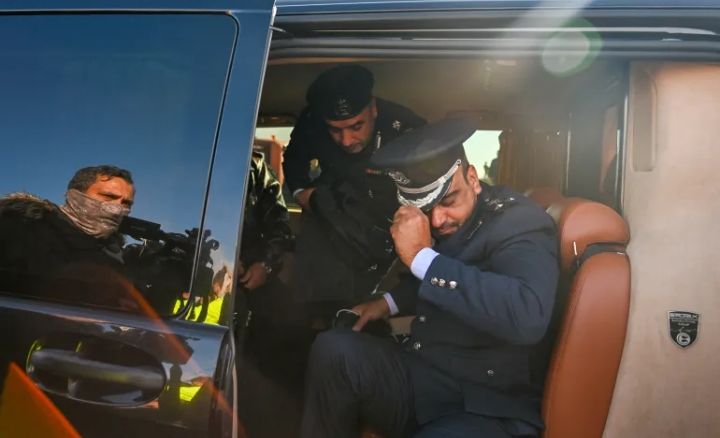
Turkish Defence Minister, Military Chief Attend Burial Ceremony at Airbase near Ankara.
Libya has held a military ceremony for senior military officers, including army chief of staff Mohammed Ali Ahmed al-Haddad, killed in a plane crash in Turkiye earlier this week.
The bodies of eight victims arrived at the Defence Ministry in Tripoli for the military ceremony after a similar event was held in Turkiye earlier on Saturday.
The officers were returning from high-level defence talks in Ankara when their aircraft went down on Tuesday shortly after takeoff due to what Libyan officials described as a technical malfunction.
Al-Haddad, Libya’s highest-ranking military officer, was a key figure in United Nations-brokered efforts to unify the country’s divided armed forces.
His death has drawn condolences even from rival factions.
“Haddad was this strong, charismatic leader who always sought peace in the country,” said Al Jazeera’s Malik Traina, reporting from al-Haddad’s hometown of Misrata. He was “a man of peace, well-respected across the country, even among people he fought against.”
Khalifa Haftar, head of eastern Libya’s rival administration whose forces al-Haddad opposed during a 2019 advance on western Libya, was among those who extended sympathies.
In a statement, Haftar expressed “deep sorrow over this tragic loss” and offered condolences to al-Haddad’s family and “to all the Libyan people”.
Earlier on Sunday, Turkiye held a military ceremony at Murted airbase outside Ankara to honour the delegation.
Turkish military chief Selcuk Bayraktaroglu and Defence Minister Yasar Guler attended the ceremony before five coffins draped in Libyan flags were loaded onto a plane for repatriation.
Bayraktaroglu accompanied the bodies back to Libya, according to Turkiye’s public broadcaster TRT.
Libya plunged into chaos following the 2011 uprising that toppled longtime dictator Muammar Gaddafi. The country remains split between rival administrations in the east and west, backed by rogue militias and different foreign governments.
Turkiye has been the main backer of Libya’s western government but has recently taken steps to improve ties with the eastern-based administration as well.
Traina said it will be “extremely difficult” for Libya’s western government to find someone as respected to replace al-Haddad, who had chaired a UN-backed truce committee. “They are extremely big shoes to fill.”