


My Intervention Was Crucial in Nvidia CEO Jensen Huang’s Return, Says Trump
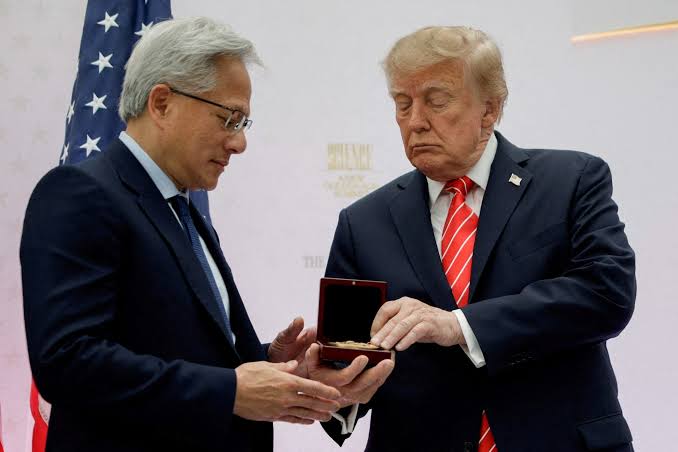
United States President Donald Trump has said his intervention played a significant role in the decision by Nvidia’s board to reinstate Jensen Huang as the company’s Chief Executive Officer, adding that he personally spoke with the technology executive before the announcement.
Trump made the remarks during a telephone interview with CNBC on Monday, where he disclosed that he had communicated directly and indirectly with members of Nvidia’s board to encourage them to bring Huang back.
“I believe my intervention was very important,” Trump said, expressing confidence that the board would not have reinstated Huang without his involvement.
The President revealed that he spoke with Huang on Sunday night, shortly before the company announced his return to the position.
Trump also disclosed that he had been represented at the board meeting where the decision was reached, although he did not explain who represented him.
According to him, Nvidia’s directors had requested assurances concerning national security implications surrounding Huang’s return, adding that his administration provided the necessary guarantees based on the information available to government officials.
“They did ask for assurance on the national security threat, and we gave them assurance at least with everything we know, and we know a lot,” Trump said.
He explained that his intervention was not solely motivated by concerns about Nvidia’s immediate business performance but also by the company’s long-term importance to the American economy and technology industry.
Trump acknowledged that the recent decline in financial markets following Huang’s departure may have influenced his thinking, but maintained that the broader significance of retaining the executive was more important.
The President also disclosed that Vice President JD Vance, Treasury Secretary Scott Bessent and Commerce Secretary Howard Lutnick participated in discussions surrounding the decision.
He praised the officials for their contributions, describing their involvement as important in securing the board’s decision.
Trump further argued that Huang’s absence could have created difficulties for Nvidia and the wider American technology sector, particularly given the company’s importance in the development of artificial intelligence.
He maintained that retaining the executive was necessary to protect the company’s position and sustain America’s technological advantage.
Nvidia announced Huang’s reinstatement on Monday, following his resignation on November 12 amid reports of multiple extramarital affairs, including allegations involving a woman suspected by US intelligence officials of having links to Chinese intelligence.
The company’s board said it had received input from senior levels of the US government and was confident that Huang’s return did not present a national security threat.
Huang, who co-founded Nvidia, was subsequently restored as the company’s president, CEO and board member.
The decision came after several prominent technology figures and investors publicly supported his return, arguing that his leadership was central to Nvidia’s success.
Nvidia shares surged following the announcement, rising by more than 30 per cent and contributing to a broad recovery across the US stock market.
However, the reinstatement has attracted questions from lawmakers in both political parties, particularly over the national security assurances provided to the company and the extent of the government’s involvement in its internal corporate decisions.
Some lawmakers have also raised concerns about Nvidia’s compliance with US export restrictions governing the sale of advanced artificial intelligence chips to China.
Huang is expected to appear before congressional committees in December to answer questions relating to the company’s activities and national security concerns.
The company’s board has also indicated that its investigation into the issues surrounding Huang will continue.