

Netanyahu Faces Crucial Election Test as Israeli Voters Weigh War, Leadership
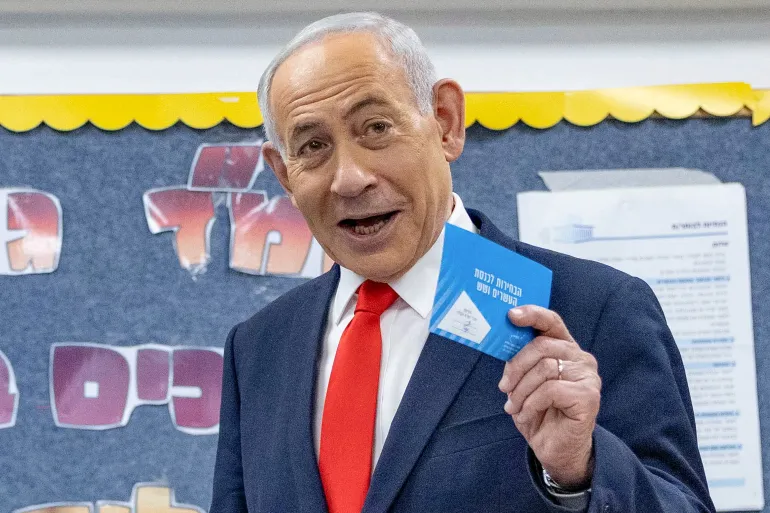
Israeli Prime Minister, Benjamin Netanyahu is facing a critical test of his political future as voters cast ballots in a closely contested election shaped by the October 2023 Hamas attack, years of war and uncertainty over the formation of the next government.
Netanyahu’s Likud party and its right-wing allies are battling a rival political bloc led by former military chief of staff Gadi Eisenkot, with opinion polls indicating a tight contest and neither side appearing certain of securing enough parliamentary support to govern without difficult coalition negotiations.
Polling stations opened at 7am local time and are scheduled to close at 10pm, with about 7.3 million Israelis eligible to vote, including an estimated 330,000 first-time voters.
The election represents one of the most consequential political contests of Netanyahu’s long career. Despite criticism over the security failures surrounding the October 7, 2023 attack and the subsequent wars, he retains a strong base of support among right-wing voters and remains a dominant figure in Israeli politics.
Netanyahu has made his record during the country’s conflicts a central theme of his campaign, while also emphasising his relationship with US President Donald Trump.
Speaking on Sunday, Netanyahu said Trump could take further action against Iran to eliminate what he described as the Iranian threat, while suggesting that developments could be influenced by the outcome of the Israeli election.
Eisenkot, however, accused Netanyahu of relying on what he described as fear, falsehoods and threats during the campaign. He argued that Trump would work with whichever leader Israeli voters elect.
A key challenge for Netanyahu will be rebuilding a governing coalition if his bloc fails to win enough seats for a parliamentary majority.
He could once again depend on far-right politicians Itamar Ben-Gvir and Bezalel Smotrich, whose parties have played important roles in his governing coalition.
Both men have faced sanctions from Western governments over allegations concerning support for or encouragement of violence against Palestinians. Ben-Gvir’s Jewish Power party has nevertheless shown increased support in some opinion polls.
The Israeli parliament, the Knesset, has 120 seats, meaning coalition negotiations will be crucial if neither political camp secures enough support to form a government.
If no bloc succeeds in assembling a governing coalition, Netanyahu could remain as caretaker prime minister while efforts continue to form a new administration or until another election is called.
The election follows a period of intense political and social division that began with the Hamas-led assault on Israel on October 7, 2023.
The attack killed about 1,200 people and resulted in the abduction of 251 others, according to Israeli figures. Israel subsequently launched a major military campaign in Gaza, where local health authorities say Israeli operations have killed about 74,000 people.
The conflict has since extended beyond Gaza, with Israel conducting military operations against Iran-backed Hezbollah in Lebanon and engaging in direct exchanges of fire with Iran.
Israel also launched a 12-day campaign against Iranian nuclear facilities in 2025, followed by a joint US-Israeli war against Iran this year.
For Netanyahu’s opponents, the government’s handling of the October 7 attack remains a central electoral issue.
Critics have demanded an independent national inquiry into the circumstances surrounding the assault, which became the deadliest day in Israel’s history.
Mali Hajaj, an Education Ministry employee supporting Eisenkot, said such an investigation was necessary for the country to confront the failures surrounding the attack and begin the process of recovery.
Another voter, Lisa Tortor, said she wanted Netanyahu to leave office so a new government could address what she described as the damage inflicted on Israel, its citizens and Jews abroad.
Netanyahu’s supporters, however, reject efforts to place responsibility for the attack on the prime minister.
Eighteen-year-old Likud supporter Nof Gabay defended Netanyahu, describing him as the right leader for Israel and arguing that he had handled the war as effectively as possible.
Eisenkot has positioned himself as an alternative to Netanyahu while maintaining a hard line on Israel’s security.
He has said the next government must prevent Iran from obtaining a nuclear weapon, either through military measures or through a diplomatic agreement backed by the United States.
Like most major Jewish-led political parties in Israel, Eisenkot does not support the two-state solution that has underpinned decades of international efforts to resolve the Israeli-Palestinian conflict.
He has nevertheless criticised violence by Jewish settlers against Palestinians in the occupied West Bank, where attacks have increased since 2023 and contributed to tensions between Israel and several Western governments.
Eisenkot has also opposed Netanyahu’s reliance on Ben-Gvir and Smotrich as coalition partners.
Meanwhile, some traditional Likud supporters have become increasingly critical of Netanyahu. Activists opposed to his continued leadership have reportedly been campaigning in neighbourhoods and speaking directly with voters in an effort to weaken his support.
Netanyahu is also facing an ongoing corruption trial involving allegations that he committed offences while in office. He has denied wrongdoing.
The turnout among Arab citizens of Israel could further complicate the coalition arithmetic. Many Arab Israelis are of Palestinian descent, and a strong turnout from the community could affect the distribution of parliamentary seats and potentially strengthen Eisenkot’s ability to challenge Netanyahu.
Although Eisenkot has ruled out forming a formal alliance with Arab political parties, citing ideological differences, analysts say Arab lawmakers could potentially support a minority government if doing so helped bring an end to Netanyahu’s tenure.
Political analyst Amotz Asa-El of the Shalom Hartman Institute predicted a narrowly divided result, saying neither side appeared likely to secure a decisive victory.
“I expect only a narrow majority for either side, rather than a decisive victory,” he said.