
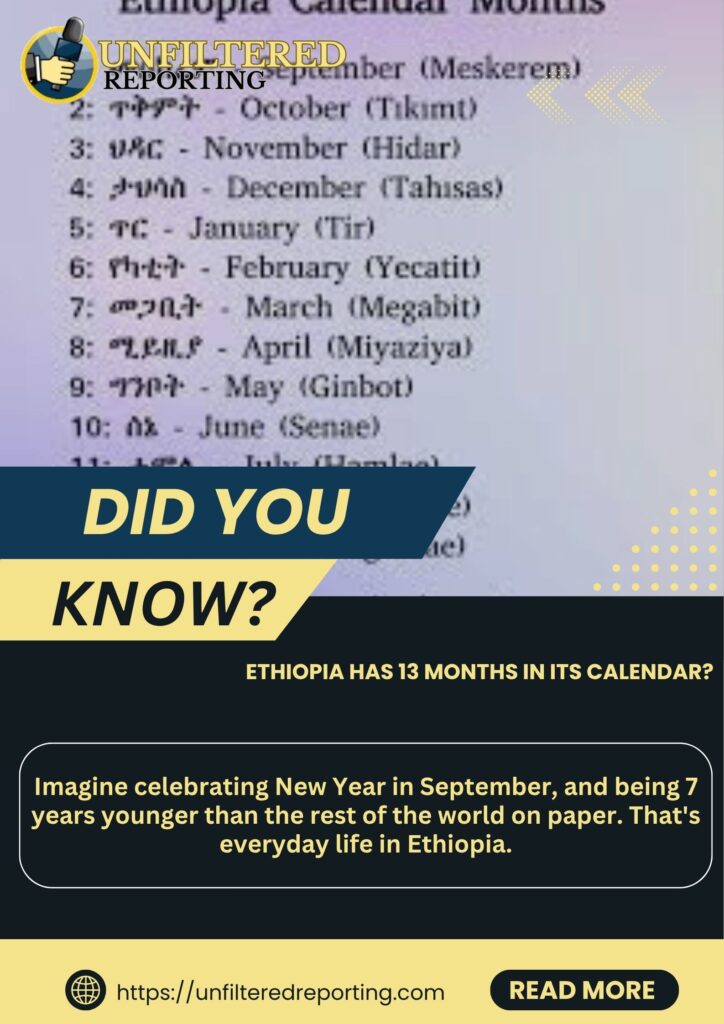


Did You Know: Ethiopia Has 13 Months in Its Calendar?
Imagine celebrating New Year in September, and being 7 years younger than the rest of the world on paper. That’s everyday life in Ethiopia.
Ethiopia uses its own calendar, which has 13 months instead of 12. Twelve of them have exactly 30 days. The 13th month, called Pagume, is a short one with just 5 days, or 6 days in a leap year. That adds up to the same length of year as the one most of the world uses.
The Ethiopian calendar is roughly 7 to 8 years behind the Gregorian calendar. The gap comes from a different calculation of the year Jesus was born. The Ethiopian Orthodox Church follows an older calculation, which places the birth a few years later than the one adopted in Western Europe.
Because the new year starts in September, the gap changes during the year. From January to early September, Ethiopia is 7 years behind. From September to December, it is 8 years behind. This means that while much of the world celebrated the year 2000 at the turn of the millennium, Ethiopia held its own millennium celebrations in September 2007.
The Ethiopian New Year is called Enkutatash and falls on September 11, or September 12 in some years. It comes at the end of the rainy season, when the countryside is covered in yellow wildflowers. People celebrate with feasts, songs, and new clothes.
Ethiopians traditionally start counting the hours at sunrise, not at midnight. So 7:00 AM on most clocks is 1 o’clock in the Ethiopian day. If you’re meeting someone there, it pays to ask which clock they mean.
Ethiopia is one of the few countries with its own calendar, and one of the oldest independent nations in Africa. It was never colonized in the usual sense, apart from a brief occupation in the 20th century. Its calendar is a living part of that heritage, still used for holidays, farming, and daily life.
Next time someone asks how old you are, remember that in Ethiopia the answer might be 7 years younger.