


Did You Know: If you try to photocopy paper money, the machine will refuse to copy it?
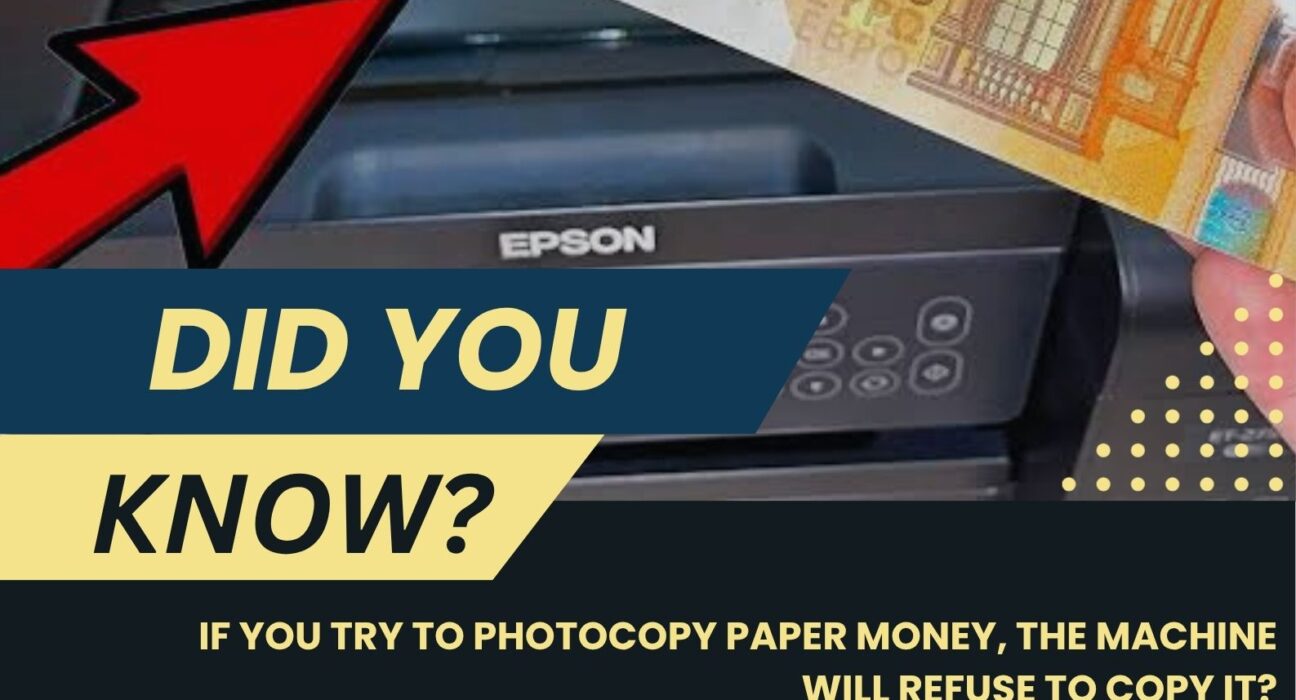
Put a banknote on a modern copier and press start. You might get a blank sheet, a smeared print, or an error message. The machine is not broken. It recognized what you were trying to copy and stopped.
For most of history, counterfeiting took skill and specialized equipment. Engravers, printing presses, and special inks kept fake money in the hands of a few criminals. That changed in the late 20th century. Color photocopiers, high-resolution scanners, and affordable printers put powerful image reproduction in ordinary offices and homes. Quality improved every year, and central banks grew concerned that anyone with a basic machine could try to duplicate a banknote.
In the early 1990s, a group of central banks formed the Central Bank Counterfeit Deterrence Group to tackle the problem. Instead of relying only on better banknote design, they pursued a different idea: teach the machines themselves to recognize money.
One of the best-known detection signals is a pattern of small circles, usually in yellow, green, or orange, scattered across part of a note’s design. It is called the EURion constellation. The circles look like a random scatter of dots, and the arrangement resembles the stars of the Orion constellation. The name comes from the euro banknotes, where the pattern was widely noticed.
The pattern was publicly documented in the early 2000s by Markus Kuhn, a computer scientist at the University of Cambridge. He noticed that some copiers refused to copy certain banknotes and investigated why. It is thought to have been in use on banknotes since the 1990s. Most people never spot it, because it blends into the background artwork and looks like decoration.
Some currencies also carry a digital watermark, which is information woven into the printed image in a way the human eye cannot see. Detection software built into a device can pick up this signal and conclude that the image is a banknote. This technology also reached software. In the early 2000s, Adobe Photoshop was reported to refuse to open images of certain banknotes, showing a message about counterfeit deterrence.
The response depends on the manufacturer and the device. A machine may print a blank or black page, produce a distorted copy, cancel the job and show an error message, or, in the case of editing software, refuse to open the image at all. The goal is simple: even if someone tries, the machine should not produce a copy good enough to fool anyone.
This is not limited to photocopiers. Scanners may refuse to process banknote images, printers may block or alter a print job, and image-editing programs may refuse to edit scans of banknotes. Because the technology lives inside the machine or software, the user does not need to switch anything on. It works quietly in the background.
Not every device has it. Older or low-cost machines may lack detection, so “many modern devices” is more accurate than “every copier.” Different countries also use different security features, and what a machine detects depends on how it was built.
It is also only one layer of defense. Banknotes use special inks, security threads, paper watermarks, raised printing, color-shifting features, and microprinting. Machine detection supports these features but does not replace them.
In most countries, producing copies of banknotes that could be passed off as real is a serious crime. Some countries allow limited reproductions under strict conditions, such as size or color restrictions for educational use, but these rules vary widely and should be checked locally.
The story of the EURion constellation shows how security evolves. As technology made copying easier, the defense moved from the printing press to the machine itself. The banknote became a kind of locked message that devices can read and respond to before a human ever looks at it.
So the next time a copier mysteriously refuses to copy a banknote, remember: it is not a malfunction. It knows exactly what it is looking at.