
Lagos, Abuja Lead 2026 Healthcare Access Ranking as South-East Lags Behind
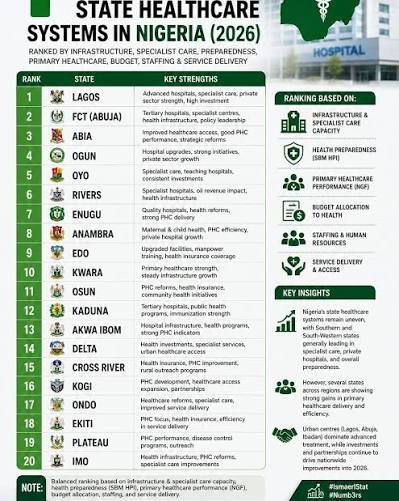
A 2026 healthcare-access ranking attributed to data firm Statisense has renewed attention on the uneven performance of Nigerian states in healthcare delivery, with Lagos, the Federal Capital Territory (FCT) and Ogun emerging as the top three states and the South-East recording some of the lowest scores in the published table.
Lagos led the ranking with a score of 56.3, followed by the FCT with 55.1 and Ogun with 52.4. Delta placed fourth (50.8), Rivers fifth (49.5), Oyo sixth (48.9), Ondo seventh (47.7), and Osun eighth (47.2). Ekiti (46.8), Enugu (46.1), Anambra (45.7), Cross River (45.2), Akwa Ibom (44.8), Edo (44.3), Kwara (43.7) and Abia (43.2) completed the list of 16 states.
The ranking assessed healthcare access using five indicators: health-facility density, NHIS coverage rate, doctor-to-population ratio, immunisation coverage, and maternal-health outcomes.
The South-West dominated the upper reaches of the table, with Lagos, Ogun, Oyo, Ondo, Osun and Ekiti all placing in the top nine. The South-South also performed strongly, with Delta, Rivers, Cross River, Akwa Ibom and Edo all featuring in the published top 16. The South-East recorded three states in the table — Enugu (10th), Anambra (11th) and Abia (16th) — while Ebonyi did not appear.
The ranking reflects broader patterns in Nigeria’s healthcare landscape. Lagos has the highest number of medical doctors at 7,385, followed by the FCT with 4,453 and Rivers with 2,194. Lagos also recorded the highest health insurance coverage with 2,757,992 beneficiaries, followed by Delta with 2,925,353 and Kano with 1,232,683, according to National Health Insurance Authority data. State Social Health Insurance Agencies accounted for 9,744,758 beneficiaries, surpassing the 7,068,457 enrollees under NHIA-managed programmes, underscoring the growing role of states in expanding access to healthcare.
Nationally, however, the picture remains stark. Nigeria has roughly one doctor for every 5,000 people and one nurse for every 2,000 people — well below World Health Organization recommendations. About 75 per cent of Nigerians lack health insurance, and approximately 70 per cent of doctors practise in urban areas, leaving rural communities underserved.
The relatively weak showing of South-East states in the ranking contrasts with recent recognition of their primary healthcare performance. Abia State was selected as the best in the South-East geopolitical region in the Primary Healthcare Centre sector by the Nigerian Governors’ Forum in its 2025 Leadership Challenge, and was named among the top six nationwide.
For Ebonyi, which did not appear in the table, the state has invested in healthcare infrastructure through the World Bank-supported IMPACT programme, reporting interventions across 164 primary healthcare centres including renovation of 145 facilities and deployment of health workers. However, the state released only ₦2.05 billion out of a ₦33.37 billion health-sector capital budget during the first half of 2026 — representing 6.2 per cent implementation — suggesting the challenge is less about absence of investment and more about how effectively those investments are translated into measurable improvements in access and outcomes.
Osun’s placement at eighth in the Statisense table contrasts sharply with a separate NPHCDA assessment that ranked the state 35th among states with functional primary healthcare centres, identifying 326 facilities as non-operational. The Osun State Government disputed that assessment, maintaining that the state remains number one in primary healthcare access in the South-West according to results from the Nigeria Governors’ Forum Primary Healthcare Leadership Challenge.
The state government said the NPHCDA report merely highlighted inactive facilities across states and did not constitute a comprehensive national ranking of primary healthcare performance.
The Statisense ranking covers only the top 16 states and should not be interpreted as a complete assessment of the entire healthcare system of any state. Being absent from the published table does not automatically mean that a state has made no healthcare investment. The ranking nonetheless offers a useful snapshot of where access is strongest and where the gaps remain most acute, as Nigeria continues its push towards Universal Health Coverage through state-owned insurance schemes, the Basic Healthcare Provision Fund and equity programmes targeting poor and vulnerable populations.