



Germany Accuses Russia for Failed Leipzig Airport Drone Attack, Announces New Measures
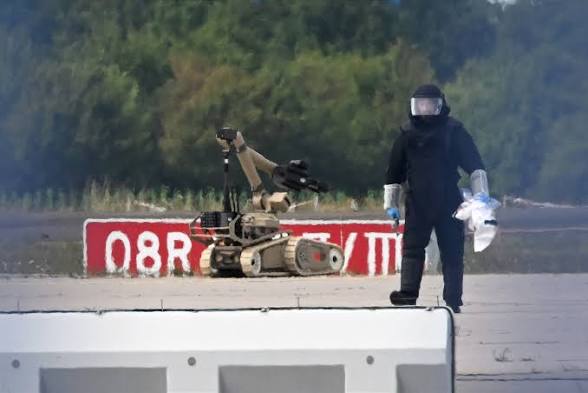
Germany has accused Russia of orchestrating a failed drone attack at Leipzig/Halle Airport, prompting Berlin to announce tougher measures against Moscow and further straining relations between the two countries.
German Interior Minister, Alexander Dobrindt said the August 4 incident bore the hallmarks of what he described as Russia’s established pattern of hybrid operations across Europe.
A drone carrying an explosive device was found at the airport in eastern Germany near Ukrainian cargo aircraft. The explosive failed to detonate, apparently because of a faulty detonator, while investigators believe another drone may have collided with a nearby cargo aircraft.
A third drone was reportedly found in the vicinity of the airport about 10 days later.
Dobrindt said an assessment of equipment recovered from the operation, together with intelligence gathered by German authorities, pointed to Russian involvement.
Russian President Vladimir Putin rejected the allegation on Tuesday, accusing Germany of fabricating evidence to implicate Moscow, but did not provide evidence for the claim.
The Russian Embassy in Berlin also dismissed the accusation as “absurd”, while Russian Foreign Ministry spokesperson Maria Zakharova accused Germany of supporting terrorism through its military and economic assistance to Ukraine.
Following the allegation, German Foreign Minister Johann Wadephul announced several measures targeting Russian interests.
He said Germany would shut down the Russian consulate in Bonn and end the agreement governing the Russian House in Berlin, which has faced accusations that it serves Russian espionage and propaganda interests.
Berlin also plans to impose tighter entry restrictions on Russian nationals and intensify efforts against Russia’s so-called shadow fleet of ageing vessels used to evade Western sanctions imposed after the invasion of Ukraine.
Wadephul said Russia’s ambassador to Germany, Sergei Nechayev, had been summoned to the Foreign Ministry over the matter.
Zakharova warned that Moscow would respond to Germany’s measures with reciprocal action, while the Russian Embassy described Berlin’s decision as an unprecedented deterioration in bilateral relations.
Germany’s position received support from several of its European and NATO allies.
NATO Secretary-General Mark Rutte expressed solidarity with Germany and said the evidence linking Russia to the incident was clear, while European Commission President Ursula von der Leyen said the European Union remained united against Russian aggression and was preparing additional sanctions.
Polish Prime Minister Donald Tusk also accused Moscow of increasing tensions across the region.
The Leipzig/Halle incident comes amid heightened European concerns over alleged Russian hybrid activities, including suspected drone operations around airports, military facilities and critical infrastructure.
The airport is an important logistics centre used by the German military and NATO allies for transporting military equipment. It also serves as a base for Ukraine’s Antonov Airlines, which handles significant volumes of Ukrainian air cargo.
German authorities had previously refrained from publicly identifying those suspected of being behind the incident, saying only that foreign powers might have been involved. US officials had also reportedly linked the operation to Russia.
Berlin has increasingly warned that Germany is being subjected to persistent hybrid threats, including espionage, sabotage and other hostile activities.
Chancellor Friedrich Merz has vowed that those responsible for attacks against Germany would face consequences, while his government is seeking expanded powers for intelligence agencies to strengthen the country’s ability to counter such threats.
The latest confrontation comes as Merz’s government faces political pressure ahead of a state election in Saxony-Anhalt, where the far-right Alternative for Germany has the potential to enter a state government for the first time.
The AfD has opposed continued military assistance to Ukraine and called for closer relations between Germany and Russia.
Separately, German police are investigating another incident in Brandenburg, where improvised explosive and incendiary devices were discovered at a power substation.
The incident damaged a power line and caused a temporary electricity outage, although authorities have not established who was responsible or determined whether the case is linked to the broader security concerns.