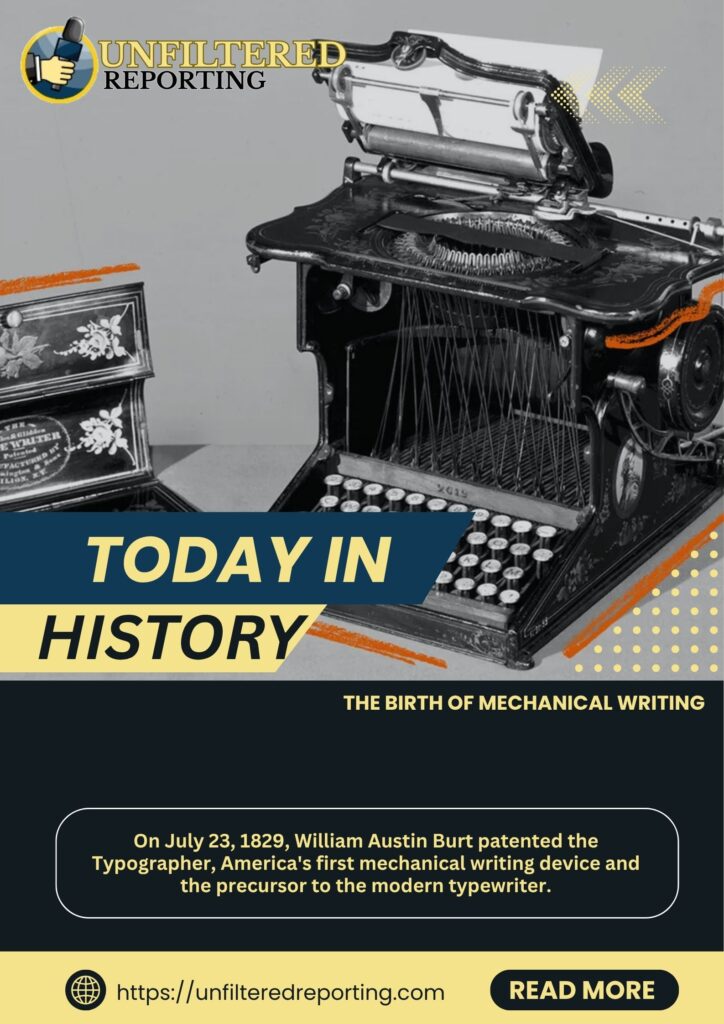



Today in History: The Birth of Mechanical Writing
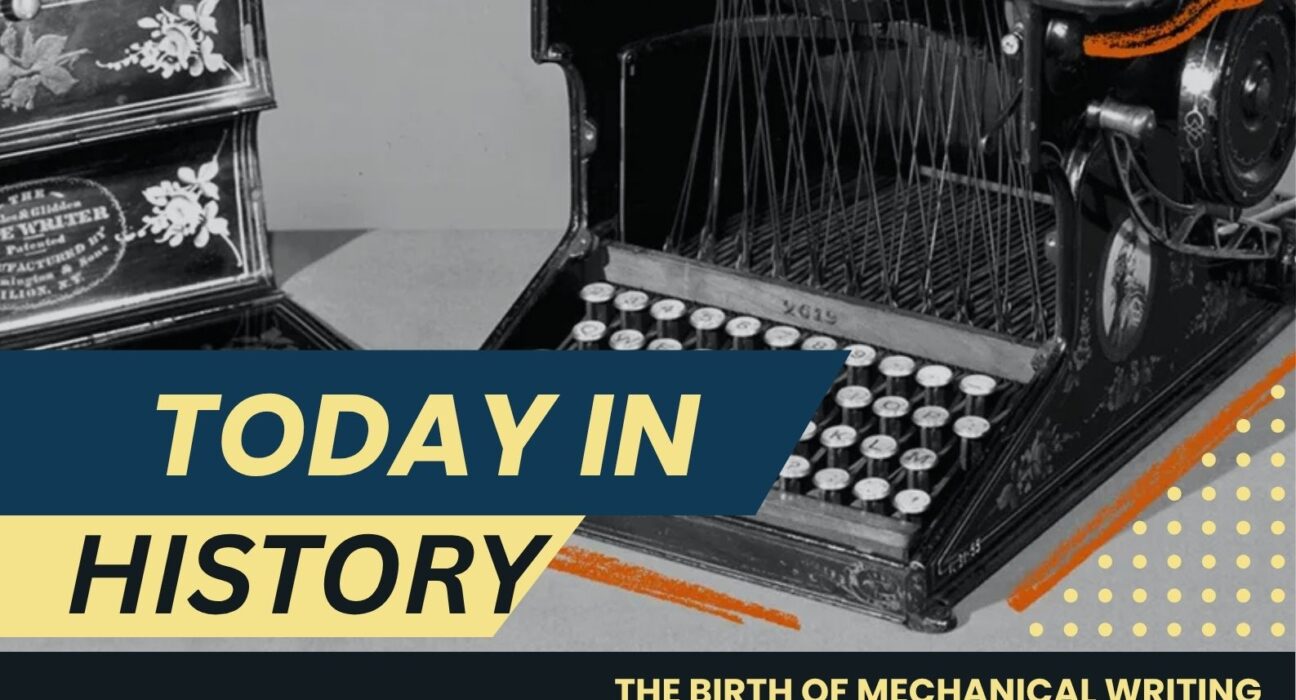
July 23, 1829: William Austin Burt Patents the Typographer, Long before the click-clack of mechanical keyboards or the soft tap of touchscreen displays became the background score of modern life, putting words on paper was an entirely manual effort. That began to change on July 23, 1829, when American inventor and surveyor William Austin Burt was granted a patent for the Typographer—the first mechanical writing device built in the United States and the direct forerunner to the modern typewriter.
Working as a government surveyor in Michigan, Burt faced a common frustration of his era: the tedious, time-consuming task of producing official reports, legal documents, and correspondence by hand. Believing there had to be a faster, more standardized way to generate written text, Burt set to work in his workshop.
The result was a rectangular wooden box housing an ingenious mechanism. Instead of individual keys for each letter, character selection was controlled by a circular dial. Characters were mounted on a rotating wheel and pressed against a parchment ribbon. To operate it, the user turned the dial to choose a letter and pulled a lever down to press the character onto paper mounted on a moving carriage.
While Burt’s original intent was to speed up the writing process, early tests showed that operating the Typographer was actually slower than handwriting. However, it achieved something handwriting could not: perfectly neat, uniform, and legible text.
Despite receiving a patent signed by President Andrew Jackson, Burt struggled to find financial backing. Investors in the 1830s viewed the device as a novelty rather than a commercial necessity, hesitant to fund a machine that could not yet beat the speed of a skilled clerk with a pen.
Tragedy struck the invention’s legacy in 1836 when a devastating fire at the U.S. Patent Office destroyed Burt’s original working prototype and official documentation. Decades passed before a full-scale working replica was constructed for the 1893 World’s Columbian Exposition in Chicago, built using surviving family papers and blueprints.
Although the Typographer was never mass-produced, Burt’s invention laid the conceptual foundation for future innovators. In a letter to his wife shortly after its creation, Burt modestly noted that he had built a machine to print letters that worked neatly, even if slowly.
Four decades after Burt’s patent, inventors Christopher Latham Sholes, Carlos Glidden, and Samuel W. Soule developed the first commercially successful typewriter, which ultimately introduced the QWERTY layout still used today. William Austin Burt’s 1829 Typographer remains a monumental milestone, marking the moment human civilization began its transition from hand-drawn ink to automated text.