

Egypt Plans Link to Tanzania’s Ports, Railways in East Africa Investment Drive
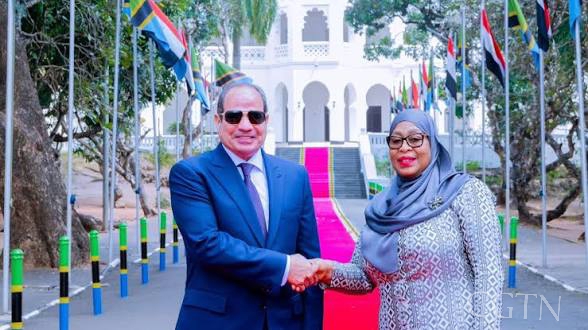
Egypt is deepening its economic push into East Africa, unveiling plans with Tanzania to expand cooperation in ports, railways, agriculture, renewable energy and healthcare as Cairo looks to strengthen trade corridors and widen its investment footprint across the continent.
The agreements were announced after Egyptian President, Abdel Fattah El-Sisi held talks with Tanzanian President, Samia Suluhu Hassan in Dar es Salaam during a state visit that culminated in the signing of two memoranda of understanding covering transport as well as electricity and renewable energy.
While presented as a bilateral partnership, the proposed projects extend far beyond the two countries. They target strategic infrastructure linking East and Southern Africa to markets in North Africa, the Middle East, Asia and Europe through the Indian Ocean, the Red Sea and the Suez Canal.
Tanzania has become one of East Africa’s most strategically positioned economies. Its Port of Dar es Salaam serves as a vital gateway for several landlocked countries, including Zambia, Rwanda, Burundi, Uganda, Malawi and parts of the Democratic Republic of Congo, making it one of the region’s busiest trade corridors.
Egypt’s interest in expanding the port, alongside renewed discussions around the long-delayed Bagamoyo deep-sea port project, highlights Cairo’s ambition to strengthen logistics links that could support trade across the African Continental Free Trade Area (AfCFTA).
Tanzania also proposed developing a railway connecting Bagamoyo Port with Kwala Industrial Park and the country’s Standard Gauge Railway network, creating an integrated transport corridor for cargo movement.
President Samia said the planned corridor would improve connectivity between East and Southern Africa and international markets through the Indian Ocean, the Red Sea, the Suez Canal and the Mediterranean.
The latest agreements reflect a broader Egyptian strategy to deepen economic ties across Africa through infrastructure, industrial investment and private-sector partnerships.
Over the past decade, Cairo has increasingly positioned itself as a regional infrastructure investor, with Egyptian companies participating in major projects across the continent.
One of the most significant examples is Tanzania’s Julius Nyerere Hydropower Project, a multibillion-dollar dam constructed by Egyptian firms, which has become a cornerstone of bilateral economic cooperation.
The new agreements suggest both governments are now seeking to expand that relationship beyond engineering projects into transport, agriculture, logistics and healthcare.
Tanzania invited Egyptian investors to participate in large-scale irrigation, livestock development, seed production, agro-processing and commercial farming projects, including investments linked to Ruvu Ranch.
President El-Sisi said Egypt was prepared to participate in flagship agricultural projects through public-private partnerships aimed at strengthening food security and expanding agricultural trade between the two countries.
The cooperation also extends to education and healthcare. Egypt pledged scholarships in medicine, artificial intelligence, information and communications technology, and cybersecurity under the Samia Scholarship Programme, while offering specialist medical training and support for developing or rehabilitating a referral hospital in Tanzania.
Both leaders repeatedly stressed that governments alone would not deliver the partnership’s ambitions. Addressing the Tanzania-Egypt Business and Investment Forum, El-Sisi urged businesses to lead investments in ports, logistics, railways, industrial zones, technology and agriculture.
“We look to the private sector to develop projects that will create new opportunities for development and prosperity for the people of our two countries,” he said.
Samia similarly called for rapid implementation of the agreements, saying the focus should now shift from political commitments to commercially viable projects capable of generating jobs and attracting investment.
The latest agreements build on an already expanding investment relationship. According to Tanzanian authorities, Egypt is Tanzania’s eighth-largest foreign investor, with 61 registered projects worth approximately $1.5 billion, creating more than 4,000 jobs across energy, manufacturing, construction, agriculture, tourism and services.
As African governments push to boost intra-African trade under AfCFTA, the Tanzania-Egypt partnership signals a growing race among the continent’s largest economies to secure strategic infrastructure, strengthen regional supply chains and expand their commercial influence beyond national borders.