Sowore Unveils 2027 Education Agenda, Promises Free Education at All Levels
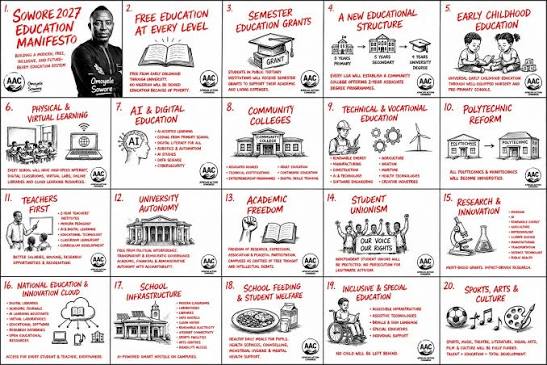
Human rights activist and African Action Congress (AAC) presidential candidate, Omoyele Sowore, has unveiled his proposed education policy for the 2027 general election, pledging free education from early childhood to university level, the abolition of public examination fees and wide-ranging reforms across the sector.
Sowore disclosed the policy on Monday through his verified X account, saying that students would no longer be required to pay fees for the West African Senior School Certificate Examination (WASSCE), the National Examinations Council (NECO) examination or any other public examination under his administration.
According to the presidential candidate, the proposed reforms are aimed at ensuring that access to education is not determined by financial status.
He said the plan guarantees free, quality education at every level, supported by improved learning facilities, virtual education platforms, better remuneration for teachers, student grants and equal opportunities for all Nigerian children.
The 20-point education manifesto outlines reforms in funding, infrastructure, curriculum development, technology, research and student welfare. Among its key proposals are semester grants for students in public tertiary institutions to assist with academic and living expenses, as well as a restructuring of the education system into five years of primary education, five years of secondary education and four years of university education.
The policy also proposes the establishment of community colleges in every local government area to offer two-year associate degree programmes.
The manifesto further promises universal access to early childhood education, expanded digital learning through internet-enabled classrooms, virtual laboratories and online libraries, and the integration of artificial intelligence, coding, robotics, cybersecurity and data science into the education curriculum.
Sowore also proposed expanding technical and vocational education in sectors including renewable energy, agriculture, software engineering, manufacturing, aviation, maritime, healthcare technology and the creative industry. In addition, he pledged to convert all polytechnics and monotechnics into universities.
The policy places emphasis on teachers’ welfare through improved salaries, housing support, research opportunities and enhanced professional training. It also promises greater university autonomy, protection of academic freedom, support for independent student unionism and increased investment in research through merit-based grants.
Other reforms include the creation of a national education and innovation cloud to provide digital learning resources, improved school infrastructure featuring smart hostels and modern facilities, expanded student welfare services, inclusive education for persons with disabilities and increased funding for sports, arts and cultural development.
Education remains a major issue in Nigeria’s political discourse, with stakeholders continuing to advocate increased funding, improved infrastructure, better teacher welfare and wider access to quality education ahead of the 2027 general election.