

Today in History: How 1 July 1960 Forged the Unified Somali Republic
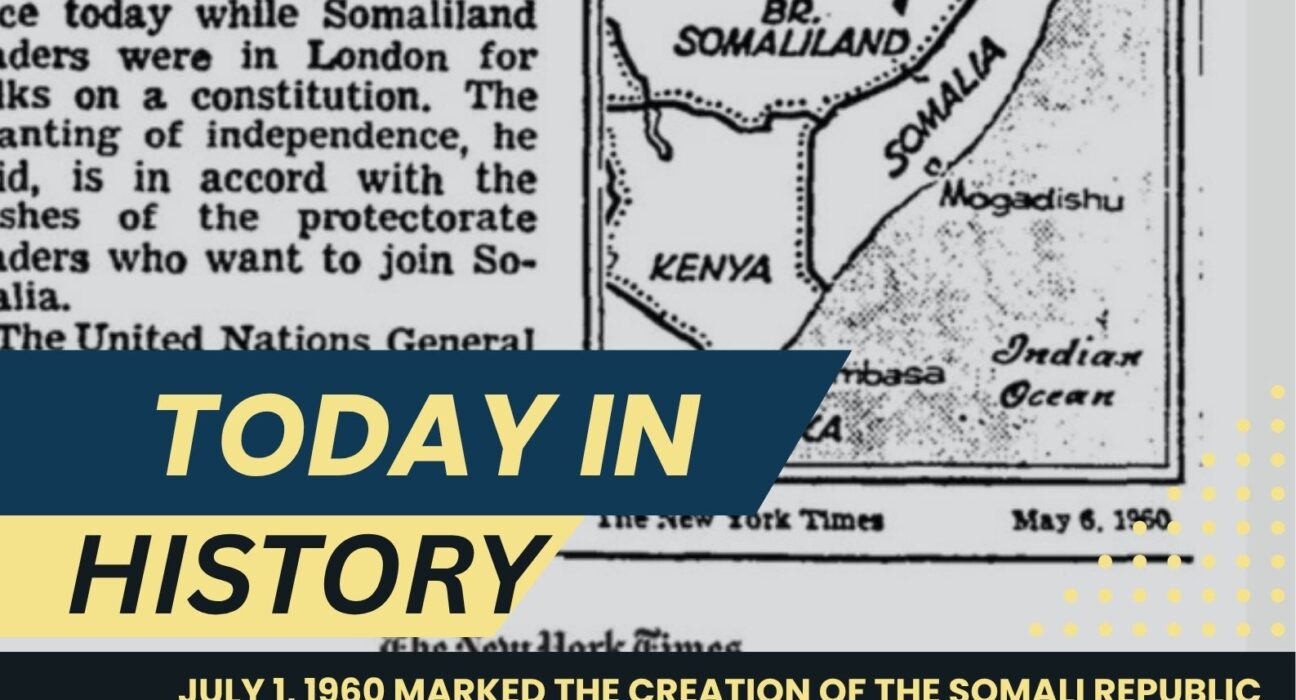
The year 1960 stands as a watershed moment in African history, widely celebrated as the “Year of Africa” as seventeen nations shattered colonial bonds. Among these liberation movements, the birth of the Somali Republic was uniquely complex, forged not just from liberation, but from the immediate fusion of two distinct colonial territories. On 1 July 1960, the Trust Territory of Somaliland—previously under Italian administration gained its independence and instantly merged with the newly liberated British Somaliland, creating a single sovereign state.
Prior to this historic union, the Somali people shared a deep cultural, linguistic, and religious identity, yet they were divided by European geometry. In the north, along the strategic Gulf of Aden, Great Britain established a protectorate in 1884, largely favoring indirect rule that left local traditional structures intact. Meanwhile, Italy carved out a larger footprint along the southern Indian Ocean coast. Following the upheaval of World War II, the United Nations placed this southern territory under a transitional Italian trusteeship in 1950, setting a strict ten-year deadline to prepare the region for full self-governance.
As the deadline neared, a powerful wave of pan-Somali nationalism swept across both zones, eclipsing the institutional barriers erected by European rule. The momentum culminated in an incredibly rapid transition during the summer of 1960. British Somaliland gained independence first on June 26, existing as a sovereign state for a mere five days. On 1 July, the UN trust mandate in the south officially expired.
That very same morning, representatives from both regions executed a pre-arranged merger, raising a single flag over the newly minted Somali Republic with Mogadishu serving as the capital.
The atmosphere in the streets was electric, marked by the election of Aden Abdullah Osman Daar as the nation’s first President. Citizens cheered for the new national flag a light blue banner bearing a white, five-pointed star where each point symbolized a traditional region of the Somali homeland.
However, the initial euphoria soon collided with the staggering reality of state-building. The young administration inherited two different official languages, two conflicting legal frameworks, and two entirely separate fiscal currencies. Despite these structural hurdles, the events of 1 July remain a remarkable chapter in the post-colonial era, representing a rare moment where European imperial borders were successfully dismantled to fulfill a vision of national unity.