


Today in History: The Cost of Victory For Battle of Bunker Hill
On June 17, 1775, the hills of Charlestown, Massachusetts, became the stage for the first major fleet-scale confrontation of the American Revolutionary War. While history remembers the conflict as the Battle of Bunker Hill, the bloodiest fighting actually unfolded on nearby Breed’s Hill. By the time the smoke cleared, the British Army held the ground, but the heavy price they paid fundamentally altered the course of the war.
It was the ultimate Pyrrhic victory a tactical win achieved at a catastrophic, unsustainable cost.
Following the initial clashes at Lexington and Concord in April 1775, colonial militia forces successfully bottlenecked the British army inside Boston. Sensing a stalemate, British commanders, General Thomas Gage alongside newly arrived Generals William Howe, Henry Clinton, and John Burgoyne planned a breakout to seize the unoccupied hills surrounding the city, which would give them a dominant artillery position over the harbor.
The Patriots caught wind of the plan. On the night of June 16, American Colonel William Prescott led roughly 1,200 militiamen onto the Charlestown Peninsula. Though ordered to fortify Bunker Hill, Prescott chose the lower, more vulnerable Breed’s Hill closer to Boston. Working in absolute silence under the cover of darkness, they constructed a massive, six-foot-high earthen fort (a redoubt).
When dawn broke on June 17, British commanders were stunned to see an American stronghold staring down at them from across the water.
General Howe confidently predicted that the raw, untrained colonial militia would break and run at the mere sight of disciplined British regulars. Rejecting a flanking maneuver, Howe opted for a direct, frontal assault to demonstrate British military superiority.
The British regulars landed on the peninsula and formed their lines. Facing them were Prescott’s men, severely low on ammunition but highly resolved. Legend holds that Prescott or another officer issued the famous command: “Don’t fire until you see the whites of their eyes,” a practical directive to conserve precious gunpowder.
The battle unfolded in three distinct waves. During the first assault, the British regulars marched uphill through tall grass under heavy equipment, only to be met with a devastating, synchronized volley of musket fire from the hidden Americans that broke their lines. Re-forming their positions for the second assault, the redcoats pressed up the hill a second time, but the relentless American fire targeted British officers specifically and forced another retreat.
Driven by pride and reinforced by fresh troops, Howe ordered a third assault with a final bayonet charge. By this time, the Patriot forces had completely run out of ammunition. Forced to fight with clubbed muskets, rocks, and bare hands against fixed bayonets, the Americans were finally overrun and forced to retreat across Charlestown Neck.
Technically, the British won because they successfully drove the Americans from the peninsula and captured the strategic high ground. However, the butcher’s bill shook the British military establishment to its core.
Out of roughly 3,000 British troops engaged in the conflict, about 1,054 were killed or wounded, representing a staggering casualty rate of over 35 percent. By comparison, the Patriots suffered approximately 450 losses out of their 2,400 engaged militia.
Among the British casualties were roughly 100 officers—a disproportionately high number that stripped the army of its leadership layout in Boston. General Clinton famously remarked in his diary: “A few more such victories would have shortly put an end to British dominion in America.”
The Battle of Bunker Hill proved to be a profound psychological victory for the American colonists. It shattered the myth of British military invincibility and demonstrated that a citizen-militia could stand toe-to-toe with the finest professional army in the world.
For the British, the horrific losses induced a sudden wave of caution. General Howe, who assumed command of all British forces shortly after, became markedly tentative in future campaigns, routinely avoiding direct frontal assaults against fortified American positions.
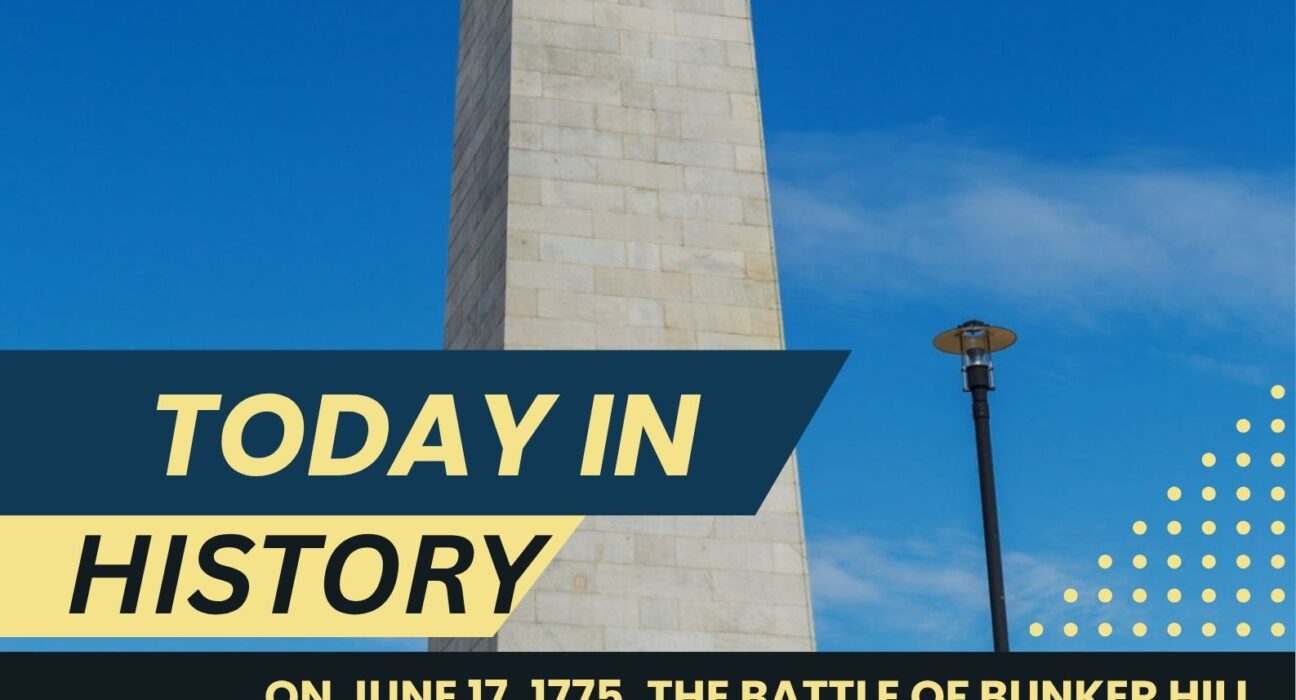
Today, the battle is commemorated by the Bunker Hill Monument, a 221-foot granite obelisk that stands proudly atop Breed’s Hill a permanent reminder of the day an untrained army proved the American Revolution was a fight the British could not easily win.