
Abdulsalami Reveals How Abacha’s Inner Circle Sought Retirement of Top Generals
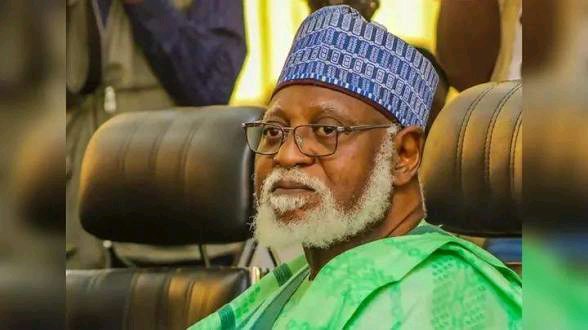
Former Head of State, General Abdulsalami Abubakar (retd.), has revealed that a powerful group of military officers surrounding the late Head of State, General Sani Abacha, repeatedly pushed for the retirement of senior officers and exerted significant influence over government decisions during the military regime.
Abubakar made the disclosure in his autobiography, Call of Duty, unveiled on Saturday in Abuja alongside two companion books, Nigeria’s Grand Patriot and Mediating for Peace in Africa, during activities marking his 84th birthday.
The event was attended by prominent national figures, including President Bola Tinubu, represented by Vice President Kashim Shettima; former Head of State General Yakubu Gowon, who chaired the occasion; and former Presidents Olusegun Obasanjo and Goodluck Jonathan.
In the memoir, Abubakar described the existence of an influential “kitchen cabinet” within the Abacha administration, alleging that members of the group operated outside formal government structures and often sought to shape key decisions.
According to him, the clique repeatedly demanded the retirement of several senior military officers, including himself, Lieutenant General Jeremiah Useni, Lieutenant General Garba Duba and Major General Mohammed Balarabe Haladu.
“To be fair, General Abacha was loyal to his friends,” Abubakar wrote, noting that despite persistent pressure from the group, the targeted officers remained in service because of Abacha’s loyalty to longstanding associates.
He added that many of the officers who championed the campaign against them were eventually retired before those they had sought to remove.
Abubakar further disclosed that he personally advised Abacha to dismantle the influential group, warning that its activities were becoming detrimental to the administration.
“In one of our conversations, I told him that he needed to disband the group of officers that formed the clique around him,” he recalled.
According to him, although Abacha initially suggested he engage the officers directly, he insisted that the Head of State address the matter himself. He said the officers were subsequently retired one after another.
The former military ruler also claimed that members of the group once proposed the arrest of former military president, General Ibrahim Babangida, despite having no specific allegations against him.
According to Abubakar, Abacha rejected the suggestion after questioning the basis for such an arrest.
The memoir also sheds new light on efforts by senior government officials to secure the release of the presumed winner of the June 12, 1993 presidential election, Chief Moshood Kashimawo Olawale (MKO) Abiola.
Abubakar said several members of the administration advised Abacha to release Abiola from detention and engage him in dialogue to resolve the political crisis arising from the annulled election.
However, he said the late military ruler declined the proposal.
“We asked him to release Bashorun MKO Abiola from detention and to discuss with him one-on-one the way forward,” he wrote, adding that the recommendation received no favourable consideration.
While acknowledging his role as Chief of Defence Staff and a member of the Provisional Ruling Council, Abubakar maintained that ultimate authority rested with the Head of State.
He also alleged that many crucial decisions during the Abacha administration were taken outside official government channels, with some matters already decided by members of the inner circle before they reached the council for discussion.
The former Head of State said he was frequently excluded from sensitive security matters, including investigations into alleged coup plots that resulted in the arrests of former President Olusegun Obasanjo, the late Major General Shehu Musa Yar’Adua and later Lieutenant General Oladipo Diya.
According to him, despite occupying one of the highest positions in the military hierarchy, he was often left out of key deliberations because members of the inner caucus did not consider him part of the administration’s core power structure.
Abubakar also addressed allegations regarding funds later traced to members of Abacha’s family and associates, saying he only became aware of documents relating to the transfers during the closing days of his administration in 1999.
He stated that reports linking the late ruler to substantial offshore assets came as a surprise because the Abacha he knew was known for prudence and accountability in government spending.
According to him, he was informed that the funds were allegedly moved abroad as a precaution against possible international sanctions, based on advice reportedly linked to former Libyan leader Muammar Gaddafi.
While stressing that he could neither confirm nor dismiss the explanation, Abubakar said he never regarded Abacha as a thief, although he acknowledged that senior officials, including himself, were never informed about the transactions.
The memoir portrays an administration marked by the influence of an informal inner caucus operating alongside official institutions, with Abubakar presenting himself as a senior military officer who often questioned controversial decisions but remained excluded from some of the regime’s most sensitive affairs.