
Nigerians Bash APC Over Emergence of Okowa, Bello in Senatorial Primaries
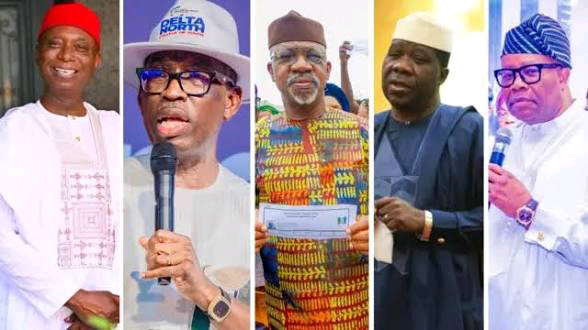
The emergence of Ifeanyi Okowa and Yahaya Bello as winners of the All Progressives Congress senatorial primaries has triggered widespread criticism from Nigerians and political commentators over their ongoing corruption trials.
Mr Okowa and Mr Bello, both facing separate prosecutions by the Economic and Financial Crimes Commission, were recently cleared to contest the party’s senatorial primaries in Delta North and Kogi Central respectively.
Mr Okowa, a former governor of Delta State, is under investigation over allegations involving the diversion of public funds amounting to about ₦1.3 trillion during his tenure between 2015 and 2023.
The EFCC had arrested him in November 2024 over claims linked to the management of the state’s 13 per cent oil derivation funds and alleged acquisition of properties in Asaba and Abuja through state resources.
The anti-graft agency also accused him of failing to properly account for ₦40 billion allegedly used in the acquisition of an equity stake in UTM Floating Liquefied Natural Gas.
Following his arrest, Mr Okowa defected from the Peoples Democratic Party to the All Progressives Congress, prompting speculation that the corruption investigation could be abandoned. However, the EFCC has maintained that the case remains active.
Mr Bello, former governor of Kogi State, is facing separate corruption and money laundering cases involving alleged diversion of ₦80.2 billion and ₦110.4 billion in public funds.
According to the EFCC, the funds were allegedly used to acquire luxury properties in Nigeria and Dubai through bureau-de-change operators and affiliated companies. The commission also alleged that state funds were used to settle school fees for his children abroad.
Mr Bello has consistently denied the allegations, describing the charges as politically motivated.
Despite the ongoing cases, the APC cleared him to contest and win the Kogi Central senatorial primary, where he is expected to challenge incumbent senator Natasha Akpoti-Uduaghan.
Reacting to the development, political scientist Abdullah Abubakar described the victories of both politicians as evidence of what he called the government’s tolerance for corruption.
He criticised the decision to allow politicians facing corruption charges to seek elective office, saying it undermines public trust in governance and accountability.
A civil servant, Biodun Agunbiade, also faulted the outcome of the Delta North primary, expressing disappointment that Mr Okowa defeated Senator Ned Nwoko despite the ongoing investigation against him.
Other Nigerians, including activists and analysts, questioned why politicians facing corruption allegations are still permitted to contest elections and remain active in the political space.
An activist, Desmond Atake, said public officials with pending corruption cases should not continue to enjoy political privileges, while data analyst Wilson Okonkwo described the development as official encouragement of corruption.
Political analyst Ahmed Walata also criticised the situation, comparing Nigeria’s handling of corruption cases with stricter anti-corruption measures in countries such as China, Japan, Europe, and the United States.
He further questioned the EFCC over what he described as inconsistency in the treatment of politically exposed persons facing corruption allegations.