



National Assembly Moves to Check Governors’ Powers Under State Police Says Bamidele
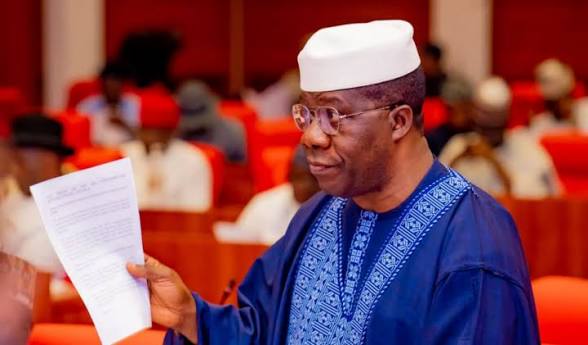
The National Assembly is working with the executive and other stakeholders to develop an operational legal framework for the proposed state police to prevent governors and other political office holders from abusing the institution.
Senate Leader, Opeyemi Bamidele, disclosed this on Thursday in Abuja, saying the framework would define the powers of federal and state police authorities and establish safeguards against political interference.
Bamidele said the constitutional amendment providing for state police had been approved by all 36 state Houses of Assembly and transmitted to President Bola Tinubu for assent.
He noted, however, that presidential assent would not be the end of the legislative process, as additional laws would be required to determine how the proposed state police would operate.
According to him, the framework would provide for the composition and functions of state police service commissions, clarify their relationship with the Nigeria Police Force and specify circumstances in which the federal police could intervene in matters involving state police.
The Senate Leader said the National Assembly was aware of concerns that state police could be used by governors against political opponents, stressing that the law must protect Nigerians regardless of which party controls government.
He said the existing Police Act would also require amendments to accommodate the new structure, while a separate legal framework would provide for state policing.
Bamidele described state police as one of the major institutional reforms being pursued by the 10th National Assembly, alongside reforms in taxation, education and the financial sector.
On the recently passed tax reform laws, he said the measures were designed to create a fairer tax system, reduce multiple taxation and protect low-income earners and qualifying businesses from excessive tax burdens.
He also identified the Nigerian Education Loan Fund as another major legislative intervention, saying the scheme had enabled hundreds of thousands of students to pursue higher education despite financial difficulties.
The senator said constituency projects in Ekiti Central had also focused on healthcare, roads, diagnostic centres, ambulances, markets, mini stadia and empowerment programmes, following consultations with community leaders and other stakeholders.
Bamidele further explained that resolutions adopted by the National Assembly were generally advisory and did not automatically compel the executive to act on them. He said parliamentary investigations could lead to recommendations, while binding measures required the completion of the legislative process.
On the 2027 elections, he condemned political violence and intimidation, urging political actors to compete through their records, policies and programmes rather than force.
Bamidele, who said he had survived a shooting at a political rally, called on security agencies to enforce existing laws without favour.
He also defended the National Assembly against allegations that it had become a rubber stamp for the executive, saying cooperation between the two arms of government did not amount to the abandonment of legislative independence.
The Senate Leader expressed support for the proposed additional seats for women in the National Assembly, describing the measure as an important step towards increasing female representation in the legislature.