



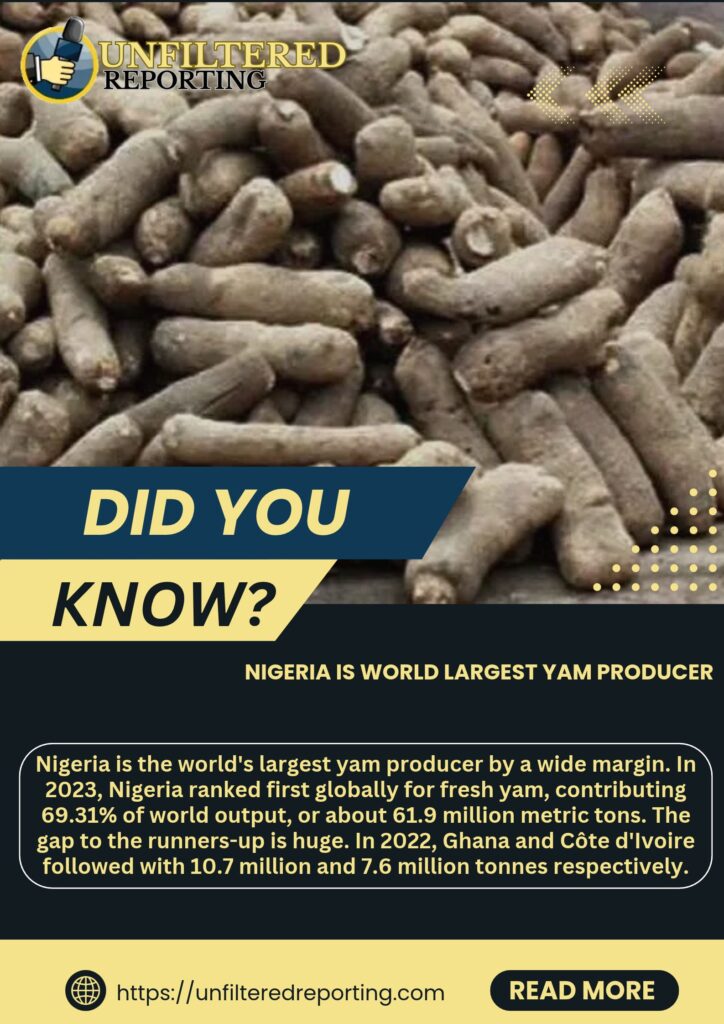


Did you know? Nigeria is World Largest Yam Producer
Nigeria is the world’s largest yam producer by a wide margin. In 2023, Nigeria ranked first globally for fresh yam, contributing 69.31% of world output, or about 61.9 million metric tons. The gap to the runners-up is huge. In 2022, Ghana and Côte d’Ivoire followed with 10.7 million and 7.6 million tonnes respectively.
That is why you will see the share quoted as anywhere from 60% to 70%. The number shifts with the year and the data source. Nigerian officials put it at 67 per cent of global production, or 67.2 million metric tonnes annually. Over the long run, Nigeria produced over 1.39 billion tonnes of yam between 1961 and 2023, accounting for 64 percent of global output. The 60-70% range in your fact is safe.
Yam is overwhelmingly a West African story. Add Ghana, Côte d’Ivoire, Benin and Togo, and West Africa consistently delivers more than 95 percent of the world’s yam supply. Within Nigeria, cultivation is concentrated in the forest, derived savanna and southern Guinea savannah zones.
Yam is a cultural symbol as well as a staple. Among the Igbo, it is called the king of crops. Yam is not the only crop planted at the start of the season, yet it is “king of all crops,” and the iri ji festival symbolises its importance in Igbo social and cultural life.
The festival goes by different names depending on the community. It is known as Orureshi, Iwa ji, Iri ji, Ike ji or Otute, depending on dialect, and is usually held at the end of the rainy season, from early August to October. “Iri ji” literally means “new-yam eating,” and the festival marks the end of one harvest and the start of the next work cycle.
The celebration is tied closely to tradition. In Igboland, no full-grown man eats new yam without first performing the festival, whether individually or in a group. The festivities include cultural shows, masquerade dances and fashion parades. The tradition also travels with the Igbo abroad: Igbo people in Jamaica have held their own iri ji festival. The New Yam Festival is not exclusive to the Igbo either. It is celebrated by almost every ethnic group in Nigeria.
Despite leading the world in production, Nigeria barely features in the global yam export trade. In 2023, Nigeria exported just 49.9 tonnes of yam, worth only US$41,564, while Ghana exported about 36,300 tonnes and earned $9.8 million. Most Nigerian yam is eaten at home. Even so, Nigeria meets only part of its estimated national demand of 120 million metric tonnes, leaving a shortfall of over 50 million tonnes.
The government is trying to close that gap. It has unveiled a plan to raise yields from 10 to 30 metric tonnes per hectare.
Yam shows how food can anchor identity as well as the economy. Nigeria feeds much of the world’s yam demand, and each year, communities mark the harvest with ceremony, gratitude and celebration. It’s a staple, a cultural symbol and a national strength in one tuber.