

Did You Know? How Babangida Got the Nickname “Maradona”
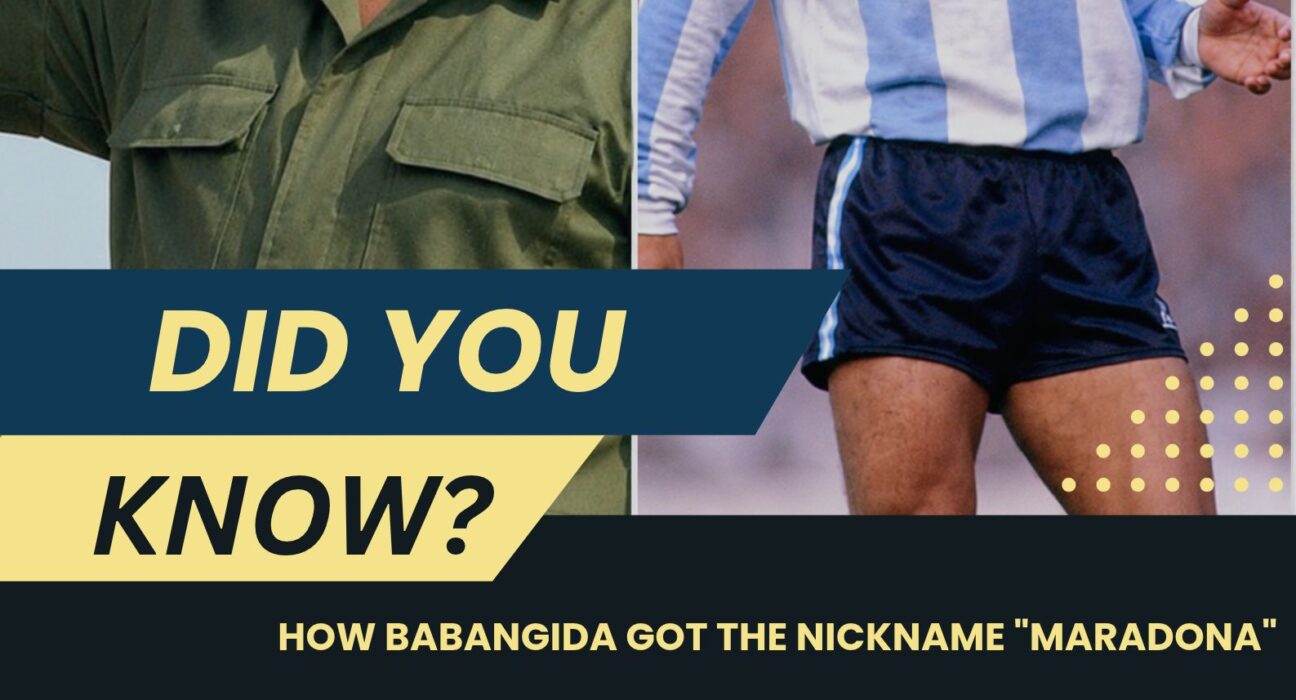
During his eight-year rule as Nigeria’s military President from August 1985 to August 1993, General Ibrahim Badamasi Babangida earned one of the most enduring monikers in Nigerian political history: “Maradona.” Coined by the Nigerian press at the height of his administration, the nickname drew a direct parallel between Babangida’s unpredictable statecraft and the dazzling, deceptive dribbling style of the late Argentine football legend, Diego Maradona.
The nickname emerged in the mid-to-late 1980s, right after Diego Maradona’s iconic performance at the 1986 FIFA World Cup in Mexico—a tournament famous for both his “Goal of the Century,” where he dribbled past five English defenders, and his controversial “Hand of God” goal.
In Nigeria, football metaphors naturally blend into political commentary. Journalists watching Babangida navigate military politics, economic turmoil, and public agitation saw a leader who could feint left, move right, and leave opponents—and the entire nation—guessing his next move.
Nigerian commentators and historians point to several defining traits of Babangida’s administration that made the Maradona label stick:
Historian, Toyin Falola described Babangida as “affable and cunning,” noting his mastery of ambiguity and ability to dictate the terms of the political game. When Babangida seized power from Major General Muhammadu Buhari in August 1985, he immediately won public goodwill by adopting the title “President” rather than Head of State, repealing repressive decrees, and throwing open the International Monetary Fund (IMF) loan debate to the public. Yet, after Nigerians overwhelmingly rejected the IMF loan, he introduced the Structural Adjustment Programme (SAP)—a homegrown policy that implemented many of the same austerity measures through a different route.
Chief Olu Falae, who served as Secretary to the Federal Military Government and later Minister of Finance under Babangida, offered an insider’s explanation for the nickname. According to Falae, Babangida was an exceptionally polite and attentive listener who hated telling anyone “no”. Whether dealing with labour unions, traditional rulers, military brass, or pro-democracy activists, he would nod, smile, and agree with everyone in the room—only to execute an entirely different strategy afterward. To observers, this looked like a midfielder selling a dummy pass before slipping away into open space.
Perhaps the most consequential display of his “dribbling” was his protracted transition to civil rule. Between 1987 and 1993, Babangida repeatedly altered the rules, banned and unbanned “old breed” politicians, dissolved 13 political associations to decree two government-created parties (the SDP and NRC) into existence, and shifted the handover date multiple times—culminating in the annulment of the historic June 12, 1993 presidential election won by Chief M.K.O. Abiola.
Unlike some leaders who bristled at press caricatures, Babangida embraced the reputation as evidence of political agility. In an August 2021 interview with Arise TV, he reflected on how the Nigerian press gave him both “Maradona” and “Evil Genius”.
“The definition of Maradona I got from the media is because of deft political moves. That’s the way the media described it.”* — General Ibrahim Babangida
He added that surviving and thriving in Nigerian governance required anticipating the media and the public at every turn. Decades after stepping aside in August 1993, “Maradona” remains shorthand in Nigerian political discourse for any leader who relies on strategic surprise, calculated ambiguity, and constant maneuvering to stay ahead of the game.