


Ukraine Launches Nearly 1,200 Drones Against Russia as Us-led Peace Talks Expand to European Security
Ukraine has launched nearly 1,200 drones against Russian targets in one of its largest aerial offensives since the war began, as Kyiv seeks to challenge Moscow’s position that victory for Russia is inevitable.
Meanwhile, negotiations led by the United States to end the conflict have expanded to include broader European security arrangements that have existed since the end of the Cold War. The development, which Russia has long advocated, has raised concerns among European leaders who fear it could weaken NATO’s role.
German Chancellor Friedrich Merz said Russia wanted discussions on Europe’s security framework but maintained that there was no need to renegotiate an arrangement that already exists, referring to NATO.
Following two days of discussions involving Russian and Ukrainian delegations in Abu Dhabi earlier in the week, American envoys briefed Russian President Vladimir Putin at the Kremlin and Ukrainian President Volodymyr Zelensky, who was in Dublin for meetings with European leaders.
US envoys Steve Witkoff and Jared Kushner said additional negotiations were expected as efforts continued to achieve a breakthrough in the peace process.
European Council President Antonio Costa announced after a meeting in Dublin that diplomats from the United Kingdom, France, Germany, Italy, Poland and the European Union would participate in the negotiations.
The meeting was largely focused on European efforts to ensure the continent was not excluded from the US-led discussions.
Kushner, who is also President Donald Trump’s son-in-law, said Russia had agreed to involve European representatives in the forthcoming negotiations after previously insisting that European governments should be excluded because of their support for Ukraine.
He explained that Europe’s participation would enable negotiators to discuss wider post-war security arrangements across Europe alongside territorial disagreements between Russia and Ukraine.
European leaders remain cautious about Russia’s diplomatic moves, as well as Trump’s favourable comments about Putin and his administration’s criticism of European countries.
The European Union’s foreign policy chief, Kaja Kallas, said European leaders must demand a ceasefire before proceeding with further negotiations, a position that differs from Putin’s demands.
Kallas warned during the Dublin meeting that engaging in discussions about Russia’s proposed European security framework could expose the continent to Moscow’s strategic traps.
Luxembourg Prime Minister Luc Frieden also stressed that European countries must take responsibility for their own future, insisting that neither the United States nor Russia should be allowed to determine their direction.
The Institute for the Study of War, in an assessment released on Thursday, said Moscow’s objective was to dismantle NATO and the European security structure established after the Cold War.
However, Kremlin spokesperson Dmitry Peskov reiterated that Russia remained open to engaging with European countries.
He explained that Moscow would consider broader discussions on resolving the conflict in Ukraine once it understood Europe’s actual intentions and willingness to contribute to the peace process.
On Friday, Zelensky renewed his complaints about restrictions placed on drone speeds through the US Starshield system, SpaceX’s military-grade version of its Starlink satellite internet service, which Ukraine relies on for its defence operations.
According to the Ukrainian president, the restrictions have limited the speed of Ukrainian drones to 100 miles per hour across the entire frontline and Russian-occupied territories.
He said the limitations were making it difficult for Ukraine to effectively deploy interceptor drones against Russia’s faster, jet-powered unmanned aircraft.
Zelensky said Ukraine had yet to receive a clear explanation for the restrictions, which were introduced without prior announcement. He had first raised the matter on Thursday.
He added that Ukrainian officials were seeking clarification and a resolution from the US State Department, the Pentagon and SpaceX.
Similar restrictions imposed by SpaceX on Ukrainian drone speeds last month reportedly disrupted military operations, raising concerns among officials in Kyiv about a possible reduction in American support.
SpaceX founder Elon Musk acknowledged in October that his company had restricted Starlink internet services in Ukraine for approximately one week, explaining that the system could not be used to support offensive attacks against Russia.
Russia’s Defence Ministry said its air defence systems intercepted 1,198 Ukrainian long-range drones between late Thursday and early Friday.
However, local officials reported that attacks across three Russian regions killed seven people, including a 12-year-old child, while another 17 people sustained injuries.
Ukraine’s General Staff also announced that its forces had struck an oil refinery in the Russian city of Volgograd, triggering a fire at the facility.
According to the military, the refinery has an annual processing capacity of approximately 110 million barrels.
The large-scale Ukrainian drone offensive appeared intended to demonstrate that Kyiv remained capable of defending itself and sustaining attacks, despite Moscow’s repeated assertions that Russia’s victory in the war was unavoidable.
Ukraine has repeatedly targeted Russian oil refineries and claimed last month that its operations had disrupted more than half of Russia’s refining capacity.
Ukrainian forces are increasingly deploying drones and ground-based robotic systems to defend against Russian troops along the approximately 750-mile frontline stretching across eastern and southeastern Ukraine.
With much of its military movement slowed by fighting on the battlefield, Russia has continued using strategic attacks on civilian areas in an effort to weaken Ukraine.
Russia also launched 117 drones against Ukrainian targets overnight, with authorities reporting that at least two people, including a 17-year-old, were killed.
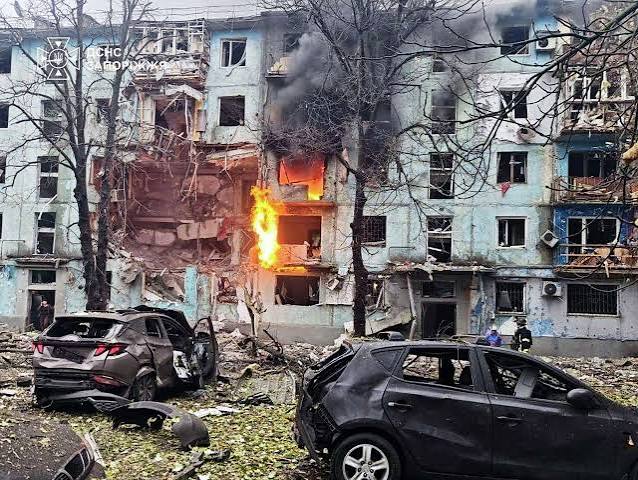
In a separate attack on Friday, Russian forces struck two five-storey residential apartment buildings in southern Zaporizhzhia, leaving 30 people injured, including six children, according to local officials.
Analysts and humanitarian organisations estimate that the ongoing war has claimed hundreds of thousands of military personnel and thousands of civilian lives.
Russian attacks on Ukraine’s energy infrastructure also triggered widespread electricity disruptions across approximately half of the country’s regions on Friday.
Ukraine’s First Deputy Energy Minister, Artem Nekrasov, confirmed the power outages, which affected 12 regions.
Russia has repeatedly targeted Ukraine’s electricity infrastructure during the winter months since the conflict began, in what has been viewed as an effort to undermine public morale.