



Travellers Stranded as Flood Submerges Lagos-Ore-Benin Expressway
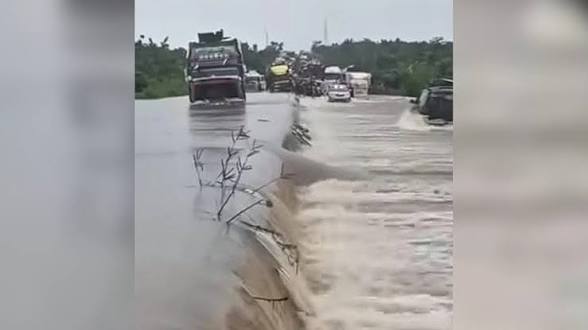
Hundreds of commuters were left stranded on Wednesday after heavy rainfall caused flooding along a section of the Lagos-Ore-Benin Expressway in Odigbo Local Government Area of Ondo State, forcing traffic to a halt on one of Nigeria’s busiest highways.
The prolonged downpour submerged parts of the road, leaving motorists trapped in hours-long congestion as many vehicles struggled to pass through the floodwaters.
The expressway is a critical transport link connecting the South-West with other regions of the country and serves as a major route for passengers, fuel distribution and commercial transportation.
The flooding also affected several communities across the state, causing widespread damage to homes, businesses and public infrastructure.
In Ondo town, the headquarters of Ondo West Local Government Area, floodwaters overwhelmed areas including Itanla Junction, Onipakala Junction and the road leading to the University of Medical Sciences (UNIMED).
Properties worth millions of naira were destroyed, while several vehicles, including those owned by university staff, were damaged during the incident.
Other communities, including Odigbo, Irele, Ode-Aye and Igbokoda, also recorded severe flooding, forcing many residents to leave their homes for safer locations.
Although no casualties were reported, numerous families were displaced and several business premises were submerged.
Residents attributed the recurring flooding to persistent rainfall, inadequate drainage infrastructure and blocked waterways, calling on the government to implement lasting solutions to prevent future occurrences.
One of the affected travellers, Joshua Oladele, described the experience as distressing, saying motorists never expected floodwaters to completely overtake the Lagos-Ore-Benin Expressway. He appealed to the government to take urgent steps to prevent a repeat of the incident.
Reacting to the development, the Ondo State Government expressed sympathy to those affected and said emergency response measures had already been activated.
The Commissioner for Environment, Tob Loko, stated that the government had previously identified several flood-prone locations for intervention but noted that recent flooding had exposed additional areas requiring urgent assessment.
He explained that amphibious excavators were being deployed through the Office of the Special Assistant to the Governor on Technical and Ecological Control to clear blocked waterways and carry out channelisation in vulnerable locations.
Loko also encouraged residents to promptly report flooding and other environmental challenges to the Ministry of Environment and relevant agencies, stressing that public cooperation would support efforts to reduce the impact of future flooding.