



Powerful Magnitude 6 Earthquake Rocks Afghanistan’s Hindu Kush, Tremors Felt Across South Asia
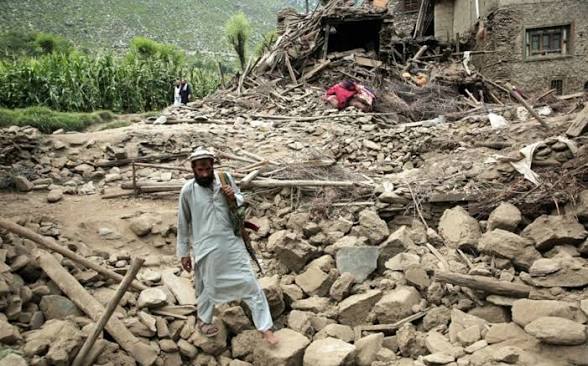
A strong earthquake measuring magnitude 6 struck Afghanistan’s Hindu Kush region on Saturday afternoon, sending tremors rippling across a vast swathe of South Asia from Kabul to Delhi, from Pakistan’s Swat Valley to the Kashmir region and triggering widespread panic among residents who poured into the streets in alarm.
The quake, confirmed by the European-Mediterranean Seismological Centre, struck at a depth of approximately 100 kilometres beneath the Earth’s surface, with its epicentre recorded around 43 kilometres south of Jurm in northeastern Afghanistan. Some seismological agencies, including India’s National Centre for Seismology, recorded the depth at significantly greater levels around 215 kilometres a depth that, while reducing the risk of severe surface damage, allowed the seismic energy to radiate outward over enormous distances, explaining why the tremors were felt so far from the point of origin.
In Pakistan’s Khyber Pakhtunkhwa province, residents of Swat district described scenes of sudden panic as the ground shook beneath their feet. One resident told reporters that the earthquake felt enormous and lasted for a considerable length of time, with people rushing out of their homes in fear. Women and children were reportedly seen crying in the streets as the tremors rolled through the region. Similar scenes played out in Islamabad and parts of northern Pakistan, where buildings swayed and residents abandoned offices and homes to gather in open spaces.
Across the border in India, the tremors were felt sharply in Delhi and the wider NCR region, as well as in Jammu and Kashmir and Srinagar, where residents reported palpable shaking. Social media lit up with real-time accounts from across the affected areas, with thousands sharing their experiences of one of the more widely felt earthquakes to hit the region in recent memory.
As of the time of reporting, the Afghanistan National Disaster Management Authority confirmed it was conducting ongoing checks but had received no immediate official reports of casualties or significant structural damage. The deep focal depth of the earthquake is generally associated with lower levels of surface destruction compared to shallow quakes of similar magnitude, and this appears to have spared communities from the worst potential outcomes particularly critical in a country like Afghanistan, where decades of conflict and poverty have left much of the housing stock fragile and poorly constructed.
The Hindu Kush mountain range sits at one of the most geologically restless intersections on the planet, where the Indian and Eurasian tectonic plates grind relentlessly against one another, making earthquakes a constant and often deadly feature of life across the region. Saturday’s quake came amid a broader burst of seismic activity in the area, with Pakistan’s Balochistan province recording at least four separate earthquakes within a 24-hour period, the strongest measuring 5.5, injuring several people and damaging mud-brick homes in remote communities. A day earlier, a 5.8-magnitude tremor had struck near eastern Honshu in Japan, highlighting a wider pattern of heightened global seismic activity in recent days.
Authorities across Afghanistan, Pakistan, and India urged calm and continued to assess conditions in affected areas as the full picture of the earthquake’s impact gradually came into focus.