Xenophobia: Nigerians Head Home as S’African Attacks Worsen
Amid rising unrest in South Africa, the Nigerian Consulate in the country, in collaboration with the Nigerian Citizens Association in South Africa (NICASA), has offered a free repatriation flight to Nigerians willing to return home permanently.
The President of NICASA, Frank Onyekwelu, who spoke to Saturday PUNCH, acknowledged that the situation had forced many Nigerians to shut their shops and businesses.
According to him, there is currently no structured support system in place for affected Nigerians, but the consulate’s intervention is already providing an option for those who wish to leave.
Onyekwelu said many Nigerians were already indicating interest in returning home.
He said, “The Nigerian Consulate in conjunction with NICASA has offered a free repatriation flight to any Nigerian who wishes to leave South Africa permanently, and the process is ongoing as we have recorded many Nigerians signalling interest to return home.”
Meanwhile, Nigerians in South Africa have narrated their harrowing experiences. They lamented that the recurring violence had continued to threaten their safety, livelihoods, and mental well-being. Those who spoke to our correspondents said they had been forced to stay indoors, and were now living in constant fear amid targeted attacks on foreign nationals.
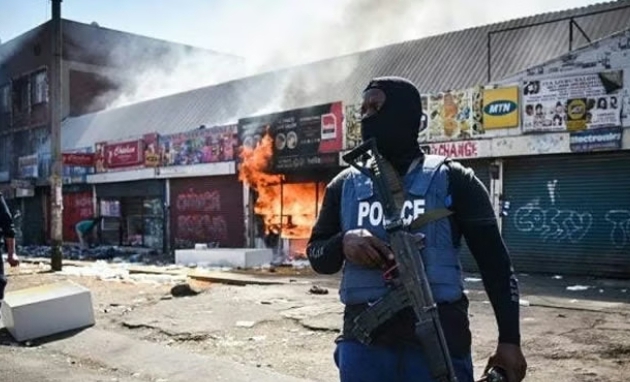
Violent anti-foreigner protests erupted in cities such as Pretoria, Johannesburg, Durban, East London, and parts of KwaZulu-Natal, resulting in harassment, looting, property damage, and injuries. This has triggered fear and panic within the diaspora community, with the Nigerians in Diaspora Commission directing Nigerian business owners to temporarily shut down to minimise risks and avoid losses.
The protests, according to reports, are being driven by community groups, anti-immigration organisations, and social movements such as Operation Dudula, the March and March Movement, and similar local initiatives, often under the banner of tackling illegal immigration and unemployment.
The demonstrations are organised by groups accusing migrants of causing economic hardship and crime, with activists demanding the deportation of undocumented foreign nationals, particularly those from African countries such as Nigeria, Ghana, Zimbabwe, Mozambique, and Somalia.
Two Nigerians were killed in separate attacks linked to the anti-foreigner protests. The Nigerian Consulate General in Johannesburg confirmed that the two victims, Amaramiro Emmanuel and Ekpenyong Andrew, were killed in separate incidents linked to the attacks.
The Consul-General, Ninikanwa Okey-Uche, disclosed in a statement on Monday that Emmanuel died from injuries allegedly sustained after being beaten by personnel of the South African National Defence Force on April 20. Andrew, she said, was apprehended on April 19 in the Booysens area of Pretoria following an alleged altercation with members of the Tshwane Metro Police, and his body was later discovered at the Pretoria Central Mortuary.
Hundreds of anti-foreigner protesters have been captured in viral videos marching through streets with sticks and chanting anti-foreigner songs. In one such video, a Nigerian trader was confronted during a protest and ordered to leave the country with his family.
In a related development, an Ethiopian national was shot dead in what appeared to be a targeted killing in downtown Johannesburg, further heightening concerns over the safety of foreign nationals. CCTV footage circulating online showed the victim being approached and shot at close range at a busy intersection, with no immediate provocation or robbery. Authorities confirmed that no arrests had been made, while investigations were ongoing.
Amid the violence, the South African Police Service condemned acts of intimidation against foreigners. “These actions are not only unlawful, but they stand in direct opposition to the values of dignity, equality, and human rights upon which our democracy is founded,” the police said.
Nigerian business owners in South Africa are lamenting mounting losses following attacks on foreign-owned shops. Some of the traders, who spoke with Saturday PUNCH, said the attacks had been largely directed at Nigerians and Ghanaians, with shops, supermarkets, and other business outlets singled out.
A restaurant operator in Braamfontein, Johannesburg, Yemisi Adewale, recounted how she narrowly escaped an attack by protesters at a local market on Thursday.
“They (protesters) have been harassing and terrorising us. They are specifically targeting shops, supermarkets, malls, and other businesses owned by Nigerians and Ghanaians. Their aim is simply to loot and destroy our goods.
“The police are present, but their presence has not stopped the attackers. The protesters continue to loot and vandalise our shops right in front of them.
“I was almost attacked on Thursday at the town market while I was out to buy goods for my business. We all had to run for safety, leaving our goods behind. The attackers went on to loot and destroy shops and merchandise.
“This is not a genuine protest. They are using the rally as a cover to steal and destroy our businesses. Although the South African government appears to be making efforts to protect us, we cannot rely on that protection. For our safety, we have shut down our shops and business outlets.
“Once they see that your shop is open, they immediately attack, loot your goods, and assault anyone they identify as a foreigner,” Adewale said.
She noted that the situation had taken a severe toll on livelihoods, warning that continued violence could force many out of business.
Another Nigerian trader, who spoke with Saturday PUNCH on condition of anonymity, described the situation as organised violence disguised as protest.
“They told us they wanted to do a protest, but what we are seeing is not a protest. This is daylight robbery and looting. The protest started on Monday and has continued till today, Thursday.
“I saw hundreds of them today at the market. They were carrying sticks and clubs, which they used to attack foreigners. They pounce on anyone they identify as a foreigner and beat them,” she said.
According to her, fear has gripped the business community and forced traders to completely shut down operations.
Meanwhile, diaspora leaders have said informal traders and residents in settlement areas are bearing the brunt of the unrest.
Speaking with Saturday PUNCH, the President of Ohanaeze Ndigbo in South Africa, ABC Okokoh, said the disturbances were largely concentrated in informal settlements, where many small-scale traders operate.
According to him, those most affected are black foreign nationals struggling to survive through petty trading, noting that their businesses have been disrupted.
He also accused some local actors of exploiting the situation for political gain, while stating that the government has been cautious in handling the unrest to avoid inflaming public sentiment.
Okokoh, however, maintained that there has been no official policy targeting foreign blacks, adding that the situation should not yet be classified as a full-scale xenophobic crackdown.
On reported killings, he clarified that the deaths of two individuals were not connected to the ongoing protests.
Corroborating this position, the President of the Association of Yorubas in Diaspora in South Africa, Olusola Agbeniyi, said there had been no casualties linked to the demonstrations.
“As of today, there has not been any casualty. The killing of the two people is unconnected with this protest.”
Agbeniyi added that security presence has helped to prevent violence, noting that movements remain normal in most parts of the country, except in specific centres where undocumented immigrants are concentrated.
Reacting, the Nigerians in Diaspora Commission said there was no official update yet on the situation, noting that the matter had been escalated to the ministerial level. Speaking with Saturday PUNCH on Friday, the commission’s Head of Media, Public Relations and Protocols Unit, Abdur-Rahman Balogun, disclosed that the Minister of Foreign Affairs, Bianca Odumegwu-Ojukwu, was engaging with South African authorities and that Nigerians were awaiting the outcome of the ongoing discussions.